

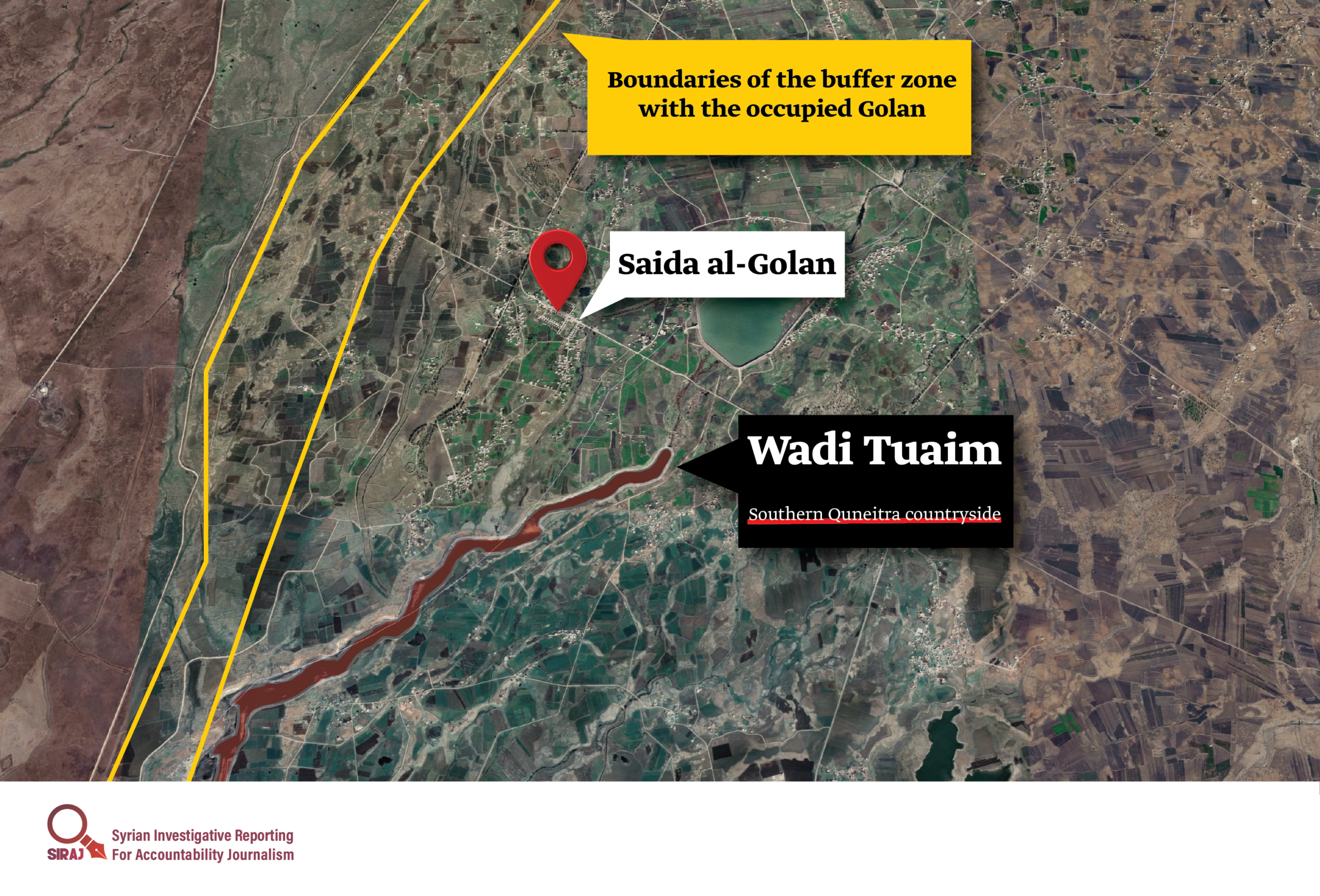
On March 26, 2013, a military force from the 61st Brigade of Bashar al-Assad’s army stormed the village of Saida al-Golan (also known as Saida al-Hanout) in Quneitra governorate in southern Syria, striking terror into the residents of the small village and its surroundings. According to reports at the time by the Local Coordination Committees of Syria, a pro-revolutionary network of opposition activists that had emerged two years earlier, that raid ended in a massacre that left between 12 and 15 people dead.
Although local sources disagreed at the time about the exact number of victims, all confirmed that a “massacre” had taken place, witnessed by residents of the village that lies just over a mile east of the buffer zone with the Israeli-occupied Golan Heights. Those sources also confirmed that regime forces had thrown the dead bodies into a nearby valley.
From that point on, as the regime’s military campaigns intensified across the country, and as its forces and allies committed dozens of documented massacres, the massacre at Wadi Tuaim was set aside. Neither the victims nor their families were granted any measure of justice against the perpetrators who had killed their sons. But the fall of the Assad regime has finally given them the chance to raise their voices and demand the justice they have sought for 13 years, and to tell a story whose details they whispered among themselves for fear of the deposed regime’s retribution.
This investigation by SIRAJ reveals for the first time the names and faces of two officers of the former regime’s army accused of being responsible for the Wadi Tuaim massacre, in which 13 people have been confirmed killed, nine of them from a single family, including a child. Regime forces threw their bodies into the bottom of a valley estimated by experts to be between 650 and 1,000 feet deep.
The journalists working on this investigation, together with relatives of the victims, sought to reconstruct the events of the massacre. Witnesses and survivors took the investigative team to the edge of the steeply sloping valley and described for us, on camera, the details of what they call that “cursed” day in the history of Saida al-Golan.
Fieldwork, the journalists’ investigative methodology, and open-source research and analysis — facial recognition software, examination of social media posts and digital footprints, and satellite imagery going back more than a decade — helped to test, cross-reference and confirm the claims made in the field interviews. This ultimately led to contact with one officer accused of involvement in the massacre, who categorically confirmed that it had taken place and gave details of it.
Extended interviews with victims’ families, a survivor and eyewitnesses also revealed details of the massacre, the circumstances surrounding it and the identities of the officers involved, which had been absent from the record and lost from view for over a decade.
For six consecutive months, the SIRAJ team conducted lengthy interviews with victims’ families and survivors of the massacre, as well as with two witnesses to the killings. By cross-referencing every detail obtained from those encounters against information from official and public sources, we were able to establish the context that preceded the massacre, the conditions in which it took place and its precise date and location.
When the force from the 61st Brigade, headquartered in Daraa governorate, also in the south of the country, stormed Saida al-Golan, it was led by three officers holding the ranks of major-general, lieutenant-colonel and major. The raid coincided with a lunch banquet hosted by a member of the Harisi family, also known as Hijazi, to which a number of relatives and local residents had been invited.
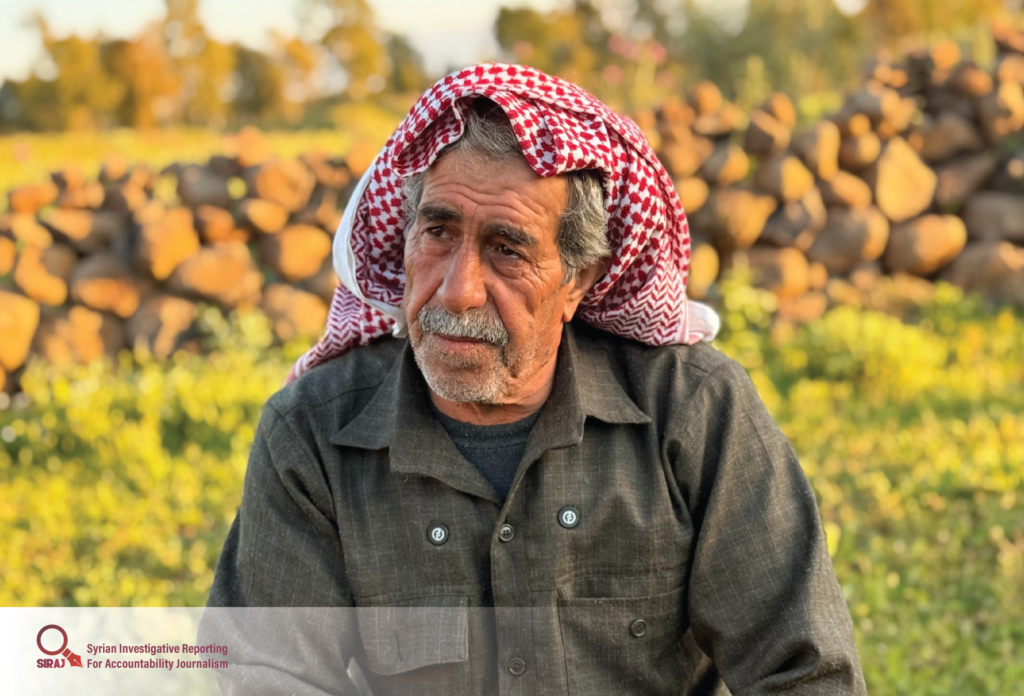
Issa Harisi, a resident of Saida al-Golan, described to SIRAJ how the brigade’s soldiers surrounded the village: “The banquet was here that day. My brother and I were there, along with Muwaffaq and a man from the village of al-Ghadir. Before we knew it, the army had encircled us and were entering the houses one after another.”
The raiding force consisted of around 20 men of varying ranks. They surrounded the houses, and then began to storm them violently, leading away several young men from different families, handcuffed and blindfolded, to three military vehicles, two of them pickup trucks.
The residents’ pleas and the tears of the village women did nothing to deter the force from completing its task. A man from the Harisi family begged one of the officers taking part in the operation, only to be told that he should “forget” his family, before the officer climbed into the vehicles with the other soldiers, which then left the village.
“The officer came over to me here,” Issa Harisi recalled. “He said, forget that the Hijazis ever existed. Go and multiply in Zaatari,” a reference to the Zaatari camp in Jordan, where thousands of Syrians from the south took refuge during the regime’s military campaigns, particularly in Daraa and Quneitra governorates.
Three of Issa’s four sons — Imad, Ali and Mohammad — were killed that day.
Witnesses from the victims’ families and other villagers told SIRAJ how they watched military vehicles leave the village with their sons in detention, heading along the road toward Wadi Tuaim, some 1.2 miles from Saida al-Golan. The valley is one of the largest and deepest in Syria.
Traveling north, the military convoy stopped at a military position at the Saida al-Golan company outpost, also belonging to the 61st Brigade, then moved off again before stopping at the reservoir of the Raqqad Dam near the village.
At almost the same moment, another man named Fadi Sayyah was detained by regime forces 3 miles away for questioning. He did not know then that he would be the only survivor of a massacre.
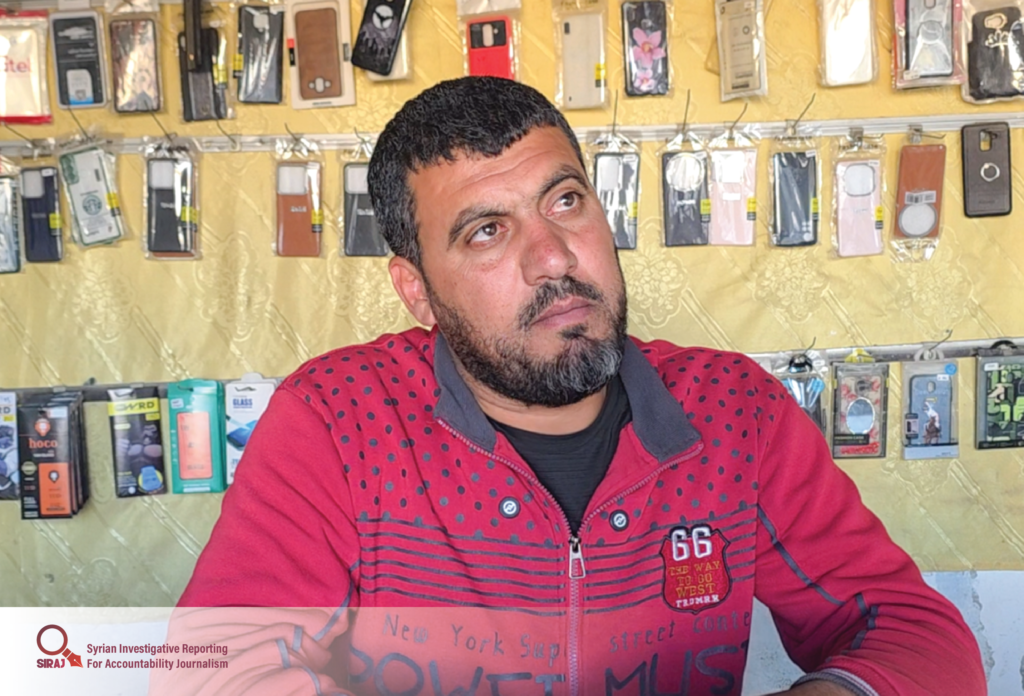
Sayyah worked in a mobile phone shop. A Kia Rio taxi pulled up outside, and men in military uniform got out, asked him his name, pulled his shirt up over his face and led him to the car. There they handcuffed him and put a blindfold over his eyes.
“I was helping some soldiers defect from the regime’s army,” Sayyah said, recalling what happened 13 years ago. The men showed him photographs of soldiers he had helped to defect, but he denied any connection to the matter. “I said, ‘By God, I know nothing about it.’ I just wanted to clear myself.” The car took Sayyah to the Ain Dhakar Battalion of the 61st Brigade and stopped there briefly.
There, Sayyah heard the men talking to Warrant Officer Abu Ibrahim of Military Intelligence. “They asked him about the vehicles that had detained the young men in Saida, and he told them they had gone on ahead of them,” he said.
“The car stopped at the dam junction,” Sayyah continued. “My blindfold had slipped, and I was able to see. I saw two security pickups pass beside us with people lying face down in the back. Then a car known to belong to the lieutenant-colonel went past, heading toward the [Wadi Tuaim] valley.”
The vehicles Sayyah described carried the detainees along the dirt track leading to Wadi Tuaim near the village of Saida al-Golan. At the head of that force was Hafez Tomeh, the lieutenant-colonel Sayyah referred to and, under his command, Raed Saleem, another officer on the staff of the 61st Brigade with the rank of major, known among local residents as Maj. Salloum.
At that moment, Sayyah heard gunfire. Two shots, then one, then two more, as he recalled. He also heard a young man pleading: “For God’s sake, sir,” before his voice was gone. One of the soldiers said to Sayyah: “Did you hear him? We’ve thrown him into the valley.” Sayyah was brought to the site of the massacre to hear what was happening and was then released, apparently because the perpetrators wanted him to recount the terror he had experienced to the people of the area.
On the other side of the valley stood two local men, who found themselves by chance in a position from which they could watch the scene without being seen, and so became witnesses to the cold-blooded execution of 13 people, including one child.
Mahmoud Youssef al-Mohammad and Hussein al-Aqla al-Issawi described those moments of terror, and their accounts corroborated those of the victims’ families and of Sayyah.
The military vehicles carrying the detainees reached the edge of Wadi Tuaim at around 4 p.m., two hours after the raid and the detentions had begun.
The soldiers brought all the detainees out, still handcuffed and blindfolded, and lined them up at the edge of the valley. They then began shooting them, executing them one after another. The sound of gunfire carried across the area, and the two witnesses saw the victims thrown into the valley one by one.
“I saw the car park at the edge of the valley. They brought several people out, shot them and then threw them into the valley. I saw it with my own eyes,” said al-Mohammad, the first witness. Al-Issawi, the other, confirmed that he recognized the young men of the Harisi-Hijazi family the moment he saw them. “He would fire and then throw the person into the valley,” he added. “Sometimes he would shoot the person as he was falling into the valley.”
The regime soldiers noticed movement on the far side of the valley and opened fire toward the two witnesses, who crawled out of range and managed to escape without being identified.
The Harisi family lost nine of its sons that day, among them a 12-year-old boy. The regime cordoned off the area, and the bodies were left lying at the bottom of the valley for four months.
On July 18, 2013, factions affiliated with the Free Syrian Army and the Syrian opposition took control of the area, including Saida al-Golan and Wadi Tuaim, and residents were finally able to recover their sons’ bodies. According to witnesses, the operation took weeks because of the rugged terrain of the valley and the difficulty of getting machinery or vehicles down to the bottom. Some of the victims were difficult to identify. One woman recounted that she could barely recognize her husband’s body, because his features had been disfigured by decomposition.
In January 2014, activists posted two videos on YouTube showing people with blurred faces recovering bodies from Wadi Tuaim. Victims’ families confirmed their authenticity. According to one of them, the bodies were “bound and unidentified,” which matched the families’ accounts of their sons being handcuffed before being executed by the Syrian army.
These two videos helped establish an indicative timeline for the massacre and, subsequently, for the recovery of the bodies from the valley after regime forces withdrew from the area. The SIRAJ team received no response from the channel that uploaded them to YouTube, which would have allowed us to verify them independently or obtain the unblurred originals.
The investigative team met members of the victims’ families, in interviews that continued over many weeks, to document the time and place of the events and the identities and names of all the victims. Fathers, mothers and wives spoke of the tragedy they had lived with since the day of the massacre, of the long months they waited before they could bury their sons, and of the terror that gripped the village for years afterward.
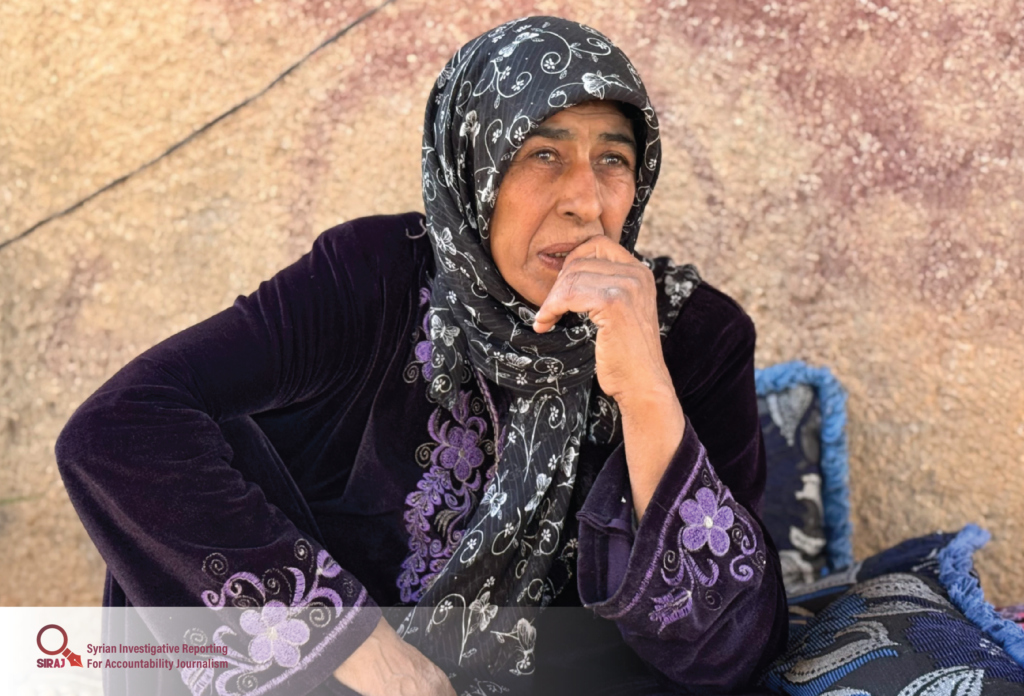
Umm Hassan Harisi lost three of her sons in the massacre. The eldest, Hassan, was 25 and left behind a wife and two children. The youngest, Abdul-Ilah, was 12. “They told me he was crying out for me before they killed him,” she said. “He screamed ‘Mama,’ then they killed him.”
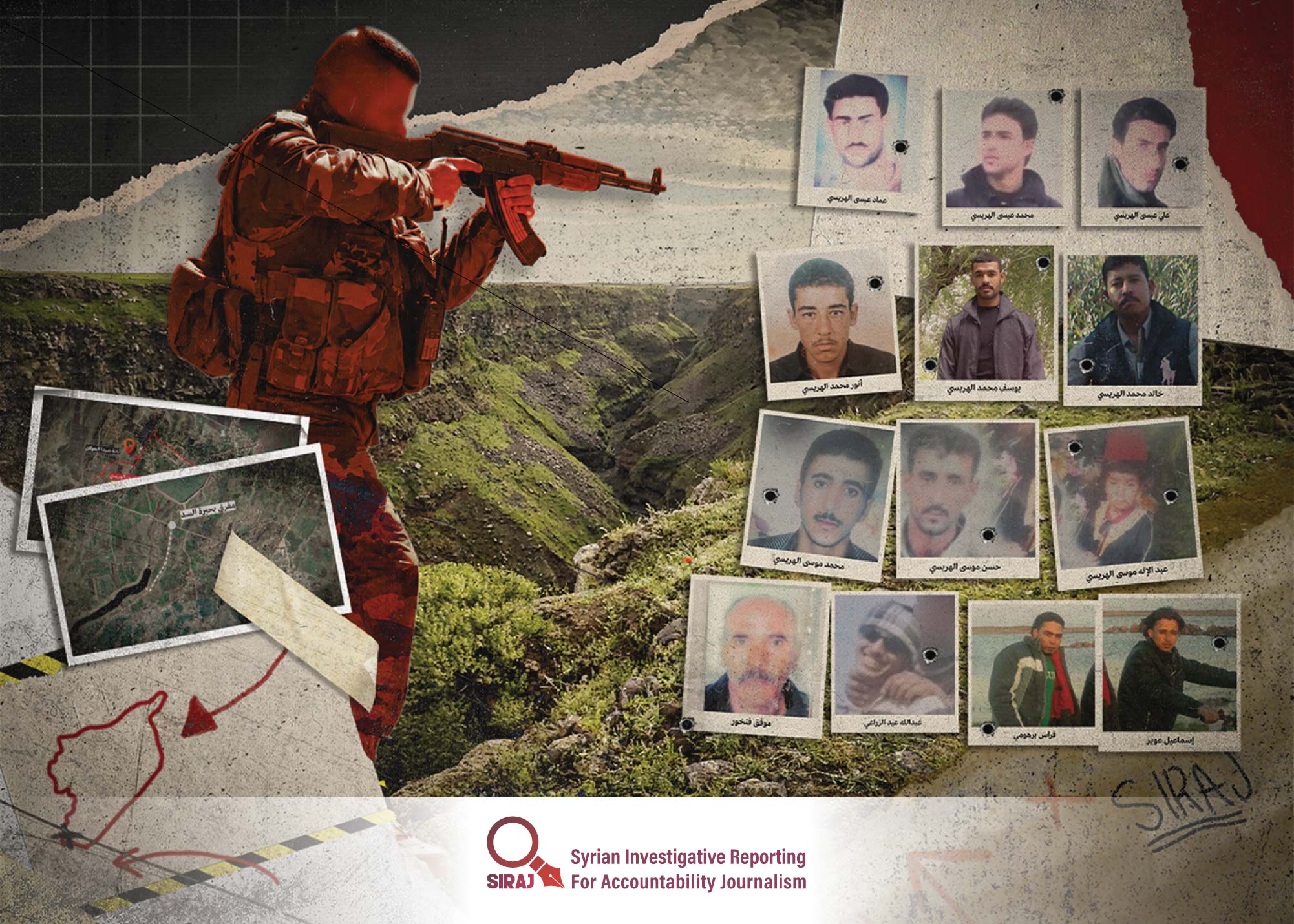
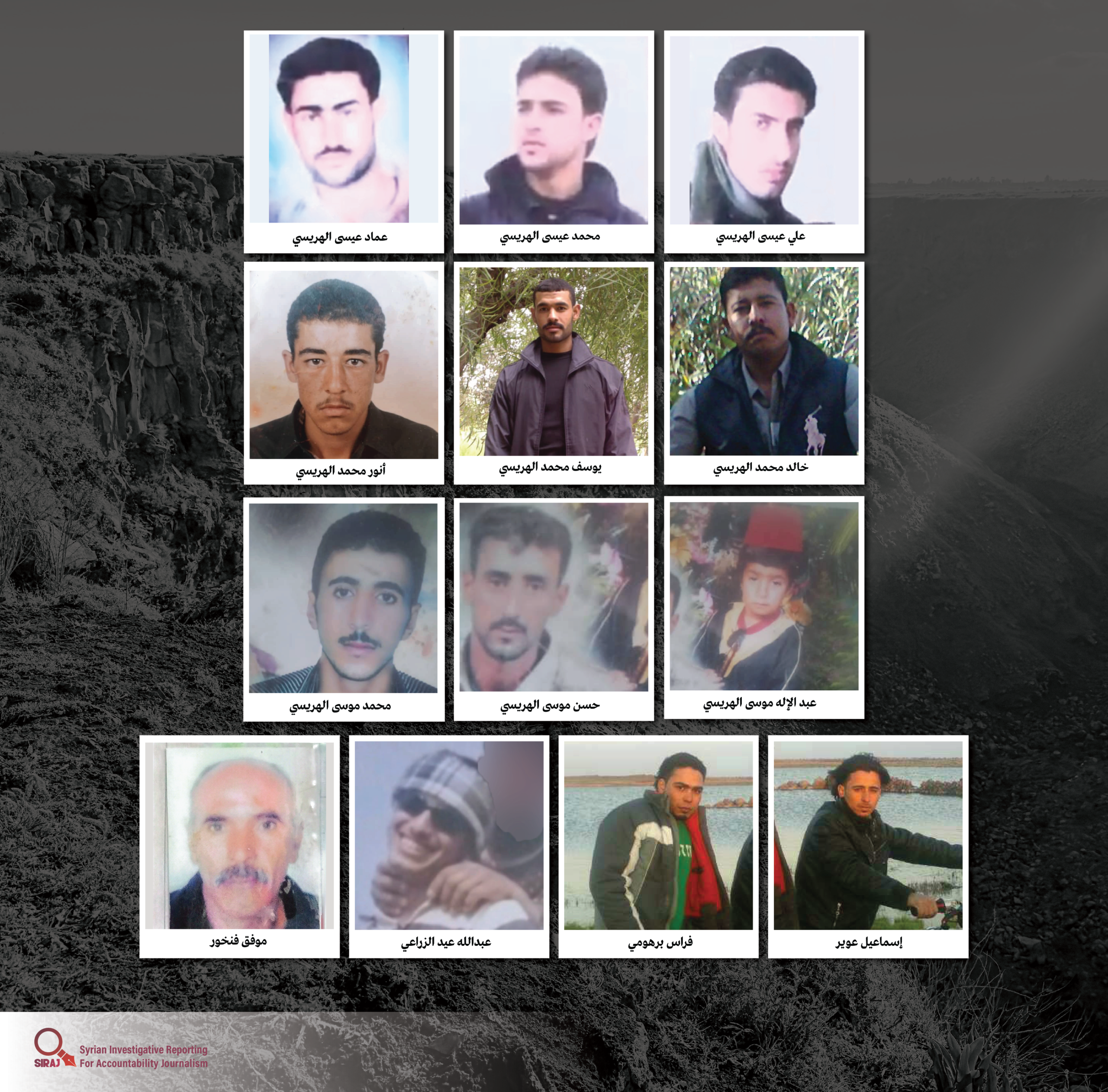
The investigative team documented the names and identities of the 13 victims killed in the massacre, whose bodies were recovered from the valley by their families. They are: Imad Issa Harisi (25), Mohammad Issa Harisi (22), Ali Issa Harisi (20), Hassan Moussa Harisi (25), Mohammad Moussa Harisi (15), the child Abdul-Ilah Moussa Harisi (12), Youssef Mohammad Harisi (23), Khaled Mohammad Harisi (20), Anwar Mohammad Harisi (21), Abdullah Eid al-Ziraie (27), Muwaffaq Mohammad Fankhour (52), Ismail Ahmad Uwair (25) and Firas al-Hamdani al-Barhoumi (23).
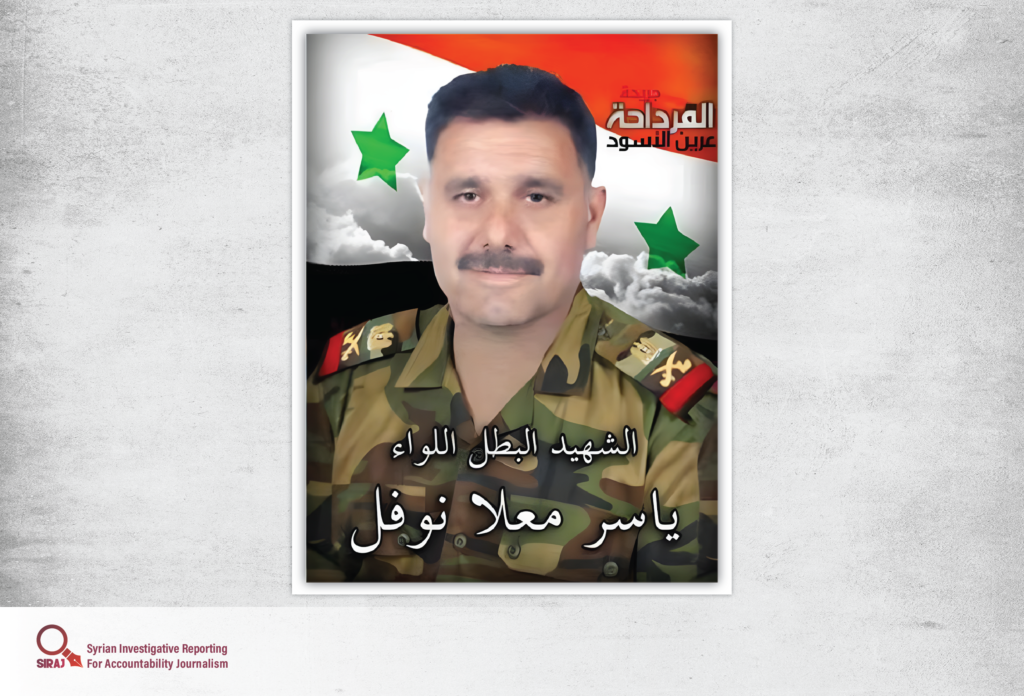
At the time of the massacre, Maj. Gen. Yasser Mualla Nofal commanded the 61st Brigade, which was then an independent formation within the Syrian army’s 1st Corps.
Nofal was killed weeks after the massacre, in April 2013. Numerous obituary posts on social media indicated that he had been killed by Syrian opposition forces.
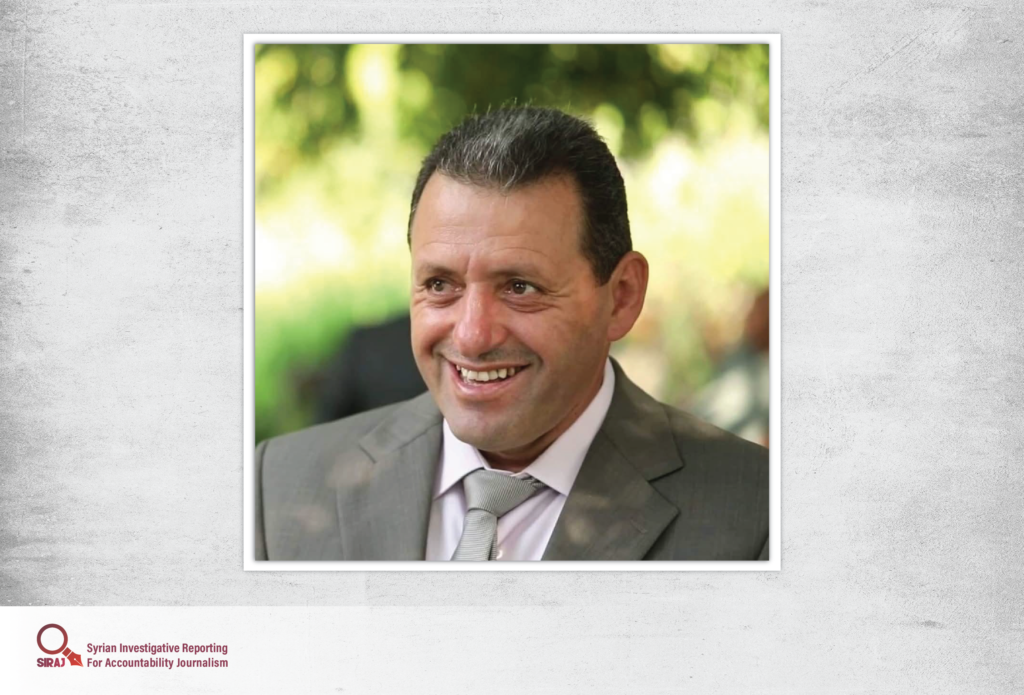
The families of the massacre’s victims, however, mentioned only the names of the two officers who led their sons to their deaths, both of whom are still alive: Lt. Col. Hafez Tomeh and Maj. Raed Saleem “Salloum.”
From the moment Tomeh’s name was first mentioned, the investigative team searched for any trace of him in public sources, particularly military news and social media, without success.
The team approached officers and soldiers from the area who had defected from the regime’s army, along with retired officers and local sources. While the sources gave differing accounts of his real name and whereabouts, all of them confirmed that he was inside Syria. After months of searching, we reached a defector known as Abu Hussein, who had served alongside Tomeh in the 61st Brigade.
This officer proved to be the key to reaching Tomeh, who had kept himself out of sight. He provided us with information about the lieutenant-colonel’s military record, along with a description of his facial features and build, which helped us to construct a picture of his appearance and subsequently to begin a search for a photograph of him.
The investigative team reviewed civil and military documents that confirmed Tomeh’s identity as a native of Talkalakh in Homs governorate, and confirmed his military posting to the 61st Brigade. The photographs of Tomeh in the civil and military documents matched a photograph believed to be of him.
We showed the photograph of Tomeh to victims’ families, villagers and eyewitnesses, and to 15 former detainees, including people whom Tomeh had personally arrested. Thirteen of them identified his photograph with certainty, compared against a photograph of another man said to be him.
Tomeh’s photograph revived a painful memory for the wife of one of the victims. On the day of the massacre, she had begged Tomeh to release her husband, Muwaffaq Fankhour, who suffered from a mental illness. Tomeh had not listened to her pleas, and Fankhour ended up a lifeless body at the bottom of the valley.
The victim’s wife said that, during the arrests, “Hafez took me by the hand in front of my house here and told me he had nothing to do with it. I told him: You are the responsible one, and if you want to kill me, then kill me.”
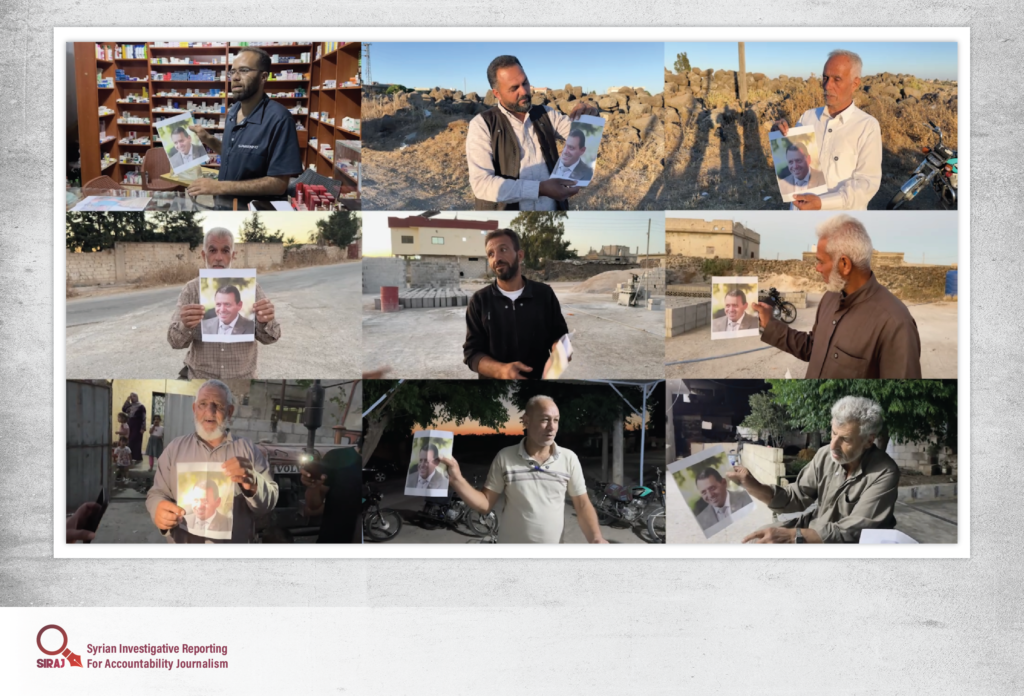
“Yes, that’s him. He wore a uniform and had more hair,” another woman to whom we showed Tomeh’s photograph said. “He once drove a tank into my house,” she added, gesturing toward an open courtyard.
The search continued for weeks afterward. Acting on information from local sources in Homs governorate, we established that Tomeh was living on a farm in the Talkalakh area near the Lebanese border. The investigative team reached relatives of his, after which the journalists contacted him directly, and he agreed to be interviewed.
The interview with the investigative team took place in two parts.
On June 17, we were able to arrange a meeting with Tomeh. On the road from Damascus to Homs, the team received a call from someone close to Tomeh informing us that he had declined to speak to journalists. He then asked to meet late at night. In darkness, the journalists traveled with local notables to the agreed location, only for the lieutenant-colonel to refuse a face-to-face meeting once again, offering instead a brief telephone conversation from a number previously unknown to the team.
Speaking to SIRAJ, Tomeh did not deny that the massacre had taken place. He confirmed that there had been no fewer than 13 victims, as we had documented, and confirmed that they had been executed and their bodies thrown into the valley, as described by residents and eyewitnesses. He denied, however, any role of his own in the massacre, arguing that his continued presence in Syria was proof of his innocence, and saying that he had left military service in 2016 and had received no compensation.
On June 20, the team received a call from Tomeh from an unknown number, in which he asked to meet a single journalist accompanied by the officer Abu Hussein at a Homs church at midnight, without offering any explanation for the request. He then ceased responding to any further attempts at contact.
Tomeh’s denial of his role in the massacre has not erased his face and his uniform from the memories and testimony of victims’ families and eyewitnesses, who recalled how he had led young men from the village, along with one child, to their deaths at the bottom of Wadi Tuaim.
Upon checking the numbers Tomeh used to contact the journalists, we found that they were not registered in his name. He used phone numbers registered to other people, which complicated the task of reaching and speaking to him.
Alongside the name of Tomeh, the residents and witnesses we interviewed repeatedly mentioned a major in the 61st Brigade named Raed Saleem, known among local people as Maj. Salloum or, simply, Salloum. According to the testimony, he was extremely violent and brutal toward local residents, particularly at checkpoints, and he was among the foremost participants in the massacre.
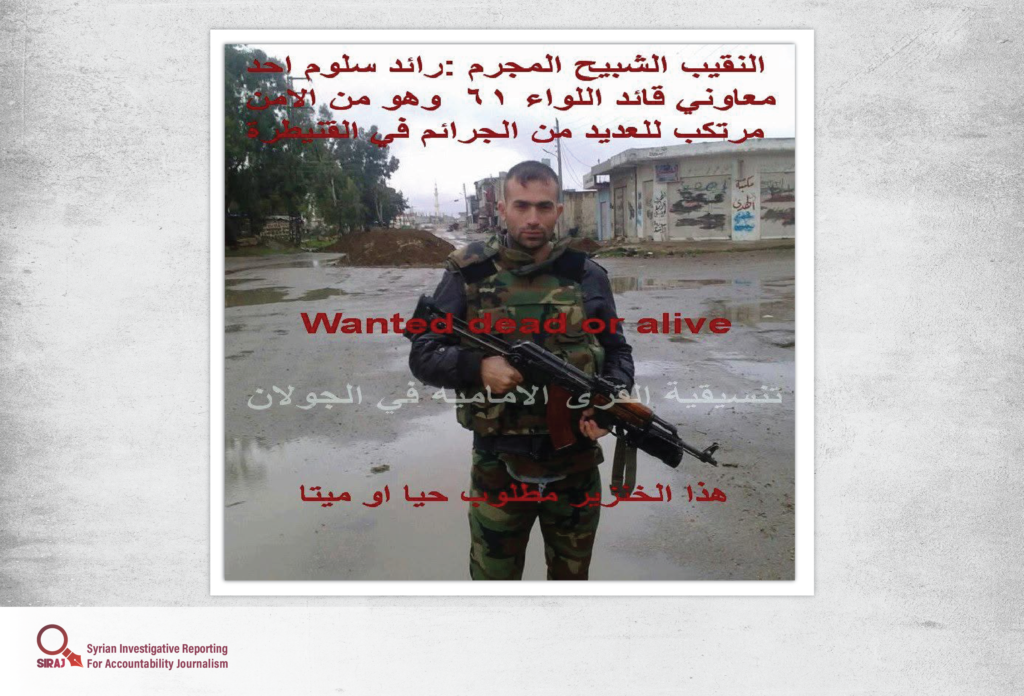
Unlike Tomeh, Saleem, who comes from the village of Beit Ana in the Jableh countryside of Latakia, has a substantial presence on social media. The team’s open-source research turned up numerous posts naming the major as one of the regime soldiers involved in crimes against civilians, including the Wadi Tuaim massacre.
When we asked Tomeh about his fellow officer Saleem during the telephone call, he described him as “filthy, and a collaborator with Military Intelligence and the National Defence Forces in the area.”
The investigative team found a photograph of Saleem posted on Facebook on April 12, 2013, roughly two weeks after the massacre, showing that he was still serving in Daraa governorate, one of the areas where the 61st Brigade was deployed.
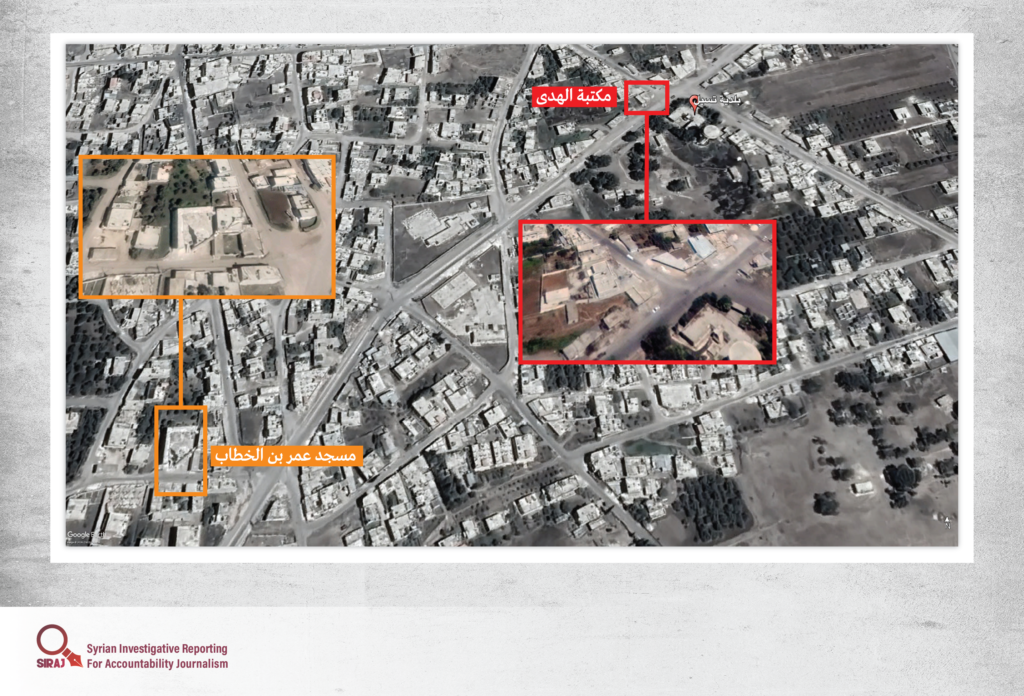
By comparing satellite imagery against distinctive markers in the photograph, the team was able to determine that it had been taken near the municipal building in Tasil, with the former al-Huda bookshop visible, along with, in the background, the minaret of the Omar bin al-Khattab Mosque, some 8 miles from the site of the massacre in Wadi Tuaim.
Searching social media, the team documented a Facebook account believed to belong to Saleem, under the name al-Uqab al-Uqab (Eagle Eagle). The account features a photograph of Saleem standing on top of a rock, aiming a Kalashnikov rifle down toward the floor of a valley surrounded by green hills.
The team received no reply after messaging the al-Uqab al-Uqab account, whose last activity dates to 2019. Our research established that no other accounts or phone numbers are linked to it.
According to an informed source, after the massacre Saleem was transferred to complete his military service in the al-Kiswah area in the countryside of Damascus.
The team contacted several local sources, who indicated that Saleem had left Syria several months before the fall of Assad to take part in a military training course for regime forces in the Sultanate of Oman. A source in the Counterterrorism Directorate of the Syrian Interior Ministry confirmed this, adding that he had left Syria four months before the fall of the regime and had not returned since.
Neither the Omani Embassy in Damascus nor the Omani Foreign Ministry had responded, at the time of this writing, to SIRAJ’s queries about Saleem’s presence in Oman, why he had been allowed to remain there after the fall of the regime if his presence is confirmed and what the Omani authorities’ position would be should their Syrian counterparts request his extradition.
While the victims’ families live with the bitterness of loss and continue to wait for a justice that might restore some dignity to them after the fall of the Assad regime, those accused of the massacre carry on with their lives as normal.
Among the local residents is Ruqayya al-Barhoumi, who lost her husband and her brother on the day of the massacre and lives in the hope that the killers will be held to account. Speaking to SIRAJ from her home in Saida al-Golan, she said she had waited years to be able to speak about her family’s tragedy without fear of the Assad regime’s retribution.
Abu Imad Harisi, who lost three of his four sons, placed all his hopes in his story prompting the Syrian government to arrest and prosecute the accused. “If I were the judge, I would sentence him to death, just as he killed them,” he said. “Throwing [the victims] into the valley is worth a thousand murders.”
In an interview with SIRAJ, the lawyer Anwar al-Bunni, head of the Syrian Center for Legal Studies and Research, said that “the Wadi Tuaim massacre falls within the category of war crimes, and may fall within crimes against humanity if it is established that it took place as part of a chain of orders from above.”
Al-Bunni noted that the Syrian penal code contains no provisions on war crimes or crimes against humanity, and that the laws currently applied are the homicide provisions of the penal code, under which cases such as this are treated as the murder of more than one person, something he regards as “a trivialization of the crime and of the victims, and an obstacle to any prospect of pursuing the orders and the chain of command leading to the crime.”
The investigative team contacted the Syrian Interior Ministry and shared its findings with it.
On that basis, and in particular in light of the information disclosed here for the first time, Brig. Gen. Nayef Abdul Majid, director of the ministry’s Counterterrorism Directorate, said that “Hafez Tomeh is on the Interior Ministry’s wanted list. The information and inquiries provided to us by the SIRAJ investigative unit have supported security efforts to determine his whereabouts. Acting on the information you provided, the authorities went to the location indicated, but he was not present there. Initial indications suggest he may have fled the country.”
Regarding Saleem, he confirmed that should his presence in Oman be confirmed, the Interior Ministry will submit a formal extradition request through official channels, including the International Criminal Police Organization (Interpol), “within the framework of the established mechanisms for pursuing fugitives outside the country.”
The Wadi Tuaim massacre is one of dozens committed by the forces of the deposed Syrian regime across the country that have gone for years without the documentation needed to expose those responsible and hold them to account. It is further testament to the reach of the regime’s bloody arm, from the furthest point in northern Syria to the furthest point in the south, and into a remote village in the Quneitra countryside.
Thirteen years after the massacre, and in the absence of accountability for the criminals who killed their sons, despair is seeping into some of the victims’ families and pushing them toward revenge. Asked what she would say if she came face to face with her family’s killers, Ruqayya, who lost her husband and brother, said: “If it were up to me, I would do to them what they did to my brother and my husband. I was pregnant when they killed them, and because of all of it my child was born disabled and is still suffering to this day.”
- A group of field journalists, researchers and whistleblowers working with SIRAJ took part in preparing this investigation. Contributors include: Sanad al-Hindawi, Omar al-Bam, Osama al-Qaeed.
- Photographs of the victims were published with the consent of the victims’ families or relatives.
- Creative direction and visual solutions: Radwan Awad.