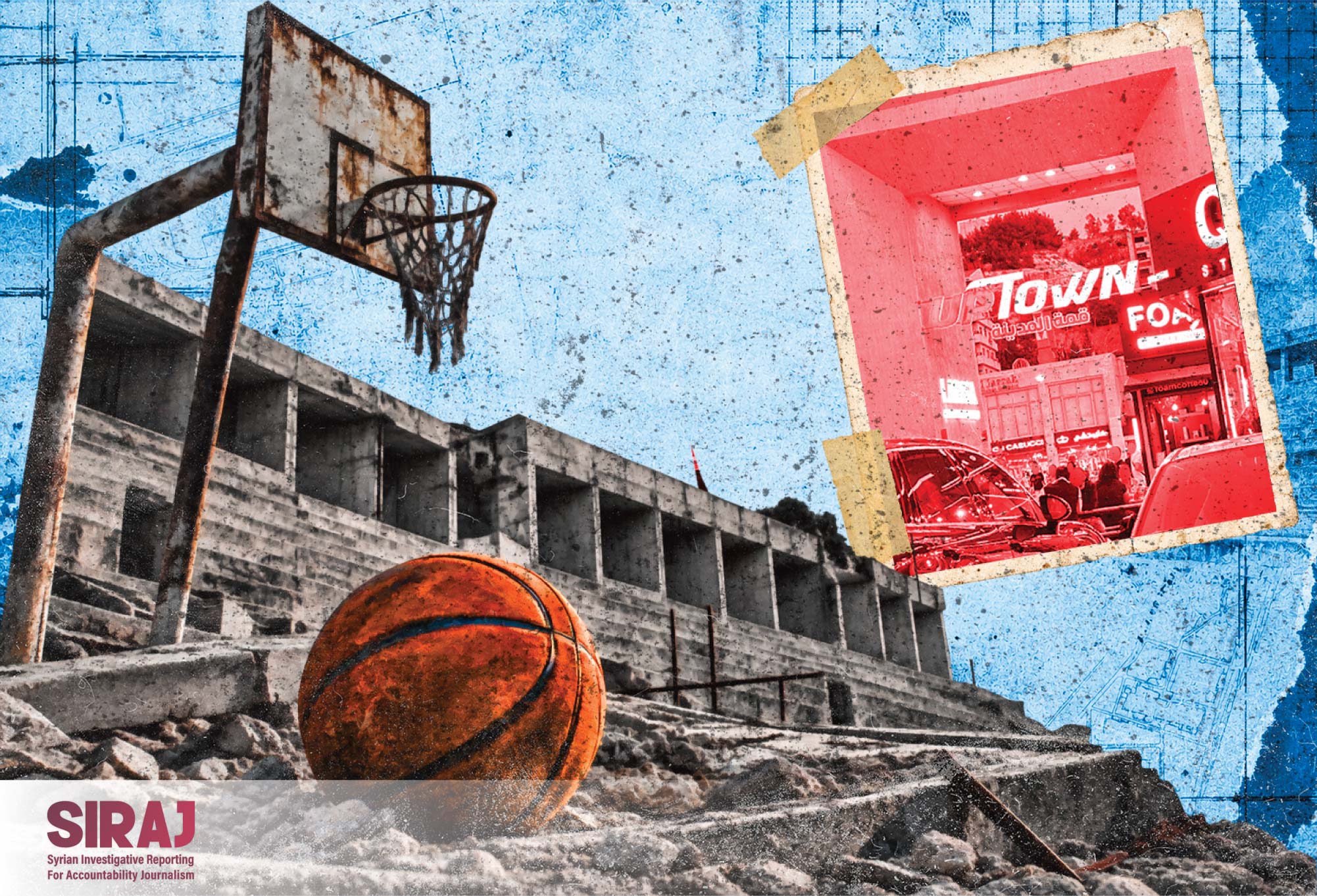


On August 16, 2016, then-Syrian Prime Minister Wael al-Halqi inaugurated the Al-Fayhaa Sports Club complex in the Mashrou Dummar residential district of Damascus. The complex, widely known as “Uptown,” featured sports, social, cultural, and recreational facilities spread across 38 dunams (approximately 9.4 acres). The project cost a total of 6 billion Syrian pounds, equivalent to approximately $39.7 million at the exchange rate at the time. State-run media portrayed it as one of the capital’s most prominent sports developments, while the complex’s official Facebook page stated that its opening was held “on the occasion of the election of President Bashar al-Assad to a new constitutional term” in 2014.
But documents and witness accounts reviewed by the Syrian Investigative Reporting for Accountability Journalism (SIRAJ) reveal a different story behind the development of these commercial projects—one that ran counter to the interests of the club and those responsible for it. Land originally allocated to support Al-Fayhaa Sports Club and sports-related investments was converted into private commercial ventures. According to the documents, the process was facilitated by Major General Ghassan Bilal, an official in the Fourth Division, for the benefit of Palestinian-Syrian businessman Naim al-Jarrah.
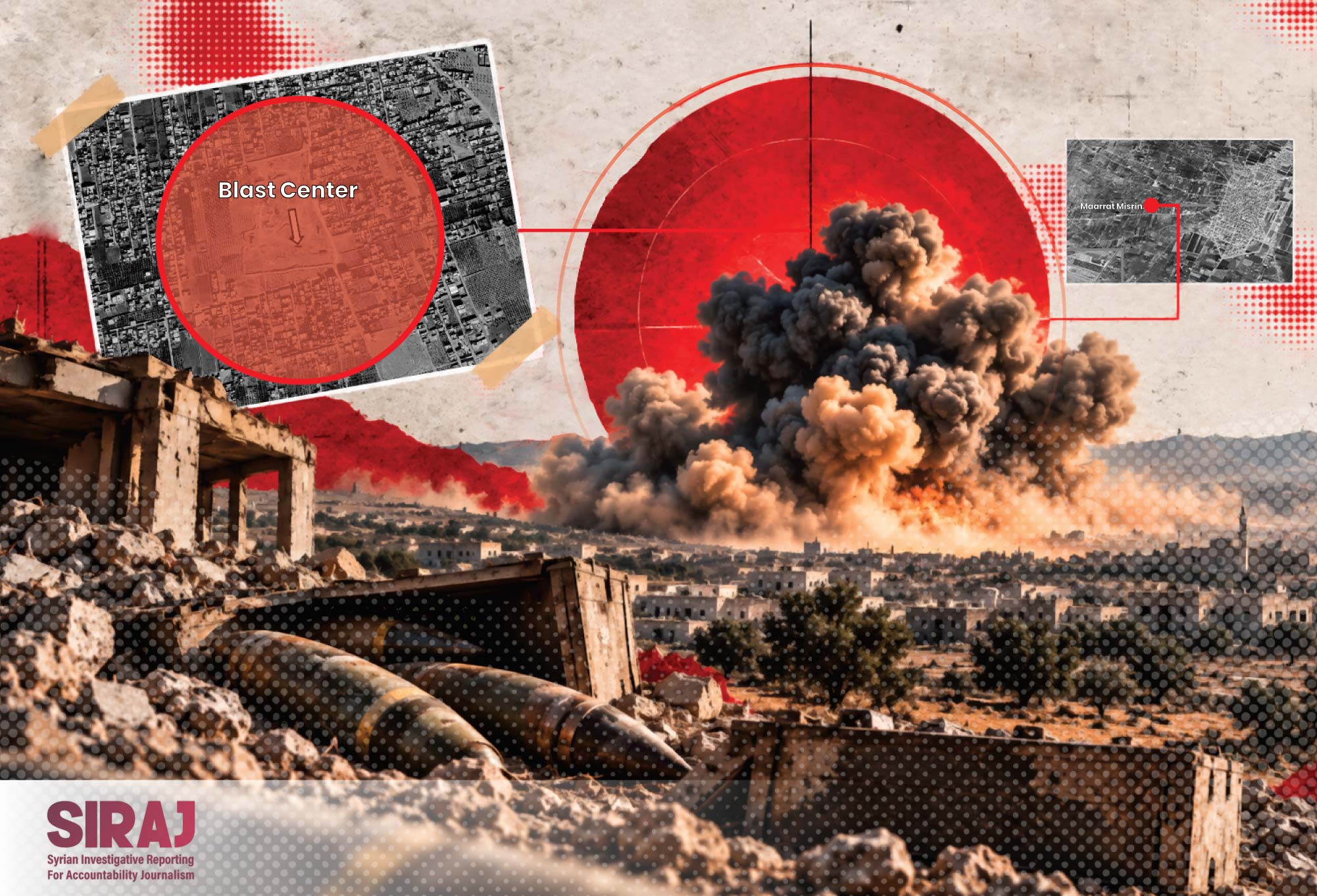
Al-Jarrah also has family ties through marriage to one of the most senior officials at the presidential palace under Bashar al-Assad. On September 9, 2016, media outlets reported on what they described as an extravagant, almost fairytale-like celebration—the largest wedding ever held in Syria—between al-Jarrah’s son, Khaled, and the daughter of Major General Bassam Merhej Hassan, Bashar al-Assad’s security adviser. Hassan was placed under U.S. sanctions on August 20, 2020, over his role in the use of chemical weapons that killed civilians in Eastern Ghouta, in the Damascus countryside.
According to three independently corroborating, recorded testimonies from individuals close to al-Jarrah, the businessman also maintained a close relationship with Major General Ghassan Bilal, who headed Maher al-Assad’s office and oversaw the Fourth Division’s economic affairs. Bilal’s name has appeared in Syrian judicial investigations concerning the operation of drug-trafficking networks dealing in illicit pills.
Al-Jarrah’s name also appears in an official interrogation and investigation report issued by the Syrian Interior Ministry’s Anti-Narcotics Department, case file No. 9024, dated July 20, 2009, a copy of which was reviewed by SIRAJ. The report concerns the purchase and trafficking of illicit pills following the arrest of a man identified as Omar H., who owned a pill-manufacturing facility in Hama province in central Syria. During questioning, Omar H. stated that he had purchased a pill press from al-Jarrah and that the two had “discussed the pill trade.” Al-Jarrah denied any involvement when questioned by investigators.
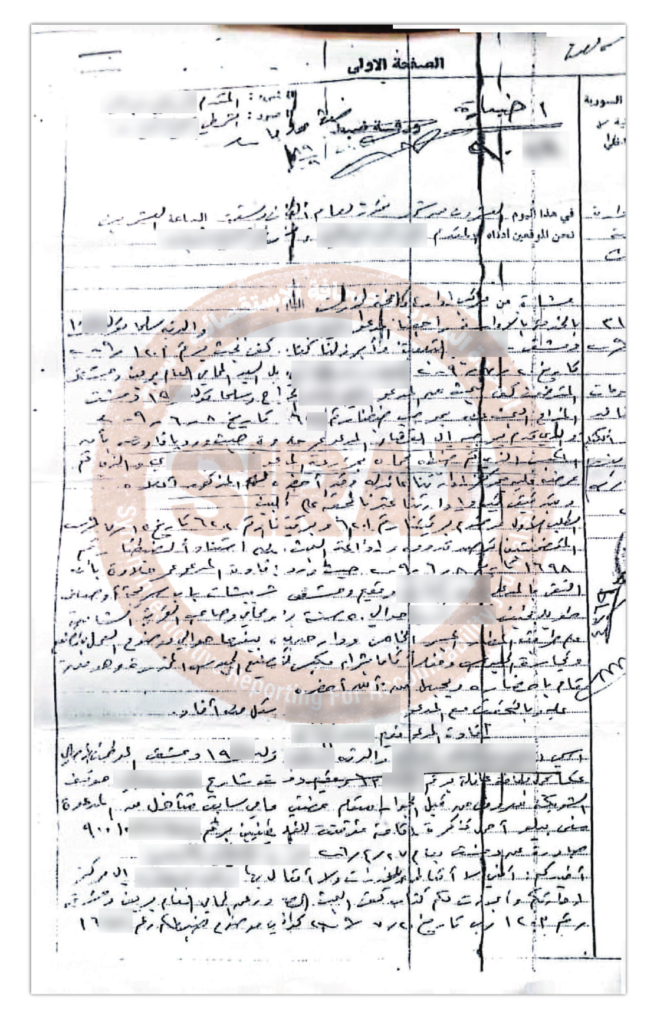
Drug Enforcement Administration investigation report naming Naeem Al-Jarrah – Exclusive – Siraj
Who Is Ghassan Bilal?
Ghassan Bilal was one of the most prominent officers in Syria’s former army’s Fourth Division. He served as head of the division’s Security Office and, beginning in 2013, also commanded the 555th Parachute Regiment. Considered one of Maher al-Assad’s closest associates, Bilal played a significant role in managing the division’s security, military, and economic affairs.
On June 17, 2020, the U.S. Treasury Department, through its Office of Foreign Assets Control (OFAC), imposed sanctions on Bilal under Executive Order 13894 concerning Syria. U.S. Treasury Department
Although the United States and the European Union eased some economic sanctions on Syria in 2025 and 2026, sanctions against Bilal remained in place.
Who Is Naim al-Jarrah?
Naim al-Jarrah owns and operates several businesses and ventures in real estate, tourism, and investment. Among the most prominent are the Uptown complex and the Al-Qarya Al-Shamiya resort. He also served as chairman of Kinda Airlines, general manager of Qutaiba Limited Liability Company for Import and Export, and managing director and founding partner of Jarrah, Shami & Ashqar Real Estate Development and Investment Company. In addition, he was a founding partner of Al-Jarrah Investments and Al-Rida Company for Import and Export and the Development of Hospitals, Medical Centers, and Tourism Facilities.
In recent years, al-Jarrah emerged as a businessman with close ties to Syria’s former regime, with his name associated with several real estate and tourism investments in Damascus and its surrounding countryside. In 2026, Syrian authorities announced the freezing of his assets and those of several family members and launched investigations into suspected illicit enrichment. He subsequently reached a settlement with the Illicit Enrichment Committee.
How the Takeover Began: A Contract Signed Under Pressure
On January 29, 2013, the management of Al-Fayhaa Sports Club, represented by its then-president in the Mashrou Dummar district of Damascus, signed a direct agreement with businessman Naim al-Jarrah. The agreement was described as a “public-benefit partnership contract.”
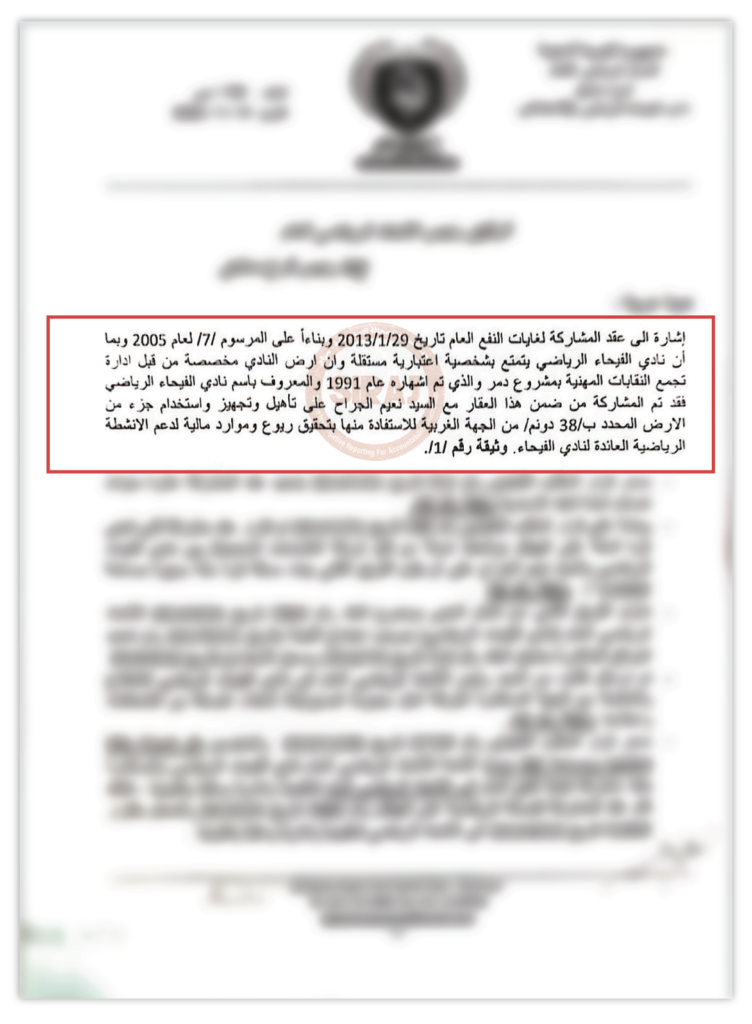
A copy of the contract obtained exclusively by SIRAJ
Under the 2013 agreement, which was extended just one year later for a 10-year term through Resolution No. 51, al-Jarrah was authorized to develop, equip, and use a portion of the western section of land owned by Al-Fayhaa Sports Club as a legal entity under the General Sports Federation Law, Law No. 8 of 2014.
The agreement covered 38 dunams (approximately 9.4 acres), roughly the size of five international soccer fields. The site would later become home to the commercial development widely known as Uptown. The stated purpose of the investment was to generate revenue and financial resources to support the club’s athletic activities.
Engineer Abdel Fattah Ayaso, a former president and founding member of Al-Fayhaa Sports Club who currently serves as director of Urban Planning and Development at the Damascus Governorate, revealed that the club’s president at the time, engineer Sahar Haffar, who died in May 2023, had faced pressure from Fourth Division officers.
According to Ayaso, that pressure led her to sign the agreement without following the competitive bidding procedures required under Syria’s public procurement laws.
Article 79 of Public Entities Contracting Law No. 51 of 2004 stipulates that sales, leases, or investment agreements involving public entities must be awarded through competitive bidding when the contract value exceeds 200,000 Syrian pounds.
In 2014, the Executive Bureau of the General Sports Federation, Syria’s highest sports governing authority, unilaterally decided to grant al-Jarrah an additional 10 dunams (approximately 2.5 acres) from the club’s total landholdings of 78 dunams (approximately 19.3 acres), an area equivalent to roughly seven international soccer fields, according to property registry records reviewed for this investigation.
The additional land was granted under Contract No. 386 of 2014 and its amendments, in exchange for the construction of a 1,000-square-meter indoor basketball arena.
The arrangement was formalized through a contract addendum signed directly with al-Jarrah. However, the arena had originally been built by the Metal Construction Company, as noted in Document No. 153/S of 2020, a letter addressed by the club’s then-president to the head of the General Sports Federation.
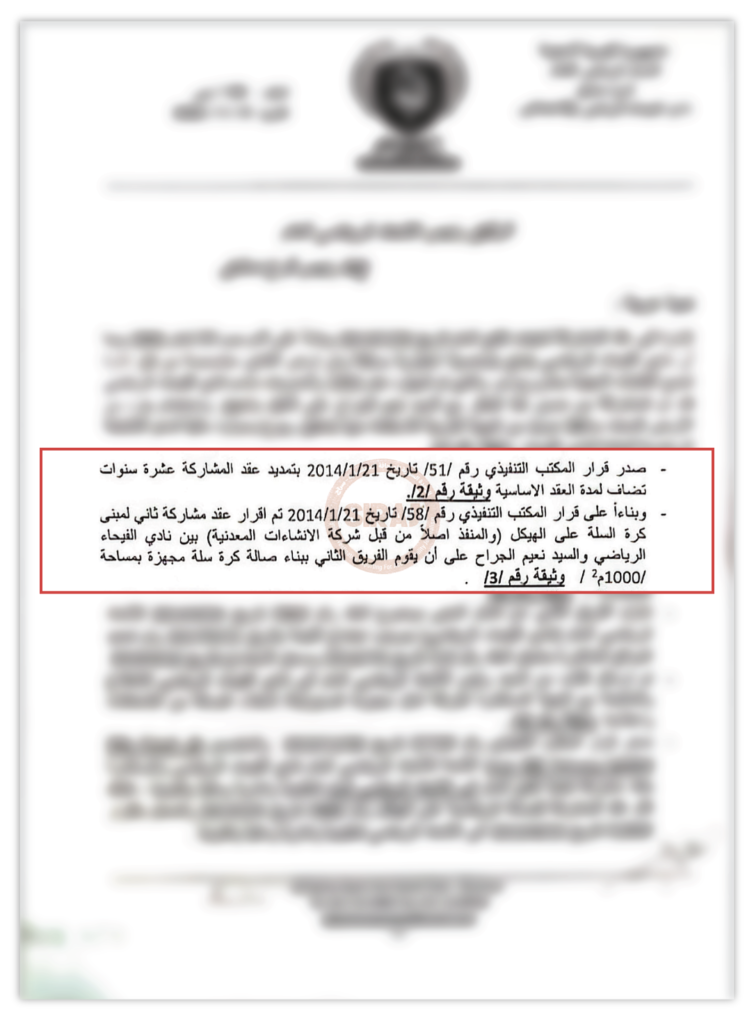
Details of the contract amendments for the Uptown complex — SIRAJ
Documents reviewed by SIRAJ show that al-Jarrah went beyond the terms of the investment agreements, using large portions of the land for commercial enterprises, including a gas station and an auto repair garage.
He also repurposed parts of the basketball arena’s unfinished structure and seating areas for other commercial uses, including a scrap storage facility and a metalworking shop. The reporter visited these facilities and obtained photographs documenting their condition and use.
Commercial projects operating on club property outside the scope of the agreements — SIRAJ
In a letter dated April 15, 2016, Document No. 71/S, addressed to the General Sports Federation, the club’s then-president, Abdel Fattah Ayaso, complained that al-Jarrah had taken over additional land belonging to Al-Fayhaa Sports Club and violated the terms of the investment agreements.
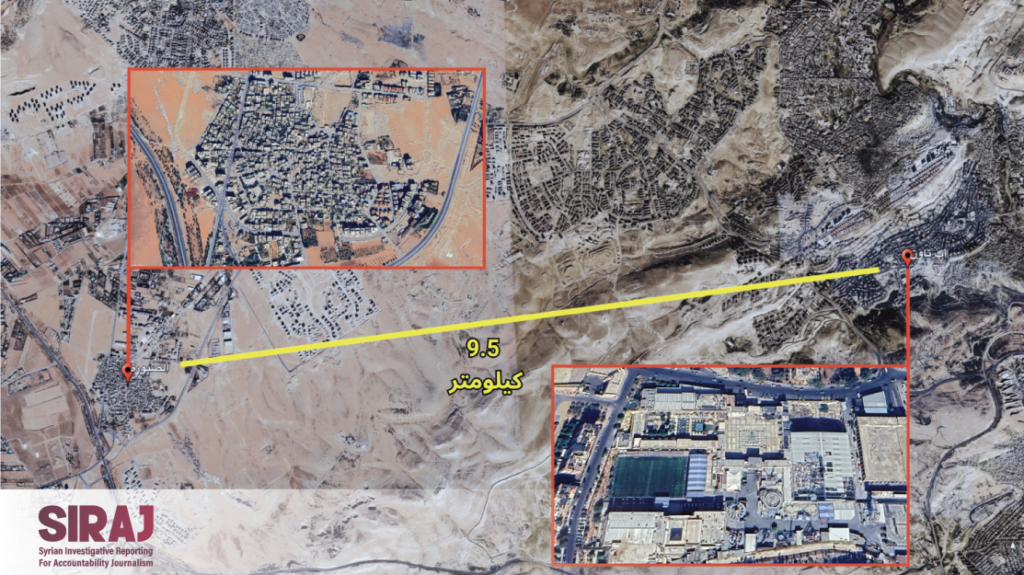
The Uptown complex is located approximately 9.5 kilometers (5.9 miles) from Fourth Division headquarters — SIRAJ
In the letter, Ayaso described what he called a “clear violation of the contract provisions,” which required 65% of the project’s total area to be dedicated to sports facilities, with only 35% permitted for commercial activities.
According to the document, Ayaso appealed to the head of the General Sports Federation to intervene and contact the investor, Amal Limited Liability Company, which held the contract, to explore the possibility of returning the concrete building—or at least the basketball arena’s upper seating area—along with any other portions of the building that had not yet been put into use.
He stressed that any such arrangement should avoid harming the investor or creating financial compensation obligations for the General Sports Federation or Al-Fayhaa Sports Club.
Ayaso also noted that the investor was using parts of the building, including basement areas, spaces beneath the stands, and certain other sections, even though the building itself had not yet been fully developed or put into operation.
Despite Ayaso’s appeal to the General Sports Federation, intended to draw attention to al-Jarrah’s expanding commercial activities and violations of contractual boundaries and conditions, the takeover of additional land and facilities continued.
According to Ayaso and the reporter’s firsthand observations, it eventually extended to most of Al-Fayhaa Sports Club’s facilities.
The sign identifying the club at the entrance to the Mashrou Dummar site had been removed, as documented in photographs and videos taken by the reporter during two visits in May and November 2025.
All that remained of the club’s facilities was a small building consisting of four prefabricated rooms and several deteriorating small sports courts dating back to the club’s founding. Most of the property and its facilities had been converted into privately operated commercial and investment projects.
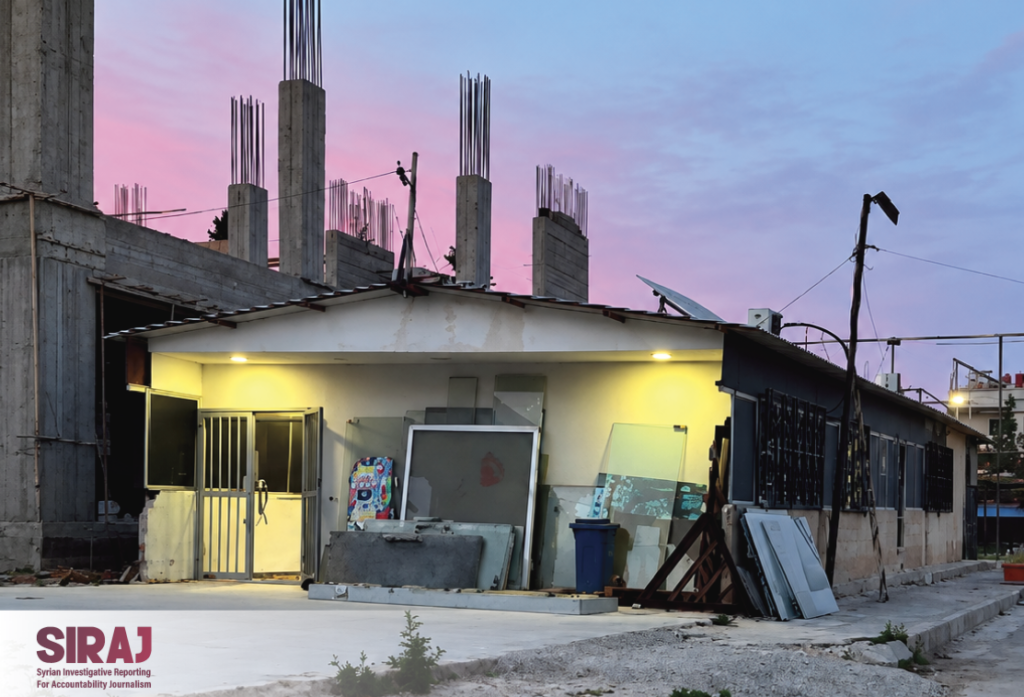
Al-Fayhaa Sports Club’s administrative building, consisting of four prefabricated rooms, in Mashrou Dummar, Damascus, on May 15, 2025 — SIRAJ
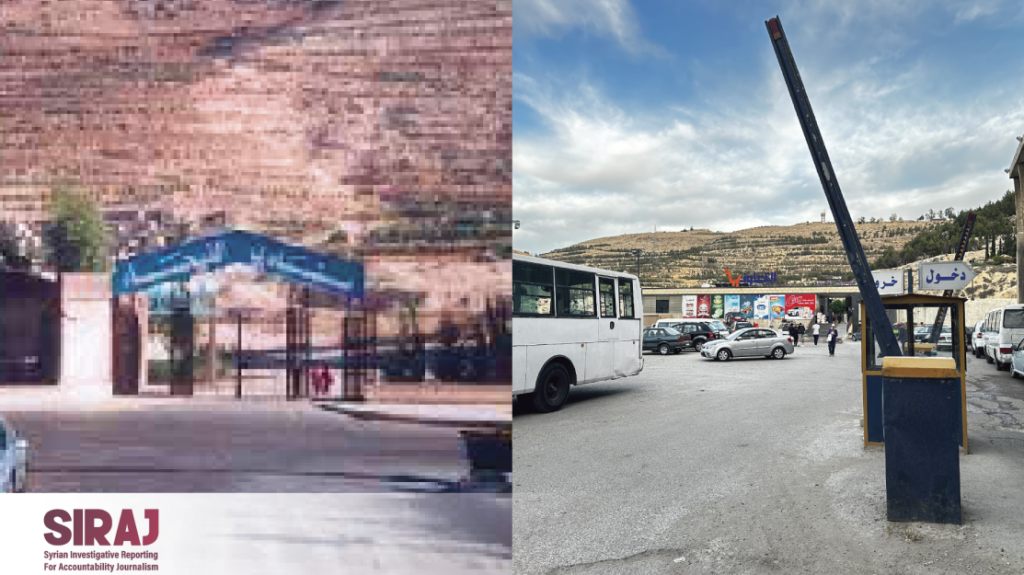
Before-and-after photographs of the site entrance — SIRAJ
In comparable cases involving land belonging to sports complexes, the Damascus Governorate has limited non-sports commercial investments to approximately 20% of the total area designated for development.
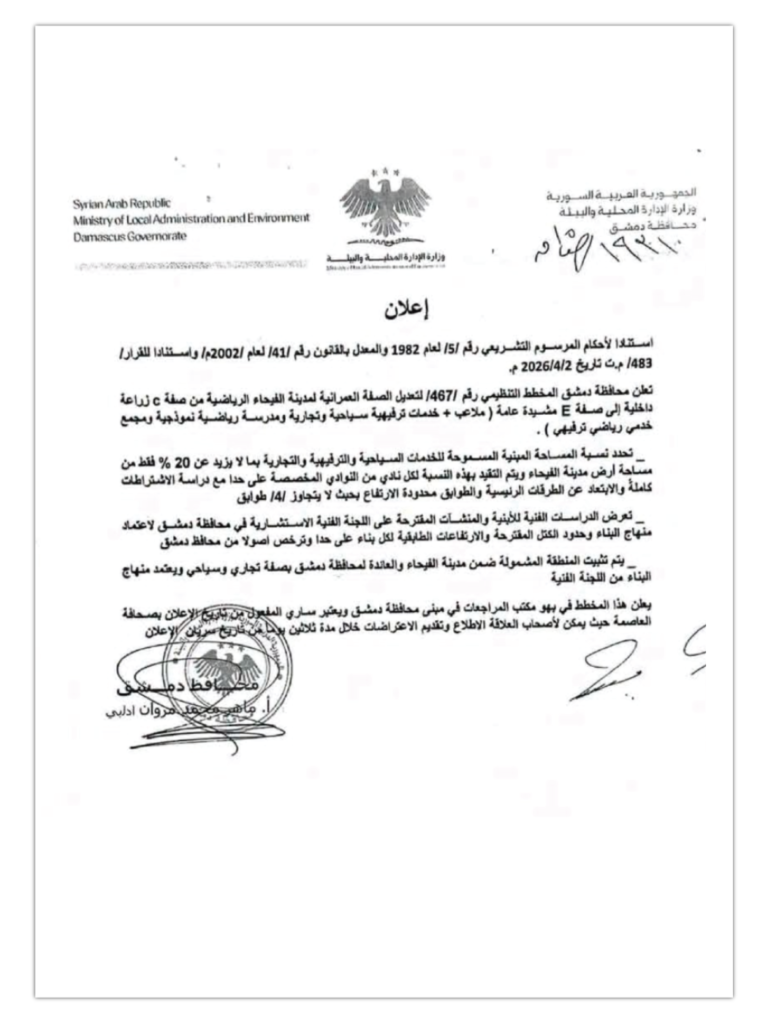
Damascus Governorate announcement setting a 20% limit on non-sports investments within sports complexes
Raghda Hariri, one of Al-Fayhaa Sports Club’s founders and one of its longest-standing supporters, told SIRAJ that she was deeply disappointed by the way the club’s assets had been developed.
She emphasized that the land on which the club’s facilities were built “was paid for out of the pockets of Mashrou Dummar residents when they subscribed to the housing development. That is why they have the right to see it used to support sports and the neighborhood’s young people.”
Hariri added that the club’s original founders had received numerous investment offers over the years but rejected them all to ensure that the club’s development remained focused on sports and contributed to its growth and the support of young athletes.
“But we were later shocked by the Uptown project,” she continued. “It shattered the dreams of many athletes and club supporters who had hoped that the substantial economic value of Al-Fayhaa’s assets would become a sustainable source of funding, helping establish the club as one of Syria’s leading sports organizations.”
Depriving the Club of Its Investment Revenue
On December 29, 2015, without providing any justification or formally notifying the club’s management, the General Sports Federation issued a decision dissolving Al-Fayhaa Sports Club’s board of directors. On the same day, it issued Resolution No. 2729, a copy of which was obtained for this investigation, transferring full financial, administrative, and legal control of the facility to the federation itself. Ayaso described the move as “a decision imposed by force.”
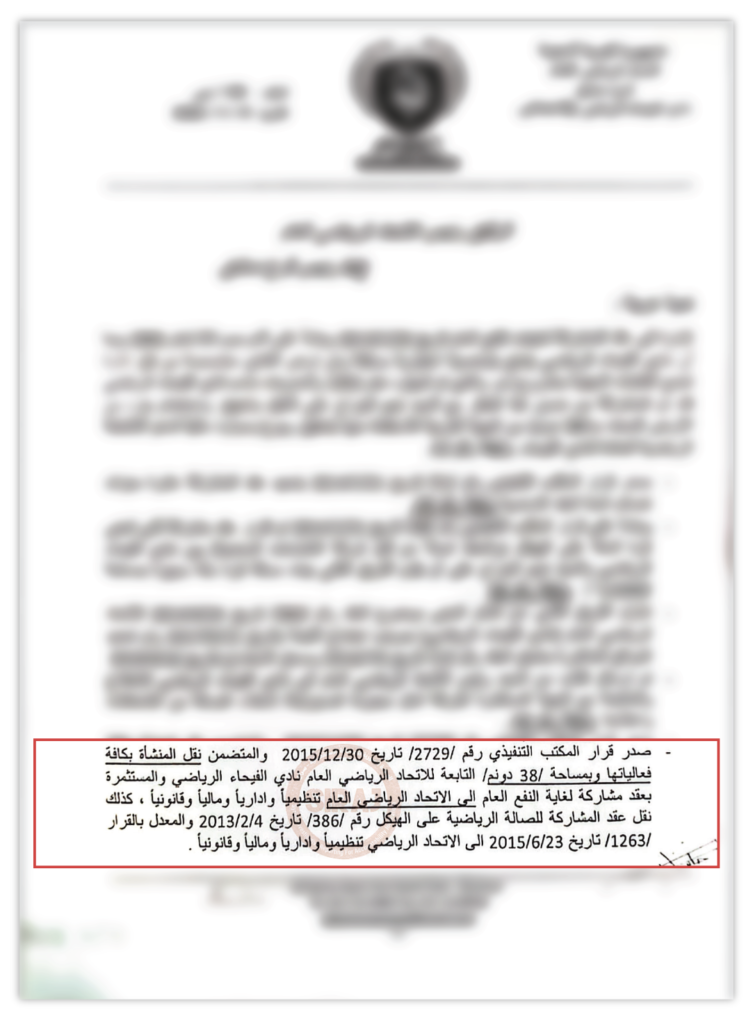
An exclusive copy of a letter sent by Al-Fayhaa Sports Club President Abdel Fattah Ayaso to the head of the General Sports Federation — SIRAJ
As a result, Al-Fayhaa Sports Club was deprived of all revenue generated by the investment projects, as the federation did not grant the club any right to share in the profits, according to members of its board of directors.
Yet property records obtained by SIRAJ from the Damascus Real Estate Registry Directorate confirm that the land remains owned by the Professional Syndicates Residential Complex in Mashrou Dummar, which had originally allocated it to Al-Fayhaa Sports Club. The land had never belonged to the General Sports Federation.
This is further supported by documents obtained by SIRAJ, including correspondence from the Prime Minister’s Office and Resolution No. 31/1/745, dated August 13, 1985. The resolution called for land designated for sports facilities to be handed over immediately to the General Sports Federation so it could develop and maintain the facilities. Crucially, the resolution authorized the handover of the land, not the transfer of ownership.
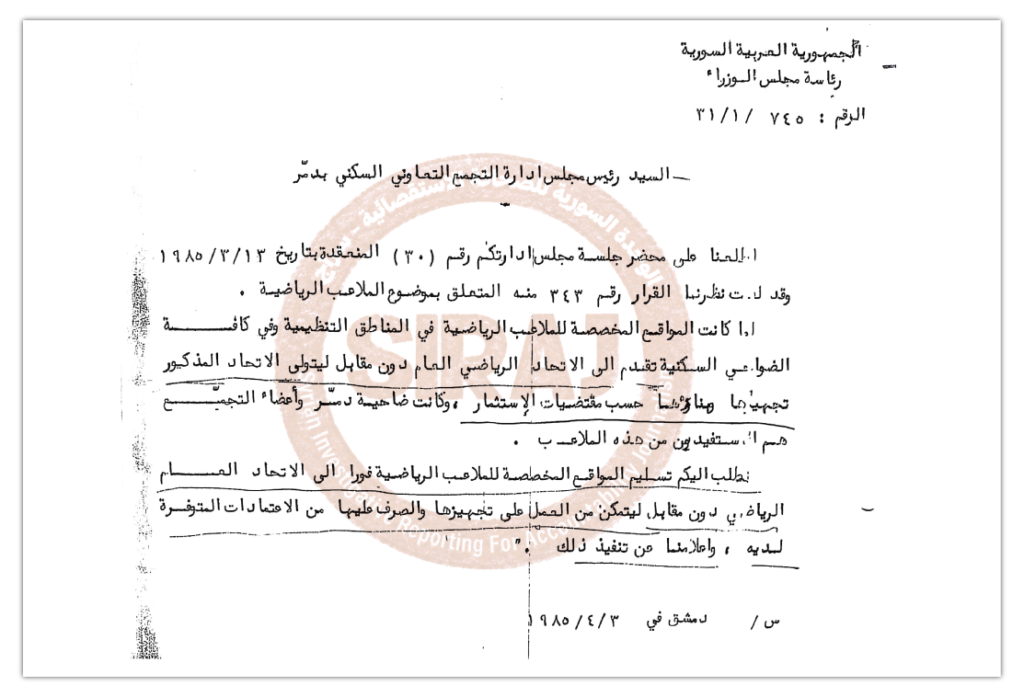
A request from the Prime Minister’s Office directing the residential complex’s management to hand over the club’s land to the General Sports Federation for development — SIRAJ
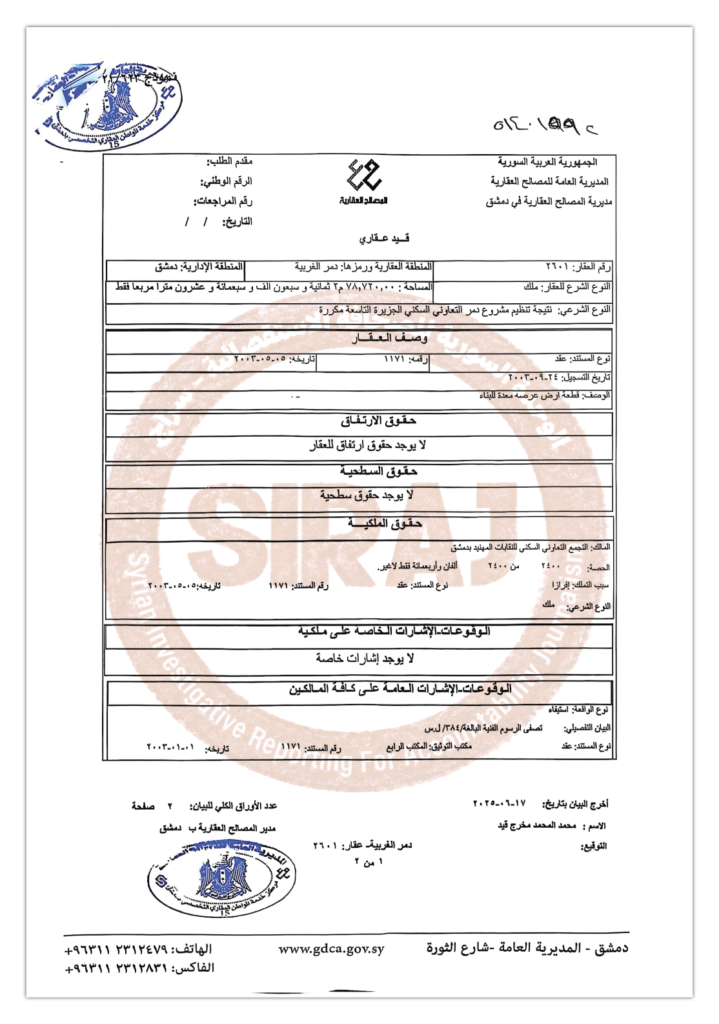
Property registry record for Al-Fayhaa Sports Club’s land, on which the Uptown complex was built — SIRAJ
According to engineer Abdel Fattah Ayaso, “The management of the Mashrou Dummar residential development designated the land as a sports complex within the residential master plan. The land belongs to the development, while the General Sports Federation’s role is limited to administrative oversight of sports clubs, including Al-Fayhaa. It does not own their facilities.”
With the federation having taken control of the club’s assets without any legal basis, the club’s president had little choice but to continue appealing for the restoration of its rights and property.
The reporter examined Document No. 153/S, a letter sent by Al-Fayhaa Sports Club to the General Sports Federation on December 9, 2020. In it, the club’s then-president, Abdel Fattah Ayaso, who had succeeded Haffar, called on the federation to “ensure fair treatment of the club and issue the necessary decision through its Executive Bureau to allocate no less than 50% of the revenue generated by the Uptown complex to Al-Fayhaa Sports Club.”
The letter emphasized the club’s urgent financial needs and its rightful claim to the revenue, explaining that the club was experiencing severe financial difficulties and had been unable to pay the salaries of its employees, players, and coaches.
According to Ayaso, however, the appeal “received no response.”
This account is consistent with the testimony of Raghda Hariri, one of the club’s founders, who said that the loss of investment revenue had directly undermined the club’s operations.
The shortage of financial resources forced many talented athletes to leave Al-Fayhaa because of inadequate funding and limited opportunities. This, in turn, weakened the club’s ability to develop its teams, retain players, and expand its sports programs.
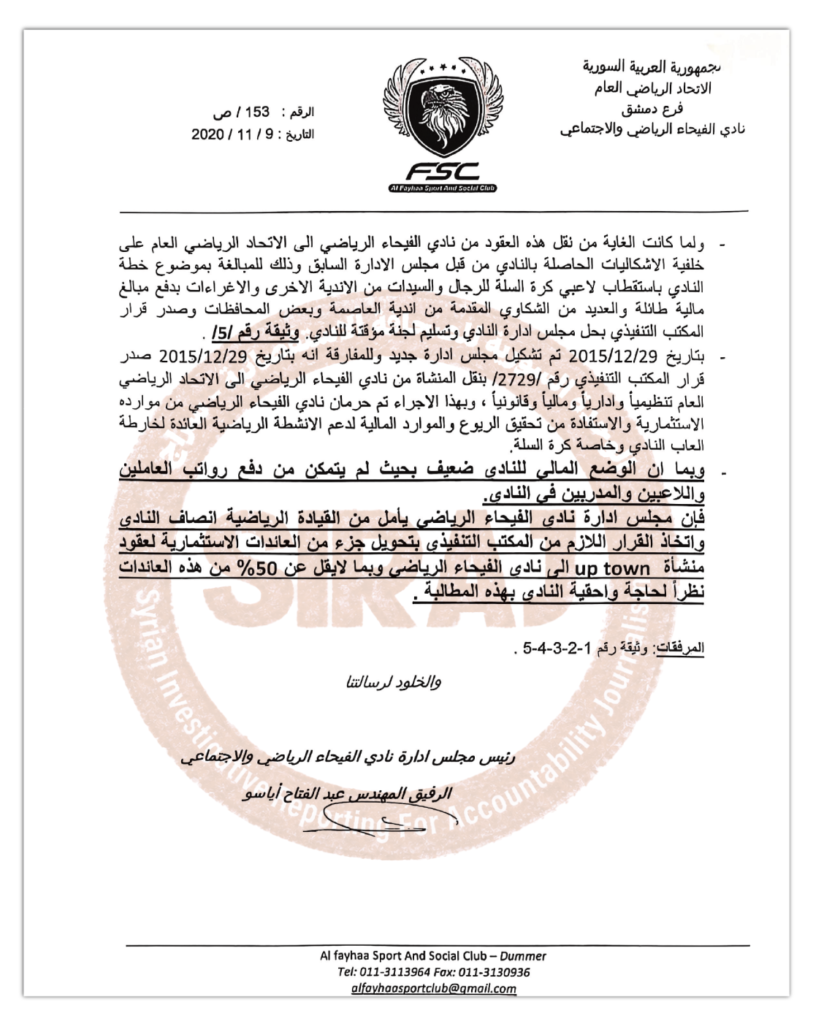
A copy of a complaint submitted by former Al-Fayhaa Sports Club President Abdel Fattah Ayaso to the General Sports Federation — SIRAJ
These documents raise serious legal questions about the General Sports Federation’s authority to grant investment rights over the land or otherwise dispose of it, despite not being its legal owner.
According to several members of the club’s recently resigned board of directors, chronic financial hardship and the lack of adequate sports facilities forced Al-Fayhaa to scale back its athletic programs.
In the years leading up to the fall of the Assad regime, basketball had become the club’s only remaining sport, played on an outdoor court that lacked even basic equipment and facilities.
Several former board members, all of whom requested anonymity, confirmed that the indoor sports arena developed by Naim al-Jarrah had originally been intended as a multipurpose facility accommodating a range of team and individual sports.
They maintained that the investment revenue the club had lost could have provided sustainable funding for its activities and potentially made Al-Fayhaa one of Syria’s most financially stable sports clubs, given the property’s strategic location in Mashrou Dummar.
Waheed Arafat, a legal adviser who works with sports clubs in the Gulf region, challenged the legality of Resolution No. 2729, which transferred financial, administrative, and legal control of Al-Fayhaa Sports Club’s property to the General Sports Federation.
“The General Sports Federation’s 2015 action to seize Al-Fayhaa Sports Club’s property cannot even be considered a legally valid decision,” Arafat said. “It goes beyond ordinary invalidity and is legally nonexistent. A waiver or transfer of ownership can only be carried out by the registered property owner or the holder of legally recognized property rights recorded in the land registry. In this case, there are no documented rights authorizing the General Sports Federation to take such action, rendering it invalid.”
Despite the alleged legal invalidity of the transfer, given that the federation did not own the club’s land, al-Jarrah continued operating his investments on the club’s property while Al-Fayhaa’s financial situation continued to deteriorate.
Arafat added that the takeover of land allocated to Al-Fayhaa Sports Club also involved serious violations of Public Entities Contracting Law No. 51 of 2004.
“The land was not offered through a competitive investment process, and neither the duration nor the nature of the investment was properly defined,” he explained.
He also noted that the agreements failed to comply with established limits on the proportion of developed land allocated to tourism-related commercial activities within sports complexes.
Arafat cited comparable decisions involving Al-Fayhaa Sports City in Damascus, where the Damascus Governorate capped non-sports investments at 20% of the total area.
By contrast, he said, the Uptown complex occupied more than 50% of the land.
Meanwhile, several real estate experts interviewed by SIRAJ in Mashrou Dummar estimated the current value of Al-Fayhaa Sports Club’s land at between $2 million and $2.5 million per dunam.
Based on the property’s total area of 78 dunams, its estimated market value could range from $156 million to $195 million.
Such a valuation would potentially make Al-Fayhaa one of the wealthiest sports clubs in Syria in terms of real estate assets.
Al-Fayhaa Sports and Social Club was founded in 1991 in Mashrou Dummar, also known as New Damascus Suburb, through an initiative led by several founders of the residential development and local athletes.
The club originally offered several sports programs, but basketball became its most prominent activity. Its greatest achievement came in 2006, when its senior basketball team earned promotion to the First Division for the first time in the club’s history.
Today, basketball remains the club’s only sport, operating with severely limited financial resources.
Assets Change Hands, but the Club Remains Shut Out
Following the fall of the Assad regime, the Uptown complex and its neighboring commercial facilities, including the auto repair garage and gas station, continued operating normally under the supervision of Naim al-Jarrah.
Meanwhile, Al-Fayhaa Sports Club’s board of directors repeatedly attempted to convince Syria’s new Ministry of Youth and Sports that the club was entitled to recover its land and the investments built on it.
Those efforts continued until February 3, 2026, when the ministry issued a decision accepting the resignation of the club’s board of directors.
According to statements obtained by the reporter from two former board members, both of whom requested anonymity, the resignations followed pressure on the club’s leadership to close the file concerning the disputed investments.
On April 15, 2026, Syria’s Illicit Enrichment Commission announced that it had completed the procedures for taking possession of assets belonging to Naim al-Jarrah and other individuals as part of voluntary disclosure applications and financial settlements concluded by the commission.
In a statement carried by the Syrian Arab News Agency (SANA), the commission said the assets had been transferred to Syrian state ownership and would be managed by the relevant government authorities to ensure their continued operation and stability.
Although the commission did not identify which government entity would assume responsibility for managing the assets and funds covered by the settlements, its current chairman, Basel Sweidan, had previously explained in an interview with Syria’s Al-Ikhbariya television channel that assets confiscated through settlements with businessmen linked to the former regime are transferred to state ownership and managed through institutions affiliated with the Supreme Council for Economic Development.
The council was established under Presidential Decree No. 115 of 2025. Article 3 of the decree places three economic entities under its authority: the Syrian Investment Authority, the Sovereign Wealth Fund, and the Development Fund.
As a result, Al-Fayhaa Sports Club, the original intended beneficiary of the land’s investment potential, remained excluded from the arrangement more than a decade after the investment agreement was signed, despite the fact that the property had originally been designated to serve the club and support its athletic activities.
SIRAJ contacted the Syrian Sovereign Wealth Fund and Naim al-Jarrah, submitting questions about the information and documents presented in this investigation, including the ownership of the assets and investments located on Al-Fayhaa Sports Club’s land and the mechanisms governing their management.
As of publication, SIRAJ had received no response from either party.
Syria’s Ministry of Youth and Sports also failed to respond to the findings presented in the investigation, despite the expiration of the response deadline.
- Editorial Supervision and Editing: Mohammed Bassiki
- Creative Coordination and Visual Solutions: Radwan Awad