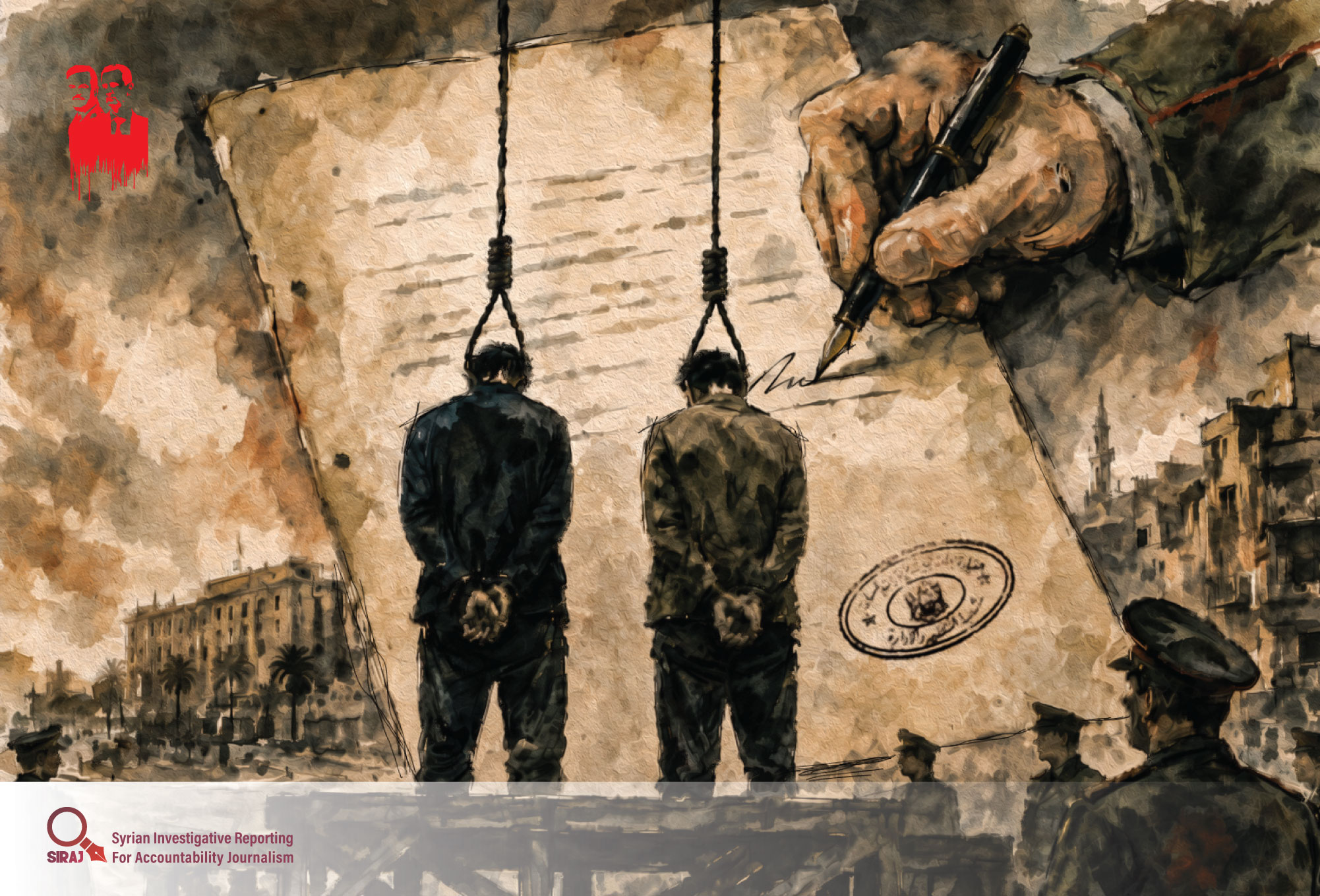


In the Summer of 1983, Syria’s Defense Minister, Mustafa Tlass, picked up his pen, signed what appeared to be just another routine document among the dozens that crossed his desk each day, and moved on with his work.
However, the document signed by Tlass—widely regarded as one of President Hafez al-Assad’s closest and most trusted ministers—and endorsed by a Field Court ruling, was in fact an execution order. It authorized the public hanging of two civilians in Damascus’ Marjeh Square, Syria’s capital, for ordinary criminal offenses that could have been prosecuted in virtually any country under civilian law.
More than four decades later, following the collapse of the Assad dynasty, reporters from the Syrian Investigative Reporting for Accountability Journalism (SIRAJ) and the newspaper Zaman al-Wasl obtained a digital copy of the document. It sheds new light on the brutality of Syria’s notorious Military Field Courts, which were established after the Baath Arab Socialist Party came to power and remained one of the regime’s most feared instruments for most of the Assads era.
The two civilians targeted by the execution order were convicted of stealing and selling subsidized food supplies. Yet rather than being tried before a civilian criminal court, they were sentenced to death by a Military Field Court.
The tribunal had originally been created during the state of war with Israel following the Baath Party’s seizure of power in the March 1963 coup. Later, however, Hafez al-Assad expanded its jurisdiction, allowing it to prosecute civilians accused of ordinary criminal offenses.
In practice, legal experts say, these were courts in name only. They did not conduct genuine trials, offered no right to defense, and provided none of the guarantees associated with a fair judicial process. Instead, they became an effective instrument for eliminating Syrians deemed disloyal to Assad’s rule. They operated as a parallel judicial system, bypassing ordinary courts to dispose of political opponents through expedited proceedings cloaked in legal legitimacy, while instilling fear throughout Syrian society, according to Nawras Al-Abdullah, a legal researcher at the Syrian Dialogue Center.
“The Field Court was originally created to deal with serious wartime crimes and enforce strict military discipline,” Al-Abdullah said. “But from the outset, it reflected the Baath regime’s broader mindset, which prioritized the elimination of political opponents above all else.”
The use of these courts did not end with Hafez al-Assad. They continued to operate under Bashar al-Assad, particularly during the Syrian uprising. According to the Syrian Network for Human Rights (SNHR), the Assad regime executed 7,872 people, including 114 children and 26 women, out of at least 14,843 death sentences issued by Military Field Courts between March 2011 and August 2023.
Field Courts formed part of Syria’s system of exceptional courts. Their proceedings were secretive and often lasted only minutes. They ignored even the procedural safeguards of military courts, denied defendants the right to legal representation, and issued unappealable judgments. Verdicts were based not on evidence presented in court, but primarily on security reports and confessions allegedly extracted under torture.
Baathist Ideology and Brutal Sentences
Although the offense attributed to the two defendants amounted to an ordinary criminal violation—one that would normally fall under consumer protection laws or the criminal code—the regime referred their case to a Military Field Court, which sentenced them to death by hanging.
The execution order approved by Mustafa Tlass begins with the handwritten instruction “Execute.” Classified “Top Secret,” it was issued by the Army General Command, specifically the Military Administration Branch – Military Discipline Division, and references Field Court Decision No. 59, dated June 19, 1983.
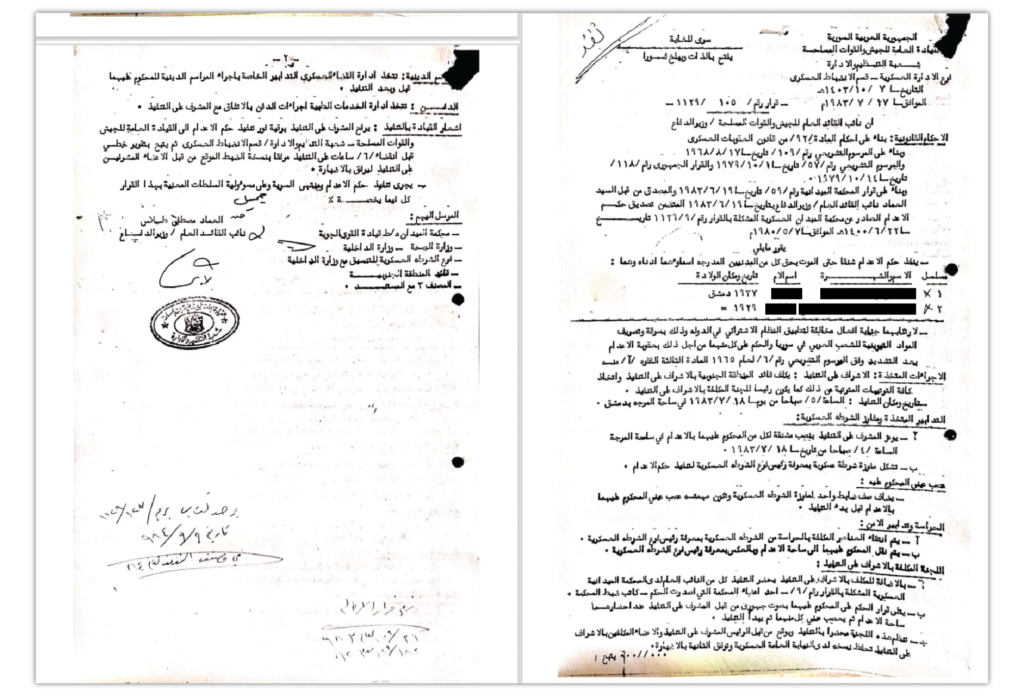
The document is filled with terminology characteristic of Baathist ideology under Hafez al-Assad. It accuses the two civilians of “committing criminal acts contrary to the implementation of the state’s socialist system” and of “stealing and distributing food supplies belonging to the Arab people in Syria.”
It also sets out, in meticulous detail, how the executions were to be carried out. The commander of the Southern Military Region was assigned responsibility for overseeing the executions and all logistical arrangements, while also serving as chairman of the supervisory committee. The executions were scheduled to take place in Marjeh Square, central Damascus, at 5:00 a.m. on July 18, 1983.
To ensure the executions proceeded as ordered, the document instructed officials to erect two gallows in Marjeh Square by 4:00 a.m. and to assign a military police unit to carry out the hangings under the supervision of the head of the Military Police Branch.
A non-commissioned officer was designated to blindfold the two prisoners immediately before the executions, while military police personnel responsible for guarding them were to be selected by the head of the Military Police Branch.
According to the order, responsibility for transporting the condemned men to and from the execution site also rested with the Military Police Branch.
The executions were to be witnessed by the Military Field Court’s prosecutor, one of the judges who issued the sentence, and the court clerk. Upon arrival at the execution site, the supervising officer was instructed to read the death sentence aloud before the prisoners were blindfolded and the executions carried out.
Afterward, the supervisory committee was required to prepare an official execution report, signed by all committee members. The Military Public Prosecutor’s Office would retain one copy, while another would be attached to the case file.
The document further assigns the Syrian Army Medical Services Administration the responsibility for burying the bodies. The same institution would later be implicated in the burial of thousands of detainees in mass graves during the Syrian conflict. Meanwhile, the Military Judiciary Administration was tasked with arranging the required religious rites before and after the executions.
Following the executions, the supervising officer was instructed to notify the General Command of the Army and Armed Forces immediately by telegram, followed within six hours by a written report accompanied by the signed execution record for inclusion in the official case file.
The order also stipulated that the executions be carried out under strict secrecy, with local authorities responsible for enforcing the directive.
At the end of the document appears the signature of an official identified as Jamil, along with distribution copies sent to the Field Court at the Air Force Command, the Ministries of Health and Interior, the Military Police Branch for coordination with the Interior Ministry, and the regional military commander.
The document concludes with the signature of Defense Minister Mustafa Tlass and the official seal of the General Command of the Army and Armed Forces – Organization and Administration Branch.
A Seven-Minute Trial
Samir Turko is among the few Syrian civilians known to have survived after being brought before a Field Court shortly after Hafez al-Assad expanded its jurisdiction.
On November 26, 1981, Turko, who is still alive today, was arrested by the State Security Directorate in Damascus because his maternal uncle was affiliated with the Muslim Brotherhood in Jordan.
He was initially held at the Internal Security Branch before being transferred to the State Security Branch for interrogation. Over the next three years, he was moved through multiple security branches in Damascus and the southern city of Daraa. After years of detention and interrogation, he was finally brought before a Field Court.
What followed, he told SIRAJ, bore little resemblance to a judicial proceeding.
“There were 22 of us chained together,” Turko recalled. “The hearing was purely symbolic. It lasted no more than seven minutes before Judge Suleiman al-Khatib.”
According to Turko, the judge opened by asking only one question: “Are you Samir Turko?”
When Turko answered yes, the judge immediately launched into accusations.
“He called me a member of the Muslim Brotherhood and an American agent,” Turko said. “I replied, ‘I am a patriot. I love my country.'”
The response appeared to anger Judge al-Khatib, who signaled to security officers inside the courtroom. They immediately beat Turko so severely that his face began bleeding.
The judge then questioned him about his uncle, threatening to arrest every member of his family before concluding with the words:
“I swear I’ll have you executed.”
Turko said the courtroom itself looked nothing like a court of law. There was no defense lawyer, no public hearing, no examination of evidence, and virtually no questioning. Defendants were never informed of the verdicts issued against them. Instead, prisoners tried to decipher their fate from the judges’ gestures.
According to Turko, Judge al-Khatib would snap his pen after interrogating a defendant—a signal that he had decided on a death sentence. Another judge communicated his decision through hand gestures: pointing with his left hand meant execution; pointing with his right meant the prisoner had escaped execution, though often only to receive a life sentence.
“What remains etched in my memory is that they wanted to execute as many people as possible,” Turko said. “They wanted to eliminate anyone they considered an opponent. They forced people not only to confess to whatever they wanted, but also to implicate family members, friends, and anyone they knew.”
Turko was ultimately sentenced to life imprisonment. He was transferred first to the notorious Tadmur (Palmyra) Military Prison and later to Saydnaya Military Prison, where he remained until his release in 2010.
During his years in detention, Turko endured repeated torture. The worst came after his arrival at Tadmur, where guards repeatedly beat the soles of his feet until they became severely infected.
“My foot became gangrenous and worms emerged from the wound,” he said.
According to Turko, the prison guards’ solution was to allow him to cauterize the wound with fire. More than four decades later, he continues to suffer permanent damage, including the loss of much of the tissue on the sole of his foot.
Legal researcher Nawras Al-Abdullah said the logic of Syria’s Field Courts rested on speed, repression, and the swift elimination of perceived threats to the Assad regime.
“Their purpose was to dispose of cases within minutes,” he said. “This pattern has been consistently documented by survivors from different periods, as well as by Syrian and international human rights organizations.”
Al-Abdullah added that Hafez al-Assad deliberately expanded the courts’ jurisdiction as the regime confronted growing opposition in the late 1970s.
“As the regime perceived an increasing threat from Islamists and other political groups, Legislative Decree No. 32 of 1980 extended the jurisdiction of the Field Courts to cover internal disturbances,” he said. “In practice, this transformed them into a tool for suppressing both civilians and members of the military.”
The Evolution of the Regime’s Most Feared Court
Syria’s Military Field Court was established on August 17, 1968, under Legislative Decree No. 109/3, based on Recommendation No. 2 issued by the Provisional Regional Command of the Arab Socialist Baath Party on February 25, 1966, which at the time held legislative authority.
The court remained in operation for more than five decades until September 3, 2023, when Bashar al-Assad issued a legislative decree formally abolishing it.
When it was first created, the court’s jurisdiction was limited to offenses within the authority of military courts, as referred to by the Minister of Defense. Its jurisdiction applied retroactively to the aftermath of the June 1967 Arab-Israeli War, reflecting its original purpose: to prosecute military personnel deemed responsible for wartime losses or offenses committed during military operations or armed confrontation with the enemy.
Its mandate, however, steadily expanded.
In February 1970, as Hafez al-Assad was rising to power, Legislative Decree No. 61/6 broadened the court’s jurisdiction to include crimes committed “in the presence of the enemy” whenever referred by the Minister of Defense, in addition to its existing authority over offenses committed during wartime or military operations.
A decade later, on July 1, 1980, Hafez al-Assad issued Legislative Decree No. 32/7, dramatically expanding the court’s powers to cover crimes committed “during internal disturbances.” The amendment enabled the Field Court to prosecute members of the Muslim Brotherhood during the violent confrontation between the regime and Islamist groups in the early 1980s, culminating in the 1982 Hama massacre. Decades later, the same legal framework was used to prosecute participants in the Syrian uprising that began in March 2011.
The amendment introduced broadly worded provisions that effectively opened the door for the prosecution of civilians. From that point onward, the Field Court could hear virtually any case already falling within the jurisdiction of military courts if the alleged offense occurred during wartime, military operations, or internal unrest, provided the Minister of Defense chose to refer the case.
According to Fawwaz al-Khouja, a lawyer and member of the Damascus Bar Association, these legislative changes were not intended solely to increase penalties or expand the use of the death sentence. They also created opportunities for corruption and political patronage.
Al-Khouja recalled one case in which a defendant charged with murder and rape before a criminal court had relatives who managed to reach Defense Minister Mustafa Tlass. Tlass allegedly ordered the case transferred to the Military Field Court, where the defendant received a sentence equivalent only to the time already served in detention.
According to Al-Khouja, many criminal cases were transferred to the Field Court through political influence or bribery. In some instances, serious offenders sought referral to obtain lighter sentences; in others, relatively minor offenses were transferred so that defendants could receive significantly harsher punishments.
“The defining characteristic of the Field Court,” Al-Khouja said, “was that it was not bound by the penalties prescribed in law. It could sentence someone to death for an offense punishable by only one year in prison, or impose only a short prison term for a crime that ordinarily carried the death penalty.”
The Mystery of the Number 22
To this day, no one knows why the number 22 became synonymous with the chains used to transport detainees to Field Courts.
For decades, beginning under Hafez al-Assad and continuing throughout the rule of his son Bashar, Syria’s security services insisted on shackling 22 prisoners together in a single chain before taking them to the Military Field Court.
Former detainee Fouad Naal, now head of the Association of Freed Saydnaya Prisoners, recalls that his own transfer was delayed simply because his group consisted of only 21 prisoners. Security officials postponed their appearance before the court until another detainee arrived, bringing the total to the required twenty-two.
Naal was arrested on April 13, 2004, in the aftermath of the U.S.-led invasion of Iraq. He was transferred between Branch 227 (the Regional Security Branch), Saydnaya Military Prison, and later Adra Prison, where he remained until the collapse of the Assad regime.
According to Naal, after the invasion of Iraq, Syria’s Grand Mufti Ahmad Kaftaro, acting under the direction of the Assad regime, issued a religious ruling urging Syrians to wage jihad against U.S. forces in Iraq. Buses carrying volunteers began departing for Iraq under the supervision of Syrian intelligence.
Naal says he soon noticed that many of those buses were being targeted near the Iraqi border and that everyone aboard was killed.
He believes the operations were coordinated by Syrian intelligence.
“It was effectively a liquidation operation targeting anyone who embraced the idea of jihad,” Naal said.
In response, Naal publicly issued a religious opinion opposing Kaftaro’s fatwa. He began visiting the Damascus International Fairgrounds, where buses carrying prospective fighters assembled, and he urged young men not to travel through channels organized by Syrian intelligence.
“I told them: if you want to fight, don’t go through the Syrian regime. It’s a plan to eliminate you,” he recalled. “We tried every possible way to persuade them to turn back, and we succeeded in convincing some of them.”
The campaign soon made him a target.
After going into hiding inside Syria, Naal was arrested in 2004 together with his wife and their four-month-old daughter at the Harasta bus station during a joint operation involving four security agencies: the Regional Security Branch, Palestine Branch, the Raids Branch, and Military Intelligence.
He remained imprisoned until December 8, 2024, when the Assad regime fell.
According to Naal, immediately after their arrest, security officers separated his infant daughter from her mother.
To secure his daughter’s release, Saeed Samour—who would later become Syria’s Interior Minister—allegedly demanded that Naal confess to every accusation brought against him.
While being interrogated at the Palestine Branch, Naal was informed that he faced 33 criminal charges.
None, he says, related to the religious opinion he had issued or to incitement against the state.
“I was interrogated by Saeed Samour, who headed the Regional Security Branch at the time, by Assef Shawkat, Assad’s brother-in-law, and by Manhal Al-Suwaid. During one interrogation session, Hassan Khlouf, head of the Palestine Branch, was also present.”
Instead, investigators accused him of plotting to assassinate senior officials including Bashar al-Assad himself and planning to bomb the U.S. Embassy in Damascus.
Naal says Assef Shawkat later offered to release his wife if he agreed to confess to an additional accusation.
A list containing several names was placed before him, and he was instructed to admit that he had planned to assassinate every person on it, including Shawkat himself.
Fearing for his infant daughter, Naal says he agreed.
In 2005, he was brought before the Military Field Court, where Major General Mohammad Kanj sentenced him to what prisoners referred to as “Field Court life imprisonment,” which means incarceration until death.
Later, Syria’s State Security Court imposed two additional life sentences and two death sentences.
Prisoners were transported to the court under brutal conditions. Chained together, they were loaded into what Naal described as a refrigerated meat truck.
When they arrived, the rear doors were opened and guards violently pulled them from the vehicle, causing prisoners to fall on top of one another before being dragged into the courtroom, still bearing visible signs of torture inflicted during interrogation.
Within roughly 30 minutes, at the end of the court’s Sunday session, every defendant had been sentenced.
Naal says no evidence was presented, no witnesses testified, and no meaningful charges were examined.
Judge Mohammad Kanj sat alongside a military officer holding the rank of major general and another man wearing a leather jacket and dark sunglasses. Naal later learned that the latter was an officer from the National Security Bureau.
The judge asked only two questions:
“What is your name?”
“Do you confirm the confession you gave?”
After Naal answered yes, the judge motioned with his right hand, signaling that he should leave.
By then, Naal had learned the meaning of the judges’ gestures.
A motion with the left hand meant immediate execution by firing squad.
A simple gesture was enough to determine whether a prisoner would live or die.
“The Field Courts executed thousands of people in the name of justice,” Naal said. “In reality, they functioned as instruments of systematic sectarian and political extermination.”
Documents reviewed by SIRAJ show that thousands of detainees were referred to the Military Field Courts during 1982 and 1983. Most were accused either of membership in the Muslim Brotherhood or in the so-called ‘Suspicious Right-Wing Organization’—a movement led by former Syrian military officers opposing Hafez al-Assad’s purge of senior commanders and reportedly backed by Iraq. Many of those referred came from Suwayda Province. Another significant category consisted of individuals accused of belonging to the Lebanese Kataeb Party.
The documents do not indicate what ultimately happened to these detainees. However, available evidence suggests that many were executed over subsequent years. The exact number of people put to death by Military Field Courts under either Hafez or Bashar al-Assad remains unknown.
Against that backdrop, Mustafa Tlass’s signature on execution orders for civilians appears less an exception than a routine element of the machinery of death.
Tlass and Hafez al-Assad shared one of the closest political relationships within Syria’s ruling establishment. The two met while studying at the Military Academy in Homs during the 1950s, later working together inside the Baath Party. Tlass played a significant role in Assad’s rise to power and was rewarded with the post of Minister of Defense in 1972, a position he retained until 2004, remaining in office for four years after Bashar al-Assad inherited the presidency.
In a 2005 interview with Germany’s Der Spiegel, Tlass admitted that he could no longer remember how many death warrants he had personally signed.
He said that during parts of the 1980s, as many as 150 public hangings were carried out each week in Damascus alone.
Smiling, he concluded: “We used weapons to seize power, and we wanted to keep it. Anyone who wants power will have to take it from us by force.”
A version of this investigation was also published by Daraj Media
Creative Production and Visual Design: Radwan Awad