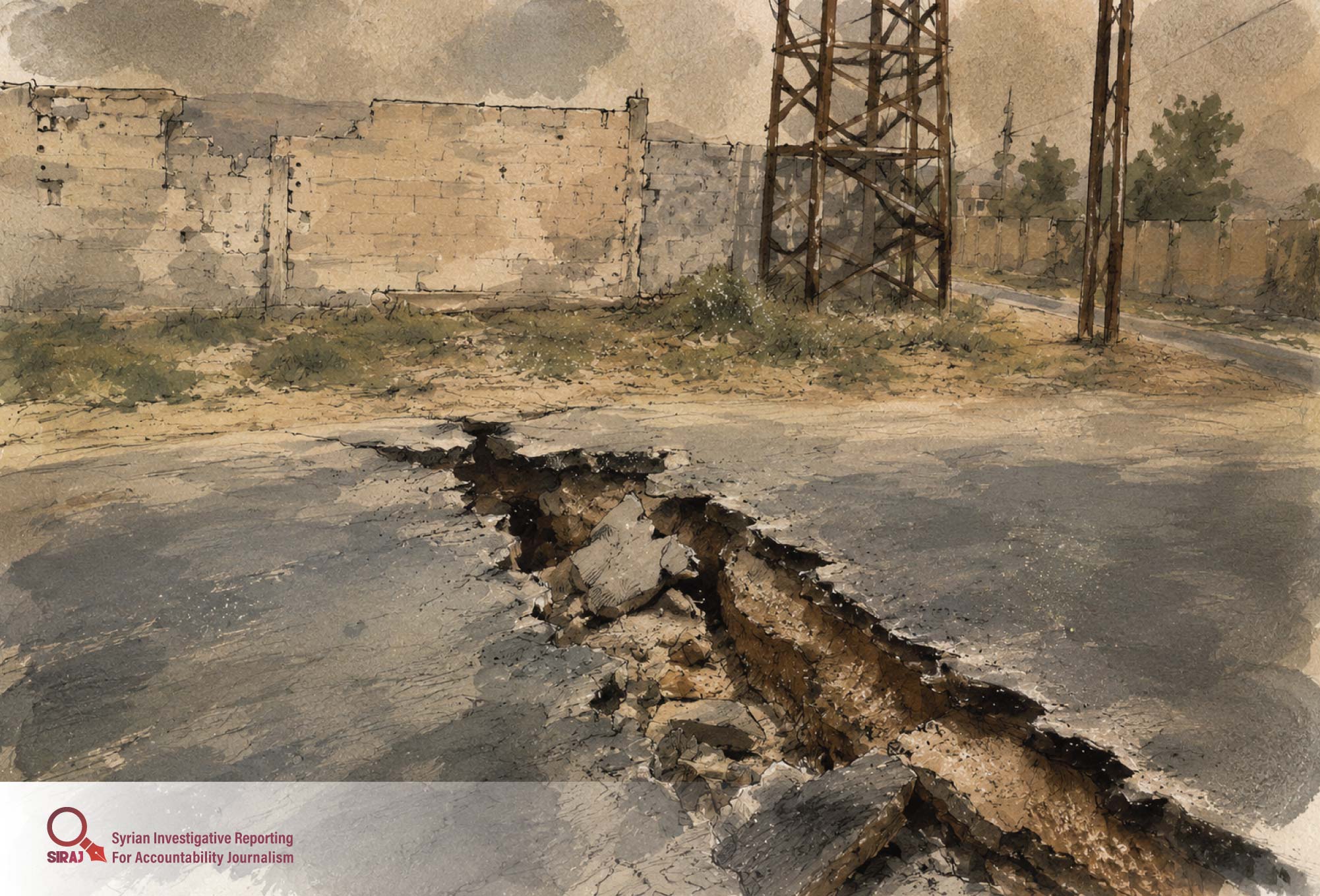


Nearly four months ago, 15-year-old Said Hijazi was riding his bicycle through Ain Tarma, on the outskirts of Damascus, when his front wheel suddenly caught in a hole that had opened without warning on a quiet side street. He was thrown to the ground, luckily without injury.
The small cavity soon widened, exposing the sewage pipes buried beneath the road. According to Khaled Hijazi, Said’s uncle, who owns a shop nearby, municipal workers responded by simply filling the hole with construction debris.
“When I tried to question what they were doing, they told me not to interfere,” he recalled. “One of them just said, ‘Mind your own business.’“
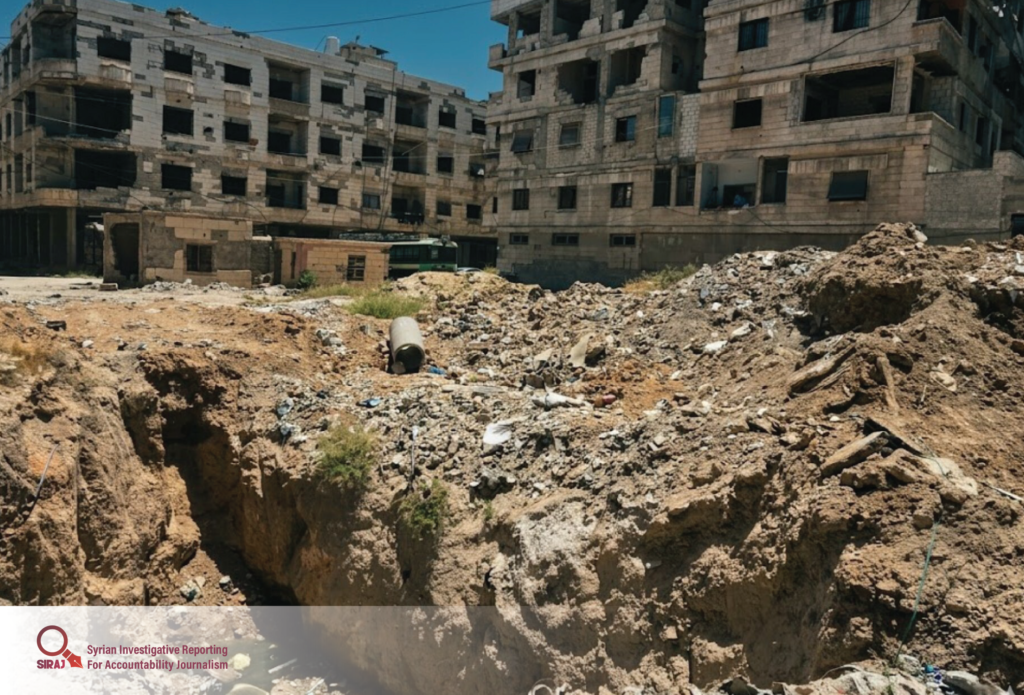
In the weeks that followed, sewage water began surfacing through other sinkholes that appeared unexpectedly across the same neighborhood, particularly after the heavy winter rains that swept across Syria earlier this year.
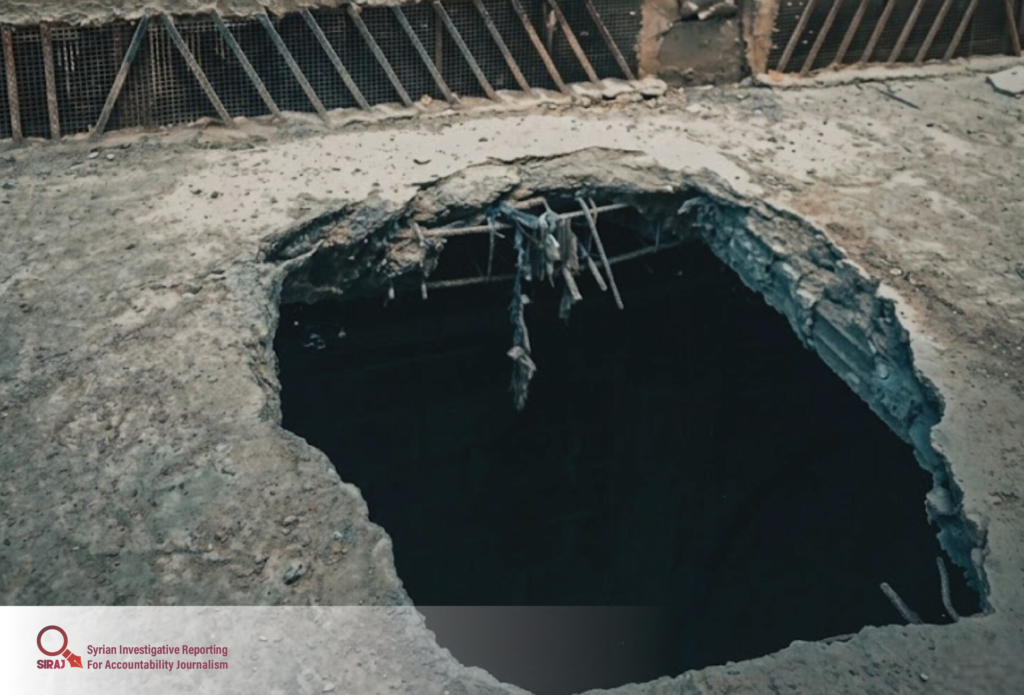
Among the most striking incidents was a massive sinkhole that opened in Ain Tarma’s main road during the Eid al-Fitr holiday in late March 2026.
Similar ground collapses have since been reported throughout Eastern Ghouta. The latest involved a 10-meter-deep sinkhole that opened in the middle of the main road in Zamalka, while numerous other collapses have been documented in Douma and several neighboring towns.
Through field reporting, along with the collection and verification of dozens of social media posts, photographs, and videos, the SIRAJ and Daraj investigative team documented at least 10 sinkholes and ground collapses across towns and cities in Eastern Ghouta between the beginning of 2026 and the publication of this investigation.
The Legacy of the Siege
What unites the communities now grappling with recurring ground collapses is a shared history: all endured years of siege by Bashar al-Assad’s forces and allied militias between 2013 and 2018, while coming under relentless bombardment. To survive, residents dug an extensive network of tunnels beneath their towns—creating underground routes that allowed them to move, seek shelter, and stay alive.
As Hamed al-Zein, who remained in his hometown of Hamouriyah until he was displaced to Idlib aboard the regime’s so-called “green buses“ in 2018, recalls:
“After the massive offensive against Eastern Ghouta between 2015 and 2018, people had no choice but to dig tunnels by hand—from inside their homes or from nearby basements—to protect themselves and their children. Entire apartment buildings were collapsing on civilians because of the shelling.”
Speaking to SIRAJ and Daraj, al-Zein said residents worked collectively to excavate what became known as “civilian tunnels.” These existed alongside tunnels dug by opposition factions to transport supplies and fighters, as well as specialized underground passages serving medical facilities.
One of the architects of that underground infrastructure was Samir Bouydani, a civil engineer who lived through the siege of Douma and helped dig three underground medical facilities. Bouydani says he was also the first to propose the idea of civilian tunnels in 2013.
“The armed groups’ commanders didn’t embrace the idea at the time,” he recalled.
His vision was ambitious: to create underground spaces where civilians could not only shelter but also live and even shop, as markets had become one of the regime’s most frequent targets.
Bouydani remembers one attack in 2015, when an airstrike on Douma’s marketplace killed 120 people.
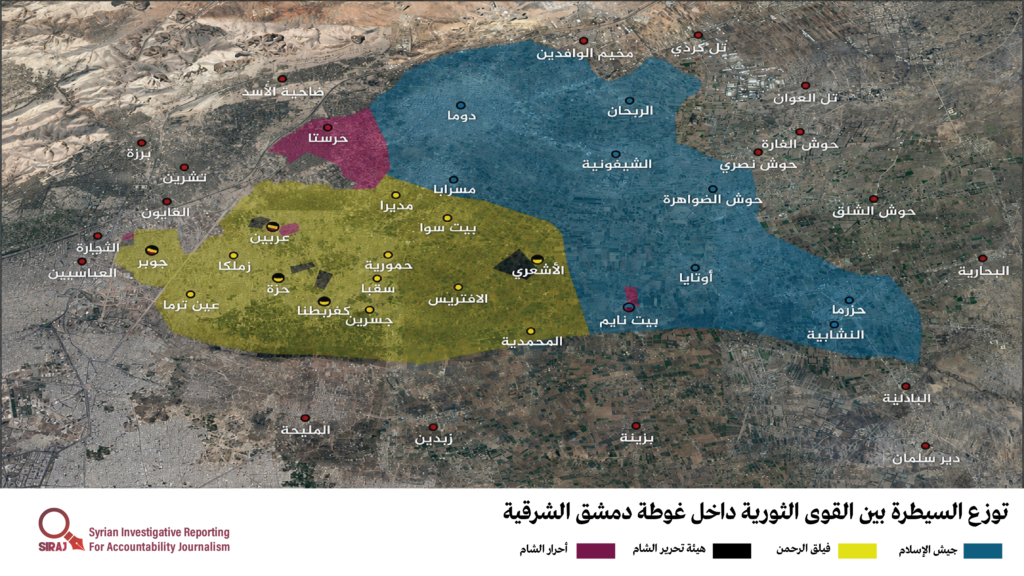
During the siege, Eastern Ghouta was divided into two principal sectors. The northern sector—including Douma and Misraba—was controlled primarily by the Army of Islam (Jaysh al-Islam-JAI). The southern sector, encompassing towns such as Arbin, Kafr Batna, and Jisreen, was controlled by the Rahman Corps (Faylaq al-Rahman) and the al-Nusra Front, later known as Hay’at Tahrir al-Sham (HTS), while Harasta remained under the control of Ahrar al-Sham.
Having lived in Douma from 2013 until his forced displacement in April 2018, and while serving with the city’s municipal council, Bouydani worked alongside local opposition authorities to oversee the construction of several underground medical facilities.
Among them were tunnels beneath the Cave Hospital in Kafr Batna, another beneath al-Shifouniyah Hospital, and the largest of them all: the Damascus Countryside Specialized Hospital, known locally as “Point One.”
The latter underground complex included long passageways wide enough for ambulances, operating rooms that Bouydani describes as “state-of-the-art,” backup power generators, a water well, and a dedicated ventilation system.
To prevent its collapse, engineers covered the structure with approximately 1.5 meters (five feet) of earth and reinforced the surrounding area with additional soil. Access to the operating rooms was concealed through tunnel entrances hidden inside nearby residential buildings.
“It was so well equipped that the hospital continued operating for six to eight months after Assad’s forces captured Douma,” Bouydani said. “Later, soldiers looted the entire facility and stripped much of the steel reinforcement.”
Bouydani says he was not involved in constructing military tunnels, which were managed by separate engineering teams. His work focused on medical facilities, while also advising civilians who decided to excavate tunnels beneath their own neighborhoods to protect their families.
According to Bouydani, civilian tunnel construction accelerated in 2015. Residents dug directly beneath their homes—particularly in informally built neighborhoods—or connected the basements of adjacent buildings to create underground escape routes.
Asked where such engineering expertise came from, Bouydani answered with a laugh: “Douma was different. We turned plastic into diesel, gas, and gasoline. We used solar heat to boil water. We had electricity for 22 hours a day using generators that ran on vegetable shortening.”
In a besieged enclave cut off from the outside world, he said, survival depended as much on ingenuity as on endurance.
Stolen Steel: The Final Blow
The airstrikes, barrel bombs, and artillery attacks carried out by Assad’s forces, backed by Russian air power and allied Iranian militias, have long since ended.
But for many residents of Eastern Ghouta, a new danger now lurks beneath their feet.
The ground is collapsing.
In the wake of these sinkholes, stagnant pools of sewage have begun spreading through neighborhoods due to ruptured sewer lines shattered as the collapsing tunnel network gives way underground.
Wael Salam, mayor of Ain Tarma, says the tunnel network began taking shape in 2015, constructed primarily by the Rahman Corps (Faylaq al-Rahman) and the JAI.
“They were enormous tunnels,” he said. “A vehicle could drive through them.”
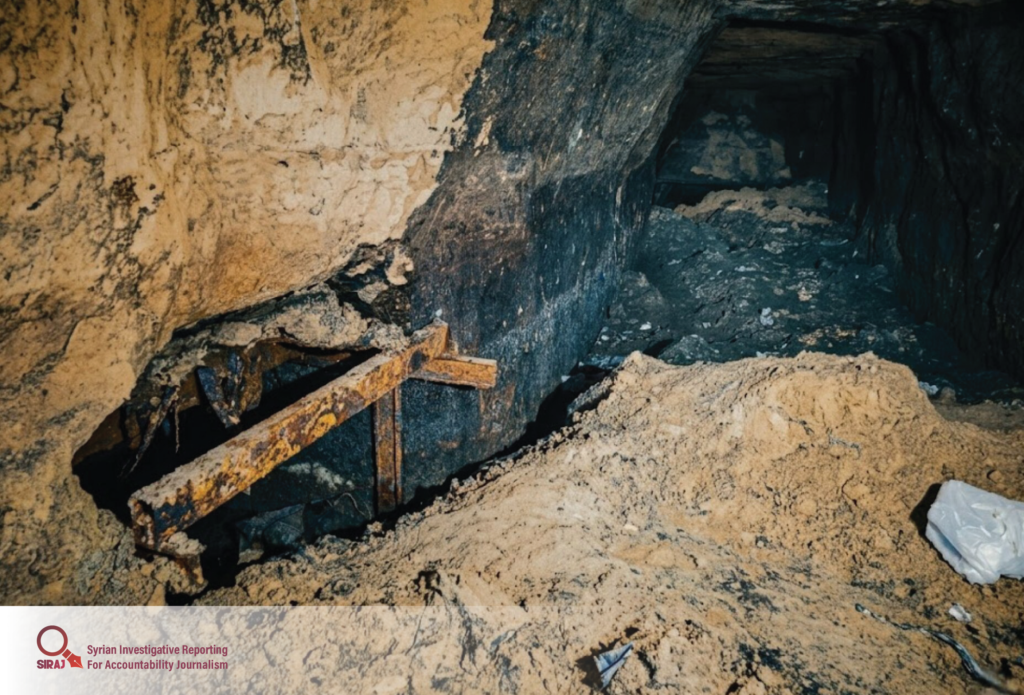
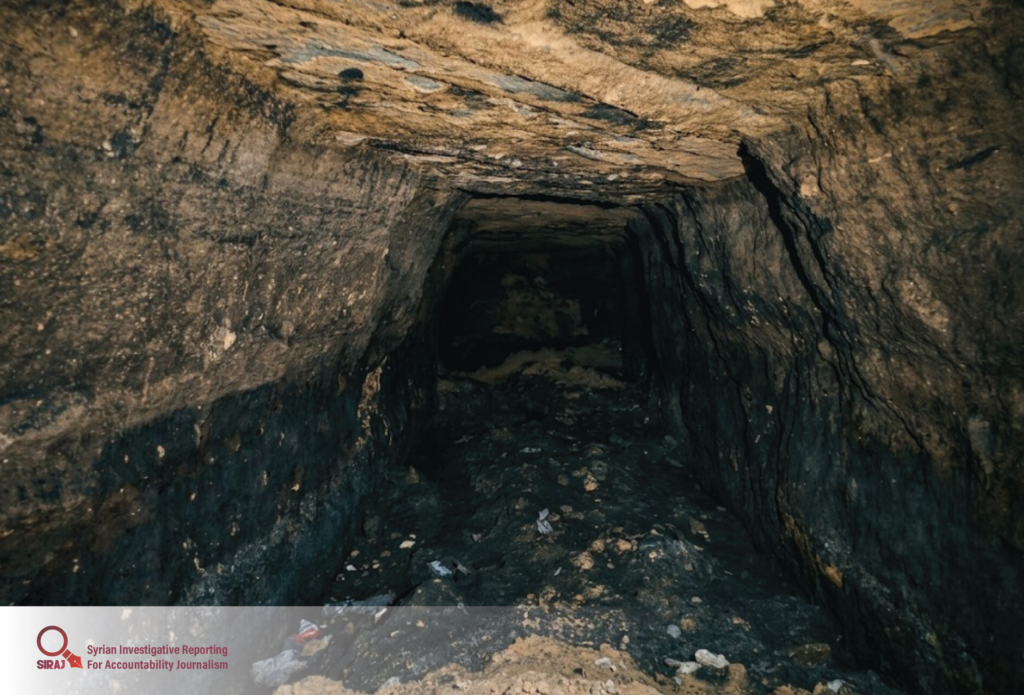
According to Salam, many of the tunnels lie 10 to 12 meters (33 to 40 feet) below ground and extend for long distances.
“We’re not afraid of the tunnels themselves,” he said. “Had Assad’s forces not stripped out their steel reinforcement, they might even have become tourist attractions—or another means of transportation.”
Instead, he argues, the way the former regime dealt with the tunnels made their collapse almost inevitable.
“When the regime removed the reinforcing steel, the surrounding soil began to cave in. The collapse eventually reached the sewer network. The pipes lost their support, leaving them suspended with space beneath them.”
Once the pipes failed, sewage began pouring into the abandoned tunnels, accelerating erosion below ground.
That process, Salam says, has increased the risk not only of further tunnel collapses but also of damage to buildings above them.
It has also created a new environmental hazard.
“During periods of heavy rainfall, groundwater levels rise and mix with sewage,” he said, raising concerns about contamination of underground water sources.
Dr. Nidal Jouni, a professor of geology and seismology at the University of Damascus, says the removal of steel reinforcement has a direct impact on tunnel stability.
“If tunnels were not excavated according to proper engineering standards,” he said, “removing the steel significantly weakens their structural integrity, increasing the likelihood of collapse and causing the overlying ground to subside.”
Ahmad Saryoul, a resident of Douma who lived through both the siege and the subsequent takeover by Assad’s forces, says the regime troops deliberately destroyed the major tunnels connecting Eastern Ghouta to Damascus after recapturing the area.
Smaller tunnels, however—including those inside towns and villages that had been used to transport wounded civilians—were largely left untouched.
“The authorities left those for residents to deal with,” he said.
Most families, he added, are already struggling simply to repair their damaged homes.
“They’re asking the government and aid organizations to help rebuild their houses,” he said. “So how can they possibly afford to fill in underground tunnels—especially when their homes are sitting on top of tunnels that could collapse at any time?”
The danger often remains hidden until chance reveals it.
Abu Nimer, a shepherd from Eastern Ghouta, recalls losing one of his goats and spending hours searching for it.
As he walked along a nearby stream, he heard the animal bleating.
Following the sound through dense vegetation, he eventually found the goat trapped inside a water channel.
Only then did he realize that an abandoned tunnel lay concealed beneath the riverbed—another unseen remnant of the siege, still hidden beneath the landscape years after the war.
Tunnels Without Maps
When sinkholes linked to Eastern Ghouta’s underground tunnels appear, the most obvious solution seems straightforward: those who dug the tunnels should fill them in.
Today, however, that solution is largely impossible.
Many of those who excavated the tunnels are no longer alive. Others remain outside Syria. And even among those who have returned, many no longer know precisely where the tunnels lie. Years of military operations after Assad’s forces recaptured Eastern Ghouta in 2018, coupled with the deliberate sealing of many tunnel entrances, fundamentally altered the landscape.
A former commander in the JAI—who requested anonymity because he now works for Syria’s Ministry of Defense and is not authorized to speak to the media—said it was the former regime that ultimately erased many of the tunnels’ identifying features.
“The regime approached the tunnels strictly as a security issue, not as infrastructure that people would one day have to deal with,” he said.
“They were afraid opposition fighters might still be hiding inside them. They didn’t care if a building collapsed as a result.”
After spending more than eight years displaced in northern Syria, he said, returning to Eastern Ghouta revealed just how dramatically the terrain had changed.
“When we came back, we realized the landscape was completely different. The situation is extremely dangerous. At any moment, a building could collapse, and people could be killed or seriously injured.”
He added that many tunnels were dug haphazardly during the early years of the siege. Only later did local municipal bodies establish a formal licensing process intended to regulate excavation and improve safety.
“By then,” he said, “it was already too late.”
A Patchwork of Underground Networks
According to Imad al-Ajwa, mayor of Douma, one of the greatest challenges today is that no single entity ever built—or documented—the entire tunnel system.
“The tunnels were constructed by multiple parties,” he told SIRAJ and Daraj. “Some were dug by opposition factions, others by humanitarian organizations, and many by civilians.”
As a result, no comprehensive map exists.
To address the problem, Douma’s municipality has begun assembling what officials describe as the nucleus of a centralized database.
The effort combines whatever historical records remain—many dating back nearly eight years—with interviews involving residents and former tunnel builders who may still remember where underground passages were excavated.
At the same time, municipal teams are identifying the areas believed to face the greatest immediate risk to prioritize field inspections.
A similar effort is underway in Ain Tarma.
Mayor Wael Salam said municipal officials have been contacting former opposition fighters who have returned from Idlib in an effort to reconstruct the tunnel network from memory.
“So far we’ve been able to map roughly 60 percent of the tunnels,” he said.
He added that officials have repeatedly heard claims that Russian forces produced tunnel maps after the regime recaptured Eastern Ghouta.
“We’ve been told those maps were drawn by the Russians and kept in government offices,” Salam said. “But we’ve never received them. We don’t even know whether they actually exist. They may have ended up in one of the regime’s intelligence branches—or perhaps they never existed at all.”
Russia announced that Assad’s forces had regained full control of Eastern Ghouta on April 12, 2018, following the evacuation of the last opposition fighters from Douma, their final stronghold in the region, and the deployment of Russian military police.
The former JAI commander, however, doubts Russian forces ever produced a complete mapping of the tunnel network.
“They entered only the major strategic tunnels,” he said, citing one leading toward Harasta Suburb, another in Zamalka, and the large underground medical facility in Douma known as Point One.
The SIRAJ and Daraj investigative team contacted the Russian Embassy in Damascus by email seeking confirmation of whether such maps exist, but received no response by the time of publication.
Searching for What Has Been Lost
Samir Bouydani, who briefly served as mayor of Douma after the area’s liberation, said he contacted the engineer responsible for the JAI’s military tunnels during the siege.
According to Bouydani, the former engineer told him the faction had lost its tunnel maps during the displacement from Eastern Ghouta.
Bouydani said he later approached the Ministry of Defense, where officials likewise informed him that any remaining maps had disappeared during the displacement process.
He also criticized the way Assad’s forces handled the tunnels after retaking the area.
Using the underground medical complex known as Point One as an example, Bouydani said the facility originally had three entrances, but government forces sealed two of them.
Without maps—and after much of the steel reinforcement had been stripped—the remaining sections became extremely difficult to access safely.
A Complex Engineering Challenge
In response to questions from the SIRAJ and Daraj team, the Media and Communications Directorate of Syria’s Ministry of Emergency and Disaster Management described the tunnel issue as “highly complex.”
The ministry said the region contains multiple categories of underground structures: large strategic tunnels, smaller passageways, vehicle tunnels, building-to-building connections, underground medical facilities, and numerous tunnels excavated independently by civilians—many of which were never documented.
Because of that complexity, officials say producing an accurate map of the underground network now requires coordination among four institutions:
- the Ministry of Emergency and Disaster Management,
- the Ministry of Housing,
- the Syrian Engineers Association, and
- local municipal councils.
The investigation team was unable to obtain responses from representatives of the armed opposition factions that controlled Eastern Ghouta until 2018.
The former JAI commander acknowledged that even his faction possessed only partial documentation.
“Our maps covered only the areas under our control,” he said. “There was never a complete map of all the tunnels dug by the factions, institutions, and civilians. Given the conditions of war, no one can accurately account for the entire network.”
Technology: the Only Way Forward
According to Dr. Nidal Jouni, locating the remaining tunnels is still possible using modern engineering geophysical methods.
Technologies such as ground-penetrating radar (GPR) and seismic surveys, he said, can identify the location, direction, dimensions, and structural condition of underground voids.
“These techniques make it possible to map a tunnel’s extent and evaluate the risks it poses,” Jouni said.
He argues that authorities should undertake both short- and long-term geological and geophysical studies to determine the types of rock surrounding each tunnel, assess the likelihood of future collapse, and develop engineering measures capable of preventing further sinkholes before additional buildings—or lives—are lost.
A Mere Emergency Measures
For now, local authorities in Ain Tarma are relying on emergency repairs rather than permanent engineering solutions to address the growing number of sinkholes.
According to Mayor Salam, a comprehensive response remains beyond the municipality’s financial and technical capacity.
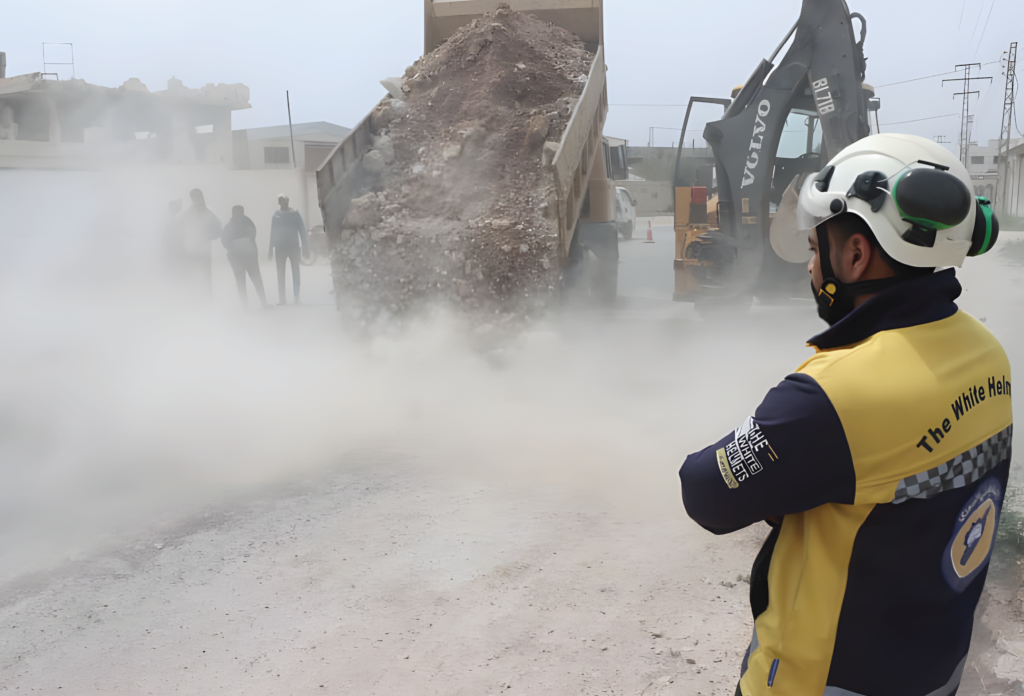
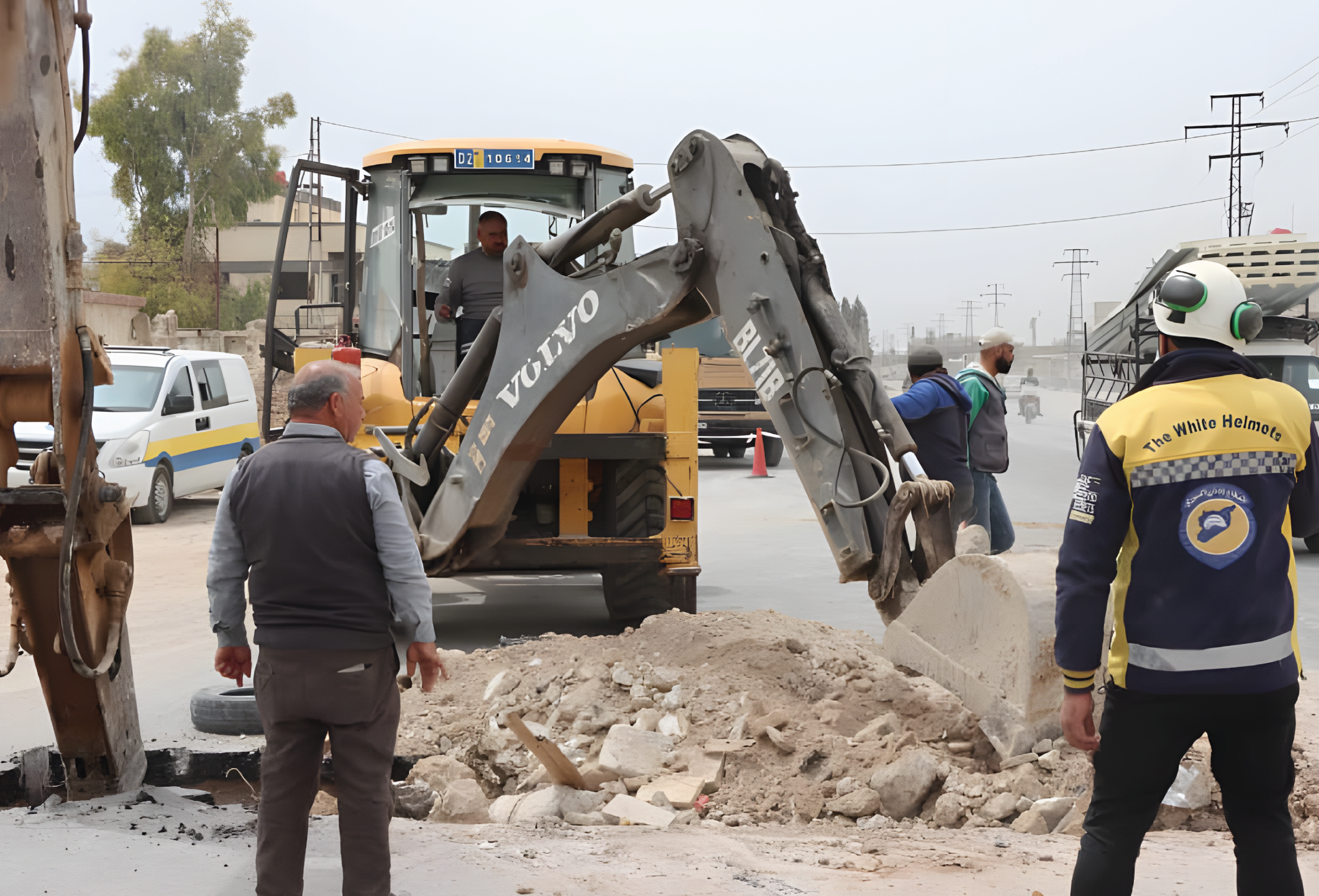
“When a sinkhole appears, we widen the opening slightly and fill it,” he said. “My priority is protecting the infrastructure—making sure the road doesn’t collapse again and safeguarding the sewer, telephone, and electricity lines. We reinforce the area with solid materials and asphalt, but I can’t fill an entire tunnel that runs beneath residential buildings.”
Meanwhile, the municipality is waiting for funding from the Damascus Countryside Governorate to implement a more substantial intervention.
The proposed plan focuses on five locations where tunnels intersect with the sewer network. At each site, crews would excavate down to the tunnel level, pump out accumulated wastewater, fill the cavity with engineered materials designed to prevent future collapses, and then rebuild the damaged sewer, water, electricity, and telecommunications infrastructure before resurfacing the road.
Officials in Douma face similar financial and technical constraints.
Imad al-Ajwa, the city’s mayor, said that only days before speaking with the SIRAJ and Daraj investigative team, new sinkholes appeared above former military tunnels behind Douma Municipal Stadium.
Those tunnels, he said, had once been reinforced with steel that was later stripped by Assad’s forces.
“Every time a collapse occurs, we provide a temporary engineering solution,” al-Ajwa said. “But we don’t have the funding to enter and stabilize the entire tunnel network. We also don’t have the specialized personnel—and I’m not going to risk my workers’ lives.”
He believes the region narrowly escaped a much larger disaster.
“Last year wasn’t a year of drought—it was actually a blessing,” he said. “If we had experienced heavy rainfall immediately after liberation, the situation could have been far worse.”
The Ministry of Emergency and Disaster Management says it is operating under similar limitations.
According to the ministry’s Media and Communications Directorate, current efforts are based primarily on incident reports and emergency response, with teams intervening only after sinkholes or structural collapses are reported.
Officials pointed to a recent operation in Douma, where several tunnels were filled in cooperation with the municipal council and the Syrian Engineers Association.
But ministry officials stress that filling abandoned tunnels is far more complex than simply dumping soil into an underground void.
“Large tunnels cannot be filled arbitrarily,” the ministry said. “The process requires pumping specialized concrete and carefully protecting building foundations under the supervision of engineering teams. Filling a tunnel is nothing like filling an ordinary hole.”
Homes Above Hidden Voids
According to Aghiad Othman, deputy mayor of Douma, backfilling sinkholes with ordinary soil is ineffective because the ground is likely to subside again.
Instead, municipal engineering teams excavate each collapse site as necessary before stabilizing it.
“But we’re treating the sinkhole—not the entire tunnel,” Othman explained. “Even when we discover an underground passage, we notify the governorate because dealing with the full tunnel requires heavy equipment and specialized engineering methods.”
The greatest concern, he said, is when tunnels pass directly beneath building foundations.
Those cases require special structural intervention.
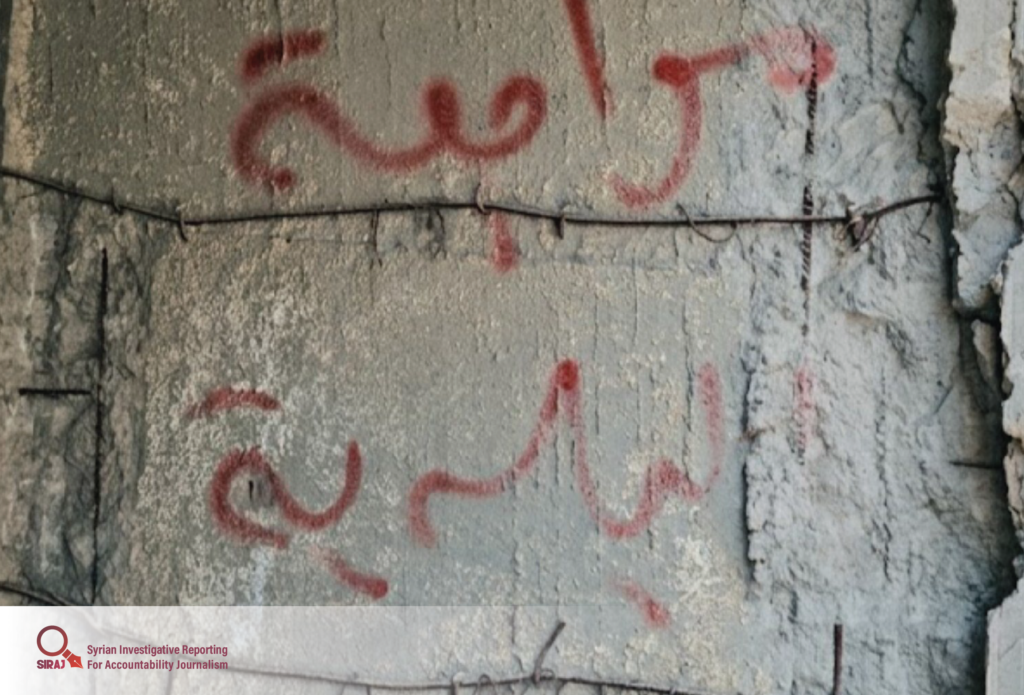
As a precaution, the municipality has begun issuing evacuation notices for buildings considered at immediate risk.
According to Othman, two residential buildings were evacuated only recently.
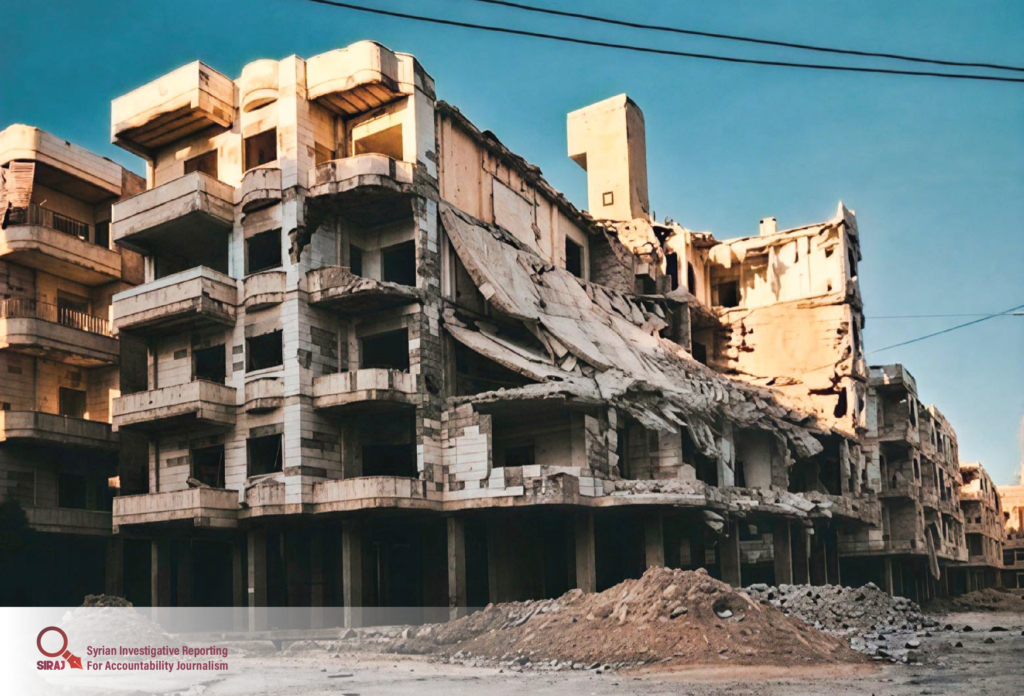
In Ain Tarma, Mayor Salam estimates that around 50 buildings are situated above underground tunnels.
Municipal authorities have placed legal restrictions on those properties, preventing their sale or transfer, and have urged residents to leave.
Many, however, have refused. They simply cannot afford to.
One of them is Abu Mohammad, an elderly resident who discovered a void beneath his apartment building while renovation work was underway.
Despite the warning signs, he chose to continue the work.
“I need to get my son married,” he said. “Our home is still better than paying rent.”
Then, with visible frustration, he added: “We’ve already started, and we’re going to finish. If the building collapses, may God have mercy on us.”
For Abu Mohammad, leaving is not an option unless an alternative home is provided.
“This is our house—we’re not abandoning it,” he said. “If it’s dangerous, then let the municipality give me another home. We’re waiting for them to close the tunnel. We can’t afford to pay for that ourselves. We’re barely surviving as it is.”
Some residents have attempted to solve the problem on their own by filling cavities beneath their homes.
Mayor Salam acknowledges that no one knows whether such efforts are actually effective.
“We don’t really know the correct engineering method. Is pouring concrete into the tunnel enough? We’ve never dealt with a problem like this before.”
He argues that Syria urgently needs specialized engineering units dedicated to tunnel stabilization and structural rehabilitation—not only for abandoned tunnels but also for buildings damaged during the war.
“There should be a dedicated restoration authority,” he said, “so that the people carrying out these repairs know they’re doing them correctly.”
As winter rains have exposed the hidden tunnel network beneath Eastern Ghouta, officials warn that the coming summer may bring a different threat: foul odors, rodents, and worsening public health conditions as damaged sewer systems continue leaking underground.
For now, residents can do little more than wait—uncertain how long it will take before permanent solutions replace temporary repairs.
- A version of this investigation was also published by Daraj Media
- Creative Production and Visual Design: Radwan Awad