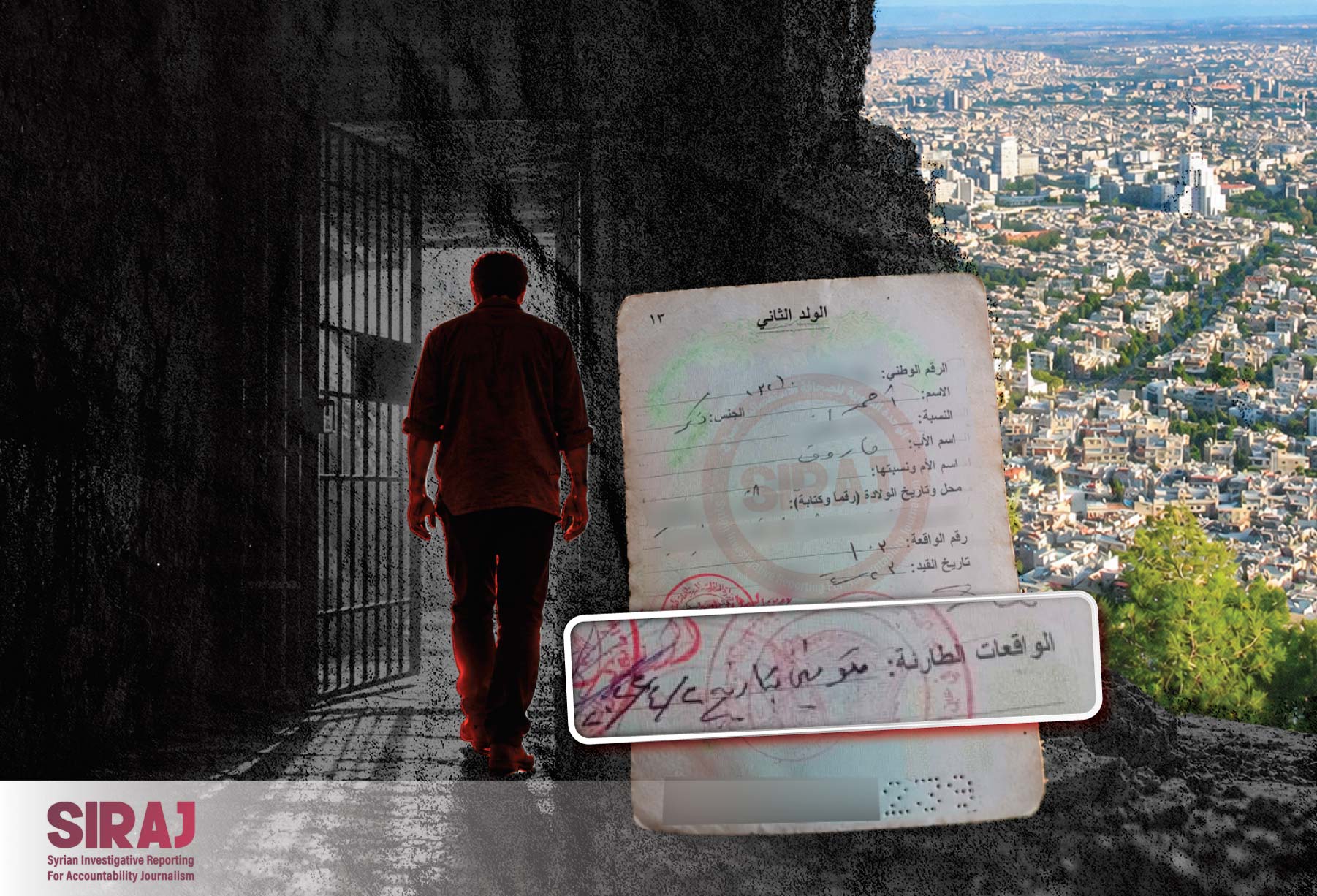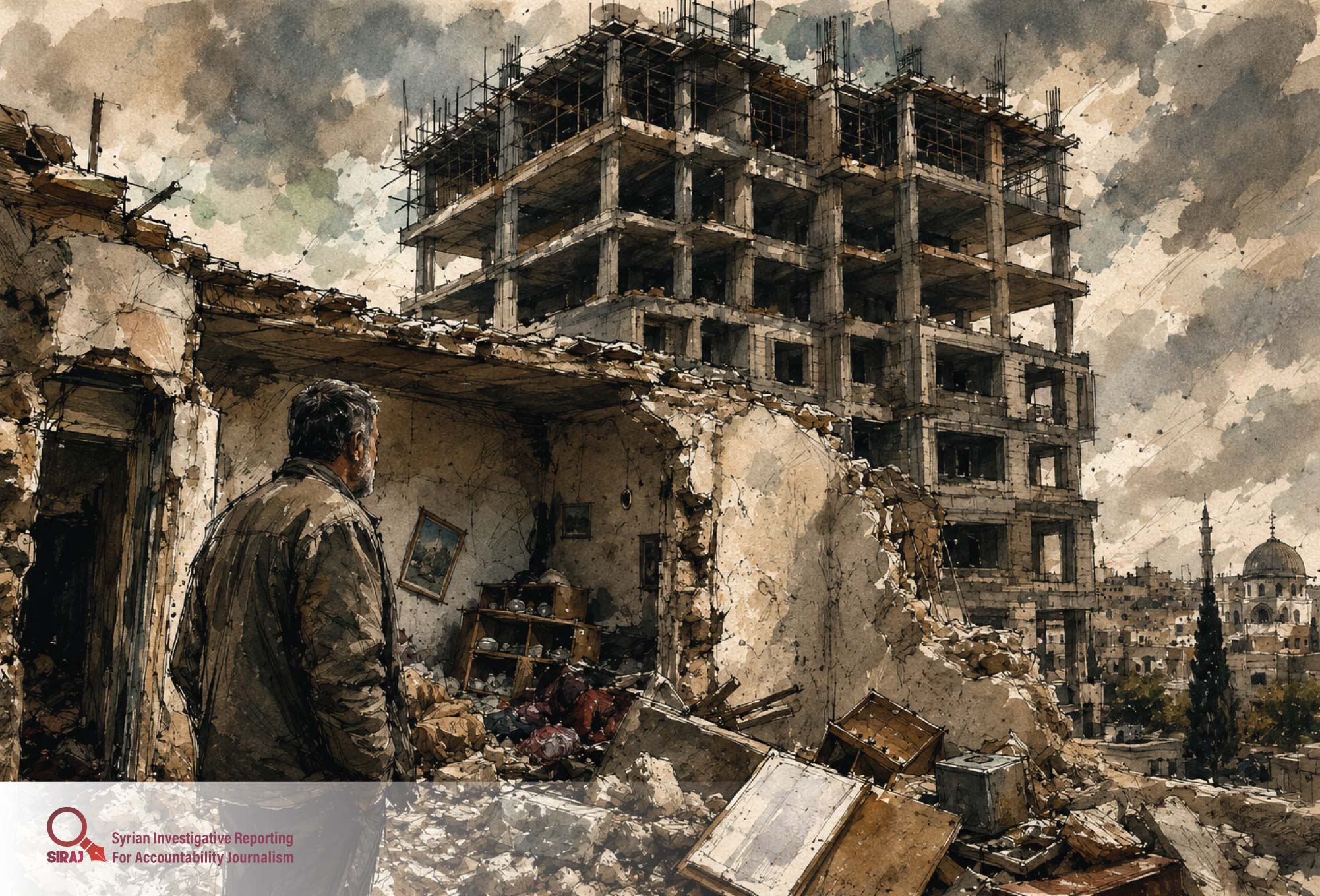


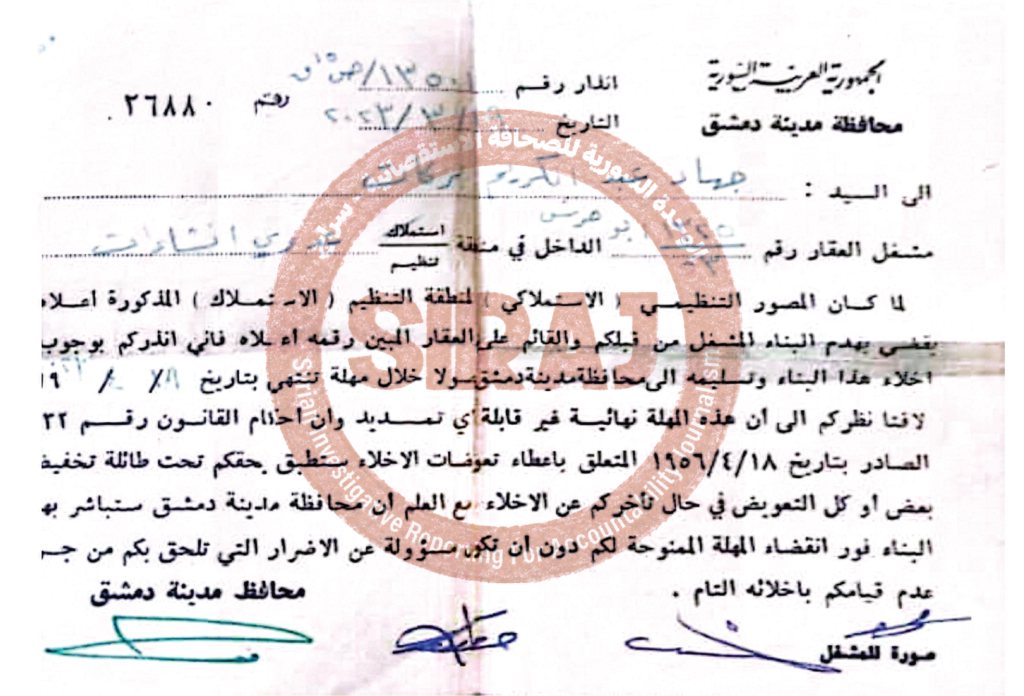
Before dawn on a cold spring morning in 2023, Jihad Barakat stood outside his home in Damascus’ Diwaniyah al-Jawaniyah neighborhood, watching municipal crews tear down the walls—along with the furniture and personal belongings he had not even had time to remove.
Weeks earlier, Barakat had received an eviction notice after businessman Mohammad Khair al-Halabi, the owner of Planning Parcel No. 36, pledged to provide him with a replacement apartment within the city of Damascus. The commitment was based on Decision No. 695/M.T., which regulates the allocation of grant housing to eligible occupants through the Damascus Governorate under specific conditions before residents are displaced.
“I turned down the cash compensation,” Barakat told the Syrian Investigative Reporting for Accountability Journalism – SIRAJ. “They offered me 25 million Syrian pounds, but I asked for a home in Damascus, just as the decision stipulates.”
He was later assigned an apartment in the Tabbaleh–Ain Tarma area. But upon inspection, he found its entire facade demolished, leaving it uninhabitable. Barakat recalled al-Halabi telling him at the time: “Fix it yourself. It’s only a few stones.”
After his home was demolished, he sought possession of the replacement apartment. Barakat, however, was asked to submit a family registry extract. He says he was then informed that two of his sons were wanted by Syria’s former Assad government for allegedly evading mandatory military service, and that the required security clearance for the apartment “could not be approved.”
“Al-Halabi told me, literally: ‘You’ve lost it, Abu Jihad. Besides, you’re classified as non-compliant.’”
As a result, the apartment allocation was canceled, and Barakat was placed on the governorate’s list of “non-compliant” applicants—a designation used by the Damascus Governorate for individuals who, according to its records, failed to complete the procedures for receiving compensation or alternative housing, or who declined the options offered within the legally prescribed timeframe.
Many of those affected reject that characterization. They insist they did not refuse alternative housing in principle, but rather objected to the conditions of delivery, the locations of the apartments, or their legal status and physical condition.
Some residents argue that the designation transformed what was fundamentally a dispute over housing rights and compensation into an administrative classification that effectively shut the door on any future efforts to pursue their claims.
Today, Barakat lives in a rented home in Damascus, paying about 2 million Syrian pounds (old currency)—roughly $150 a month. He says the cost far exceeds what he can reasonably afford as a construction laborer who depends on irregular daily wages.
A Permit That Reignited the Dispute
The roots of the current dispute in Diwaniyah al-Jawaniyah date back to mid-2022, when residents began receiving eviction and demolition notices. The notices came on the heels of amendments to Administrative Units Financial Law No. 37 of 2021, which imposed a deadline for holders of building permits who had not yet begun construction, requiring them to do so or risk having their permits revoked.
While some official documents list 32 occupied properties, others refer to 41 occupied units or 47 residential dwellings, indicating that dozens of families were ultimately displaced or became embroiled in disputes over eviction and compensation.
According to Mahmoud Hilal, Director of Urban Planning and Development at the Damascus Governorate, the owner of Planning Parcel No. 36 “reached settlements with and evacuated 42 families.” However, the Governorate officially recognized only 32 occupancies, arguing that only those cases met the criteria set out in the applicable urban planning directive.
Fourteen families interviewed for this investigation say the compensation they were offered fell far short of the market value of their homes or the realities of their financial circumstances.
Among them is Balqis al-Samakri, who received nine million Syrian pounds (old currency) in compensation for vacating her home. She described the payment as “charity.”
Another resident, Shahira Khadr Ghabn, said her entire house was demolished during the Assad era, even though only a small portion of the property fell within the boundaries of the disputed planning parcel.
“Al-Halabi refused to limit the demolition to the section inside the parcel,” she said. “The entire house was torn down.”
Ironically, the case returned to public attention after the fall of the Assad regime—not because the new authorities sought to resolve the legal disputes surrounding Planning Parcel No. 36, but for the opposite reason. The new government, through the Damascus Governorate, issued an additional construction permit allowing the project to expand vertically, despite ongoing objections from former residents and their continued demands for compensation.
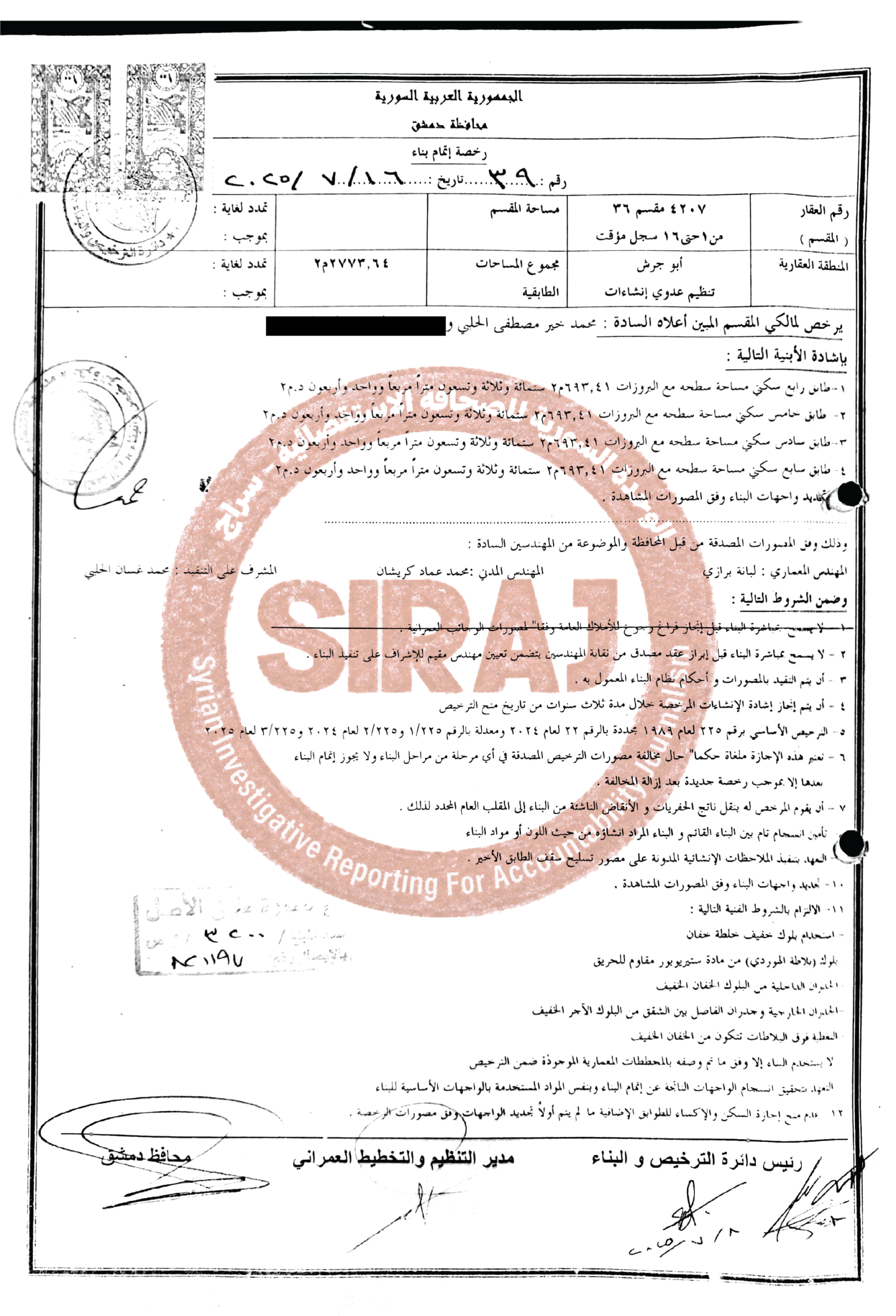
Documents reviewed by SIRAJ show that nearly two years after Barakat’s home was demolished—and just months after the fall of the Assad regime—the Damascus Governorate granted Mohammad Khair al-Halabi, on July 16, 2025, a Construction Completion Permit No. 39.
The permit not only authorized completion of the existing project but also allowed the developer to add four additional stories to the building.
That raises a central question: On what legal basis was Permit No. 39 issued? Did the Governorate rely on the applicable planning and construction regulations, or was the permit granted under interpretations and administrative procedures that exceeded the limits of the law?
Beyond the Legal Limit?
According to documents reviewed by SIRAJ, the approved zoning plan for the site limits development on Planning Parcel No. 36 to one basement, a ground floor, and three additional stories.
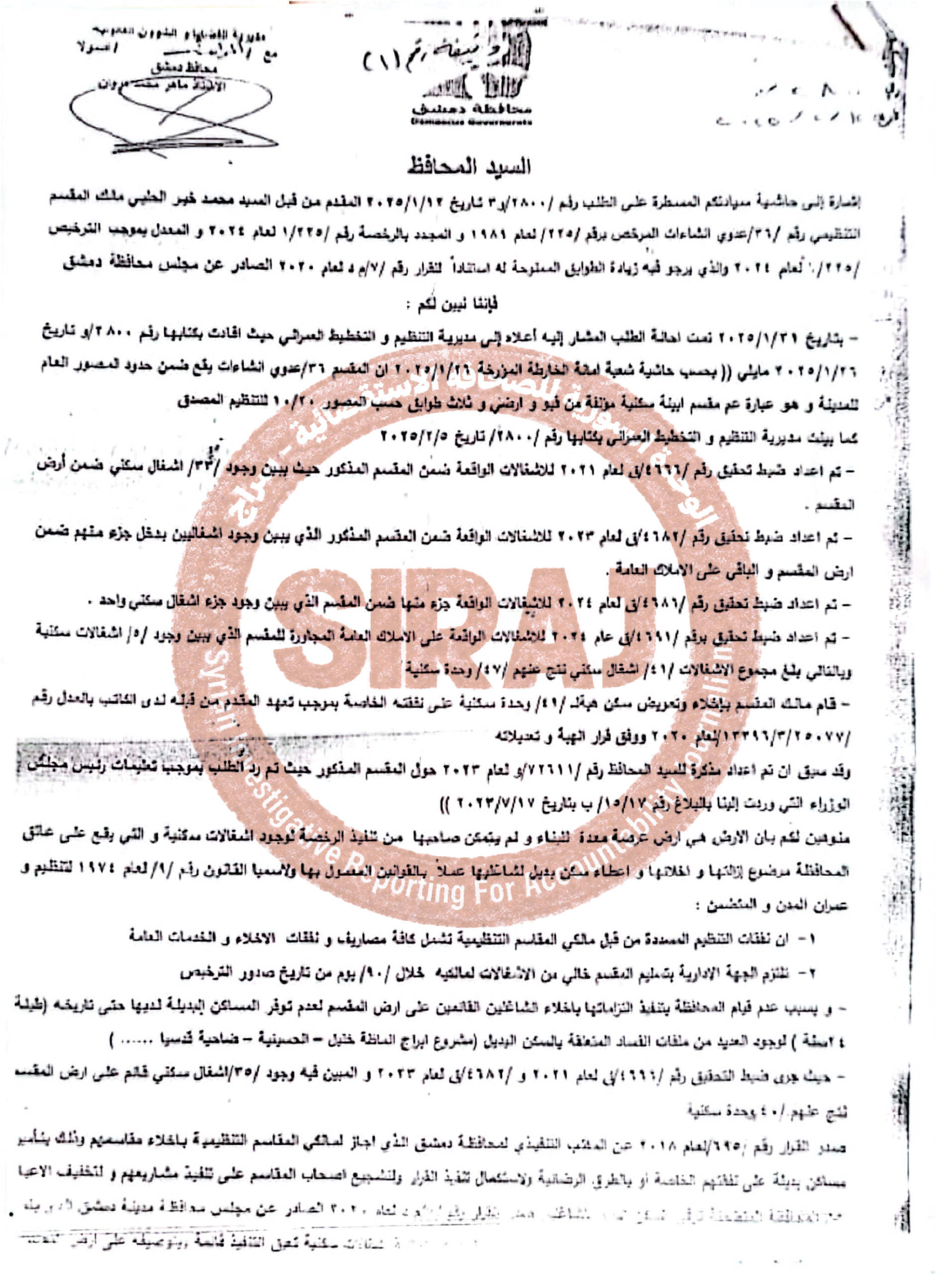
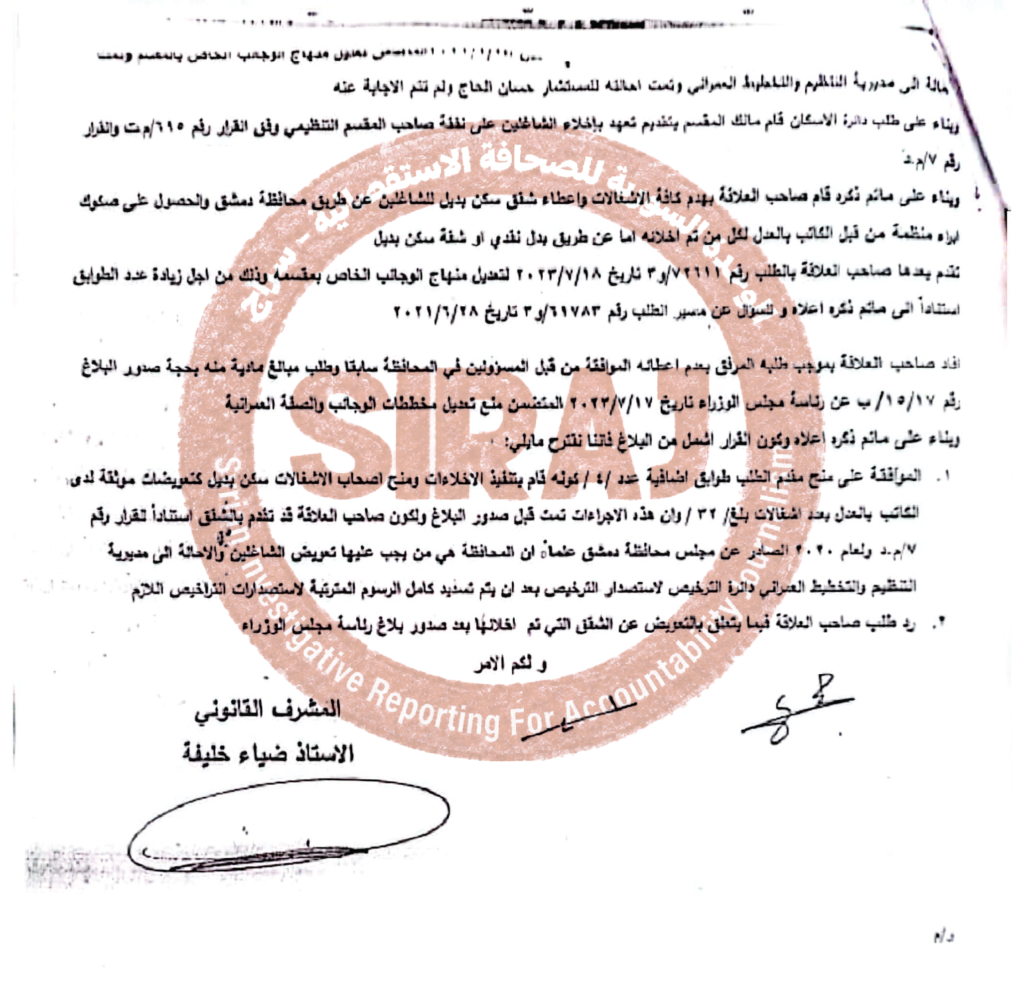
However, Memorandum No. 2800/W of 2025, prepared by Diaa Khalifa, the Damascus Governorate legal supervisor, recommended approving four additional stories, citing Decision No. 7/M.D of 2020 as the legal basis.
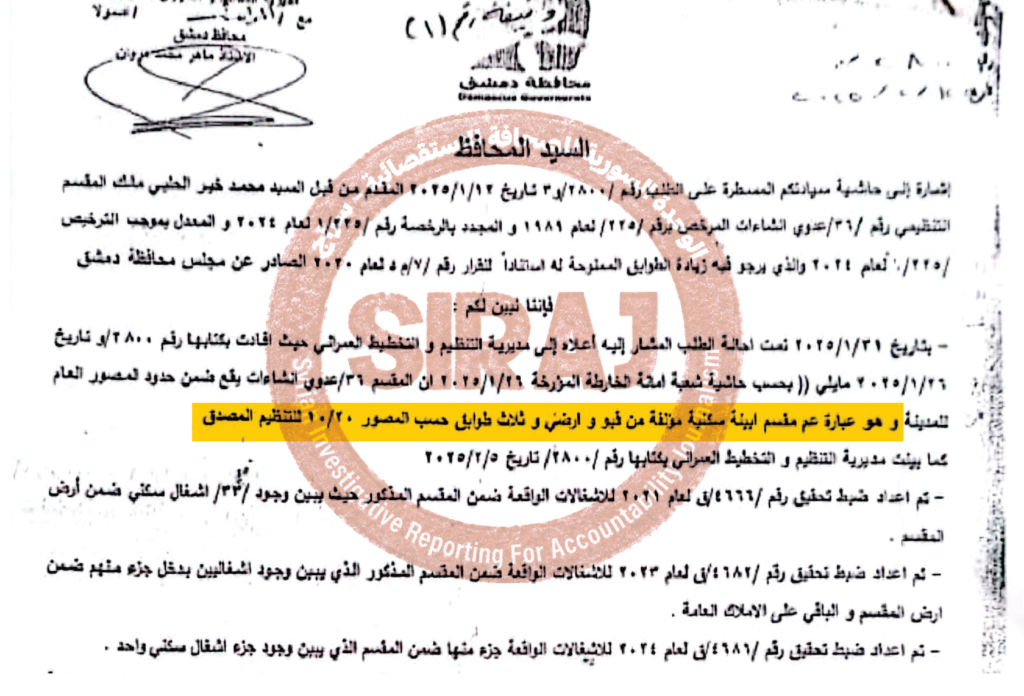
The same recommendation was echoed in Memorandum No. 20653/W, dated March 18, 2025, issued by the Complaints and Grievances Committee, chaired by Fadi al-Razzouq and established by the Damascus Governorate on January 8, 2025.
The committee concluded that the additional floors should be approved because the owner of the parcel had provided alternative housing for occupants and because the measure would reduce the financial and administrative burden on the Damascus Governorate associated with evictions and compensation.
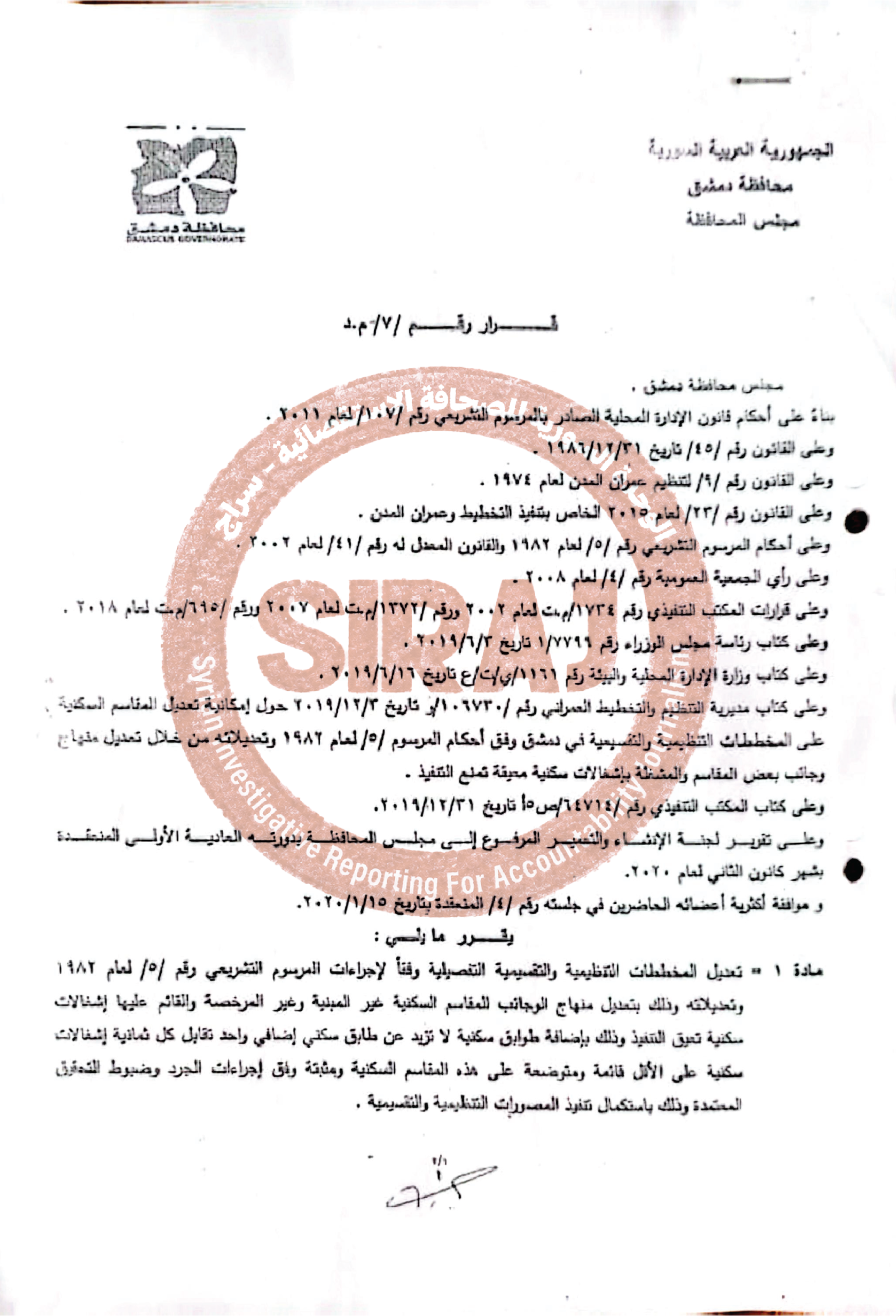
However, Decision No. 7/M.D—which became the primary legal foundation for Permit No. 39—has itself become the focus of substantial legal criticism.
Issued in 2020, the decision was intended to resolve the status of certain parcels within planned development zones and facilitate urban development projects that existing occupancies had stalled. Under specific conditions, it allows developers to receive additional planning incentives—including increased building heights or extra stories—in exchange for compensating occupants at the project site and completing construction in accordance with the approved zoning plan.
The committee concluded that the additional floors should be approved because the owner of the parcel had provided alternative housing for occupants and because the measure would reduce the financial and administrative burden on the Damascus Governorate associated with evictions and compensation.
However, Decision No. 7/M.D—which became the primary legal foundation for Permit No. 39—has itself become the focus of substantial legal criticism.
Issued in 2020, the decision was intended to resolve the status of certain parcels within planned development zones and facilitate urban development projects that existing occupancies had stalled. Under specific conditions, it allows developers to receive additional planning incentives—including increased building heights or extra stories—in exchange for compensating occupants at the project site and completing construction in accordance with the approved zoning plan.
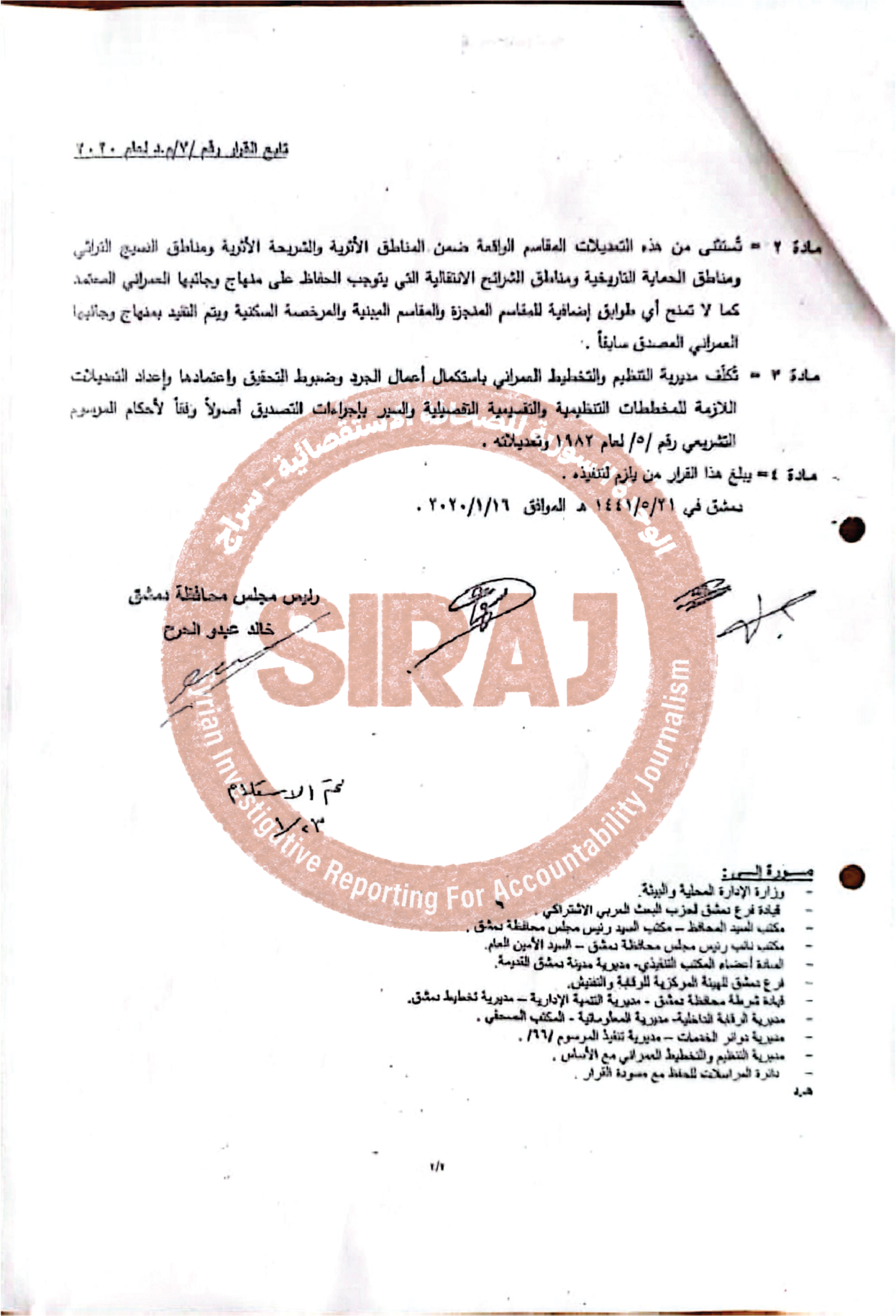
According to the documents reviewed by SIRAJ, those conditions do not seem to apply to Planning Parcel No. 36. The property has held a valid building permit since 1989, and that authorization was subsequently renewed through Permit No. 225/1 in 2024.
Documents and video footage recorded by affected residents also show that the site was not vacant land or an undeveloped project, but an existing building.
The legal dispute extends beyond Decision No. 7/M.D to its relationship with Legislative Decree No. 5 of 1982, which governs amendments to zoning plans, building envelopes, height restrictions, and permitted floor counts.
Under Article 5 of Legislative Decree No. 5 of 1982, any amendment affecting zoning regulations must follow a formal process that includes:
Public announcement of amendments to the general and detailed zoning plans.
Display of the revised plans at the administrative authority—in this case, the Damascus Governorate
A 30-day public objection period.
Review by the Regional Technical Committee
A formal decision on submitted objections.
Only after those procedures have been completed can Decision No. 7/M.D be applied to authorize additional floors.
In urban planning terms, increasing a building’s height or adding stories constitutes an amendment to the property’s building envelope and planning parameters, rather than a routine administrative adjustment.
According to attorney Nabil Hussein, Decision No. 7/M.D “conflicts with Legislative Decree No. 5 of 1982 and its amendments unless the procedures required by the decree—including public notice, publication of the amendments, and an opportunity to file objections—are fully implemented.”
An internal document obtained by SIRAJ appears to reinforce that interpretation.
In a letter dated March 9, 2025, the Directorate of Urban Planning and Development instructed the Complaints and Grievances Committee that the provisions of Legislative Decree No. 5 must be applied before approving any increase in building height, raising questions about the legal basis on which the permit was ultimately granted.
Nevertheless, only days later, the committee issued Memorandum No. 20653/W, recommending approval of the additional stories and directing the Directorate of Urban Planning and Development to complete the licensing process.
The legal controversy does not end there.
The Committee also appears to have overlooked Prime Ministery Circular No. 17/15/B, issued in 2023, which suspended approvals for amendments increasing the number of building stories. According to official records, that suspension remained in force until it was lifted in June 2026 by the General Secretariat of the Presidency.
Yet the documents reviewed by SIRAJ indicate that officials justified issuing the permit by arguing that Decision No. 7/M.D was “broader in scope” than the Prime Ministery Circular.
Responding to SIRAJ’s questions, Mahmoud Hilal, Director of Urban Planning and Development at the Damascus Governorate, argued that applying the Circular literally “would effectively halt reconstruction,” adding that “most building permits would be frozen” under such an interpretation.
He said the Circular had originally been issued to address urban planning violations and that the governorate sought to balance regulatory restrictions with the practical demands of post-war reconstruction.
Legal experts interviewed for this investigation maintain, however, that a Prime Ministery Circular carries greater legal authority than a local administrative decision and therefore takes precedence unless it is formally repealed by a subsequent circular—which, they note, did not occur until June 2026.
Belated Amendment
Documents reviewed by SIRAJ indicate that the technical committee later cited by the Damascus Governorate to justify amending the building envelope regulations (Manhaj al-Waja’eb) for Planning Parcel No. 36 was established under Decision No. 2768, issued on June 2, 2025—more than a month before Construction Permit No. 39 was granted on July 16, 2025.
According to the documents, the committee met and discussed amendments to the zoning plan before the issuance of Decision No. 61/M.T on February 1, 2026, which formally approved the amendment to the building envelope regulations pursuant to Legislative Decree No. 5 of 1982 and its amendments.
In Syrian urban planning, “waja’eb” refers to the mandatory setback areas within a property where construction is prohibited. The building envelope regulations (Manhaj al-Waja’eb) define the technical parameters governing development, including the building footprint, permissible construction area, maximum height, and the number of stories allowed.
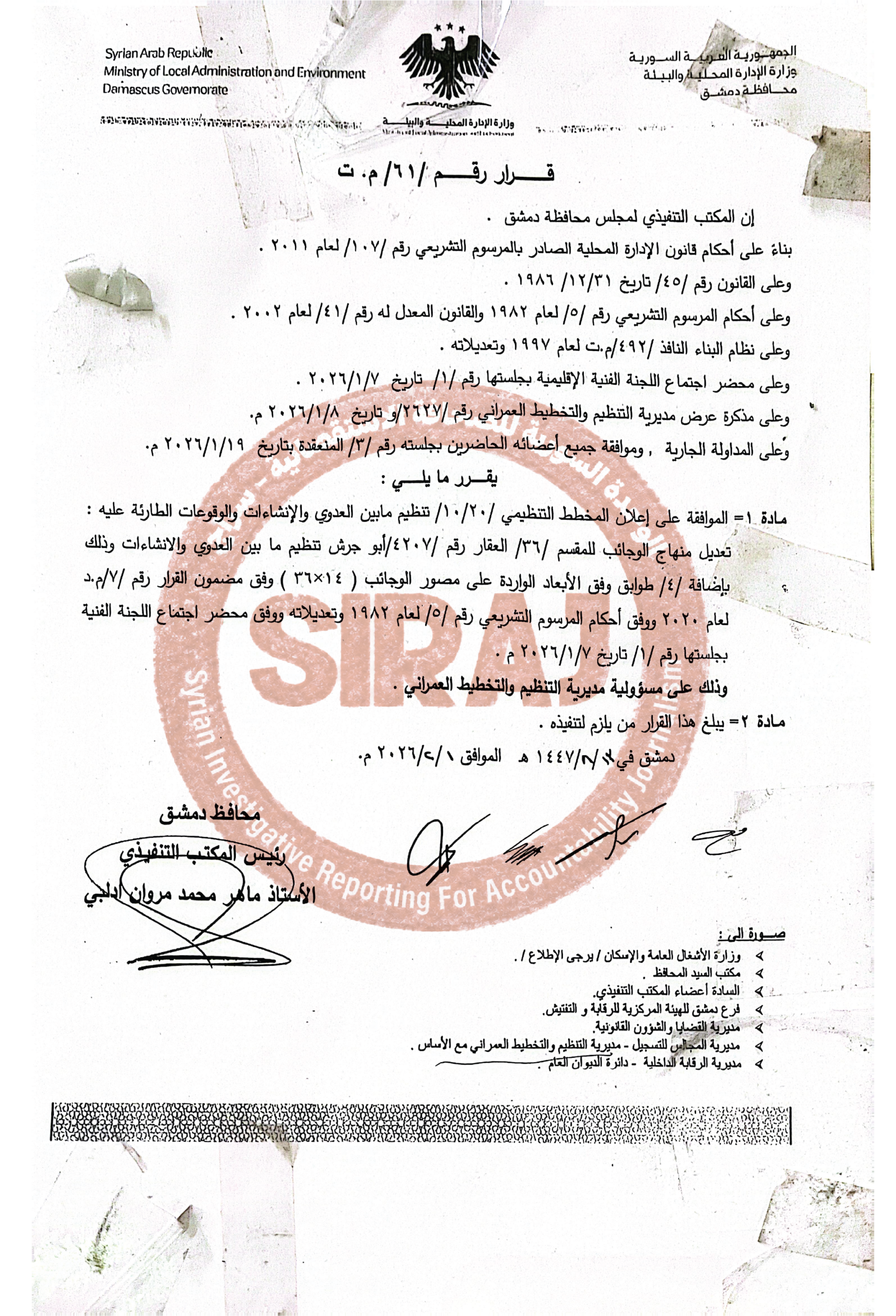
The sequence of events, however, raises significant legal questions.
Legislative Decree No. 5 of 1982 requires that objections to amendments of zoning plans be reviewed by a Regional Technical Committee consisting of seven members chaired by the governor.
Documents obtained by SIRAJ, however, show that the body which reviewed the file was not that committee. Instead, it was a 12-member committee, also chaired by the Governor, established before the zoning amendment and before the issuance of the decision that later relied on the same decree.
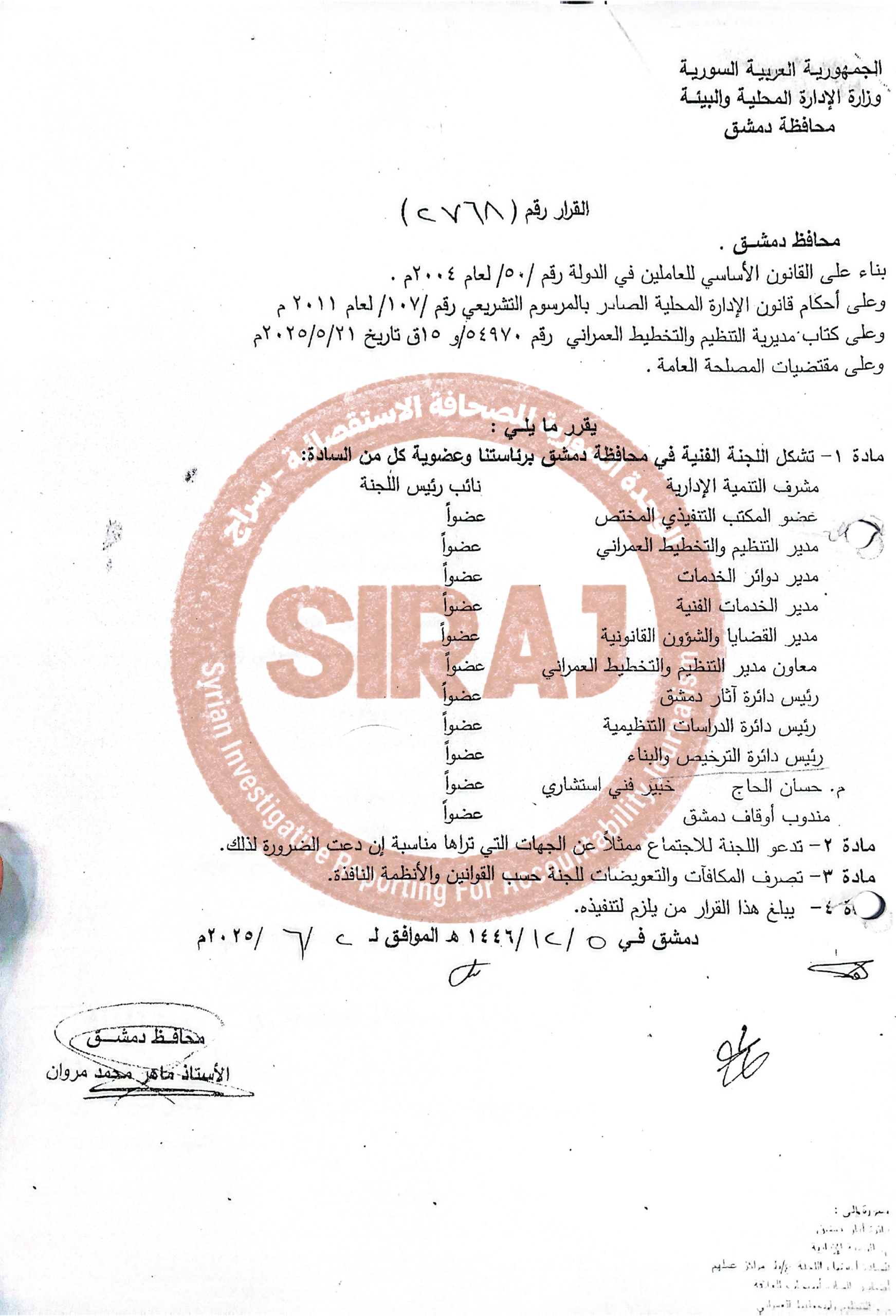
Decision No. 2768 of 2025 establishing the technical committee chaired by the Governor of Damascus
This raises a central legal question: If the Committee created under Decision No. 2768 was not the Regional Technical Committee required by Legislative Decree No. 5, on what legal basis was the building envelope amended? And how could Decision No. 61/M.T rely on the decree before the procedures it mandates had been completed?
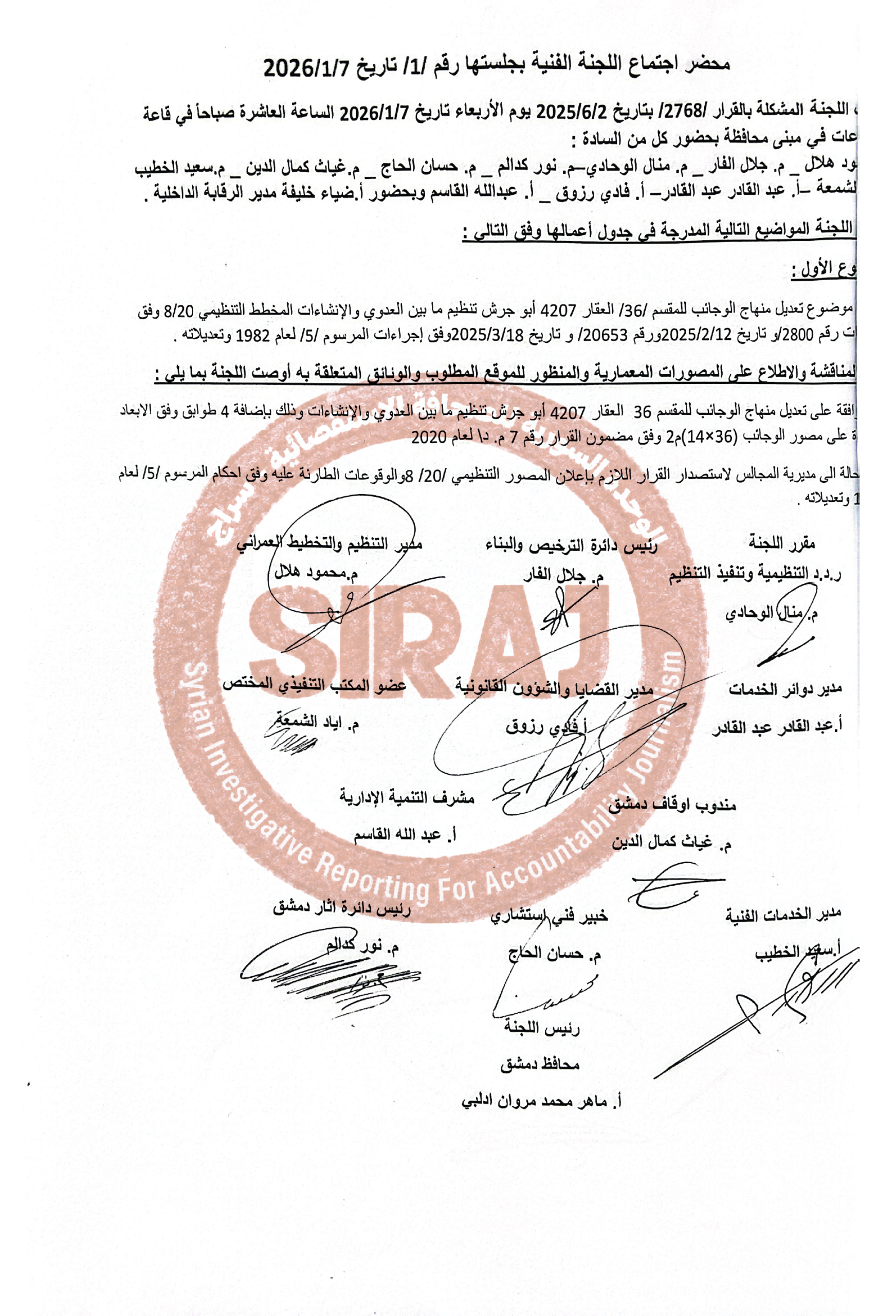
Minutes of the Technical Committee meeting discussing zoning amendments before the formal planning decision was issued
Attorney Ali al-Jundi said that while administrative authorities are entitled to amend zoning plans, such amendments must be carried out in accordance with the procedures established under Legislative Decree No. 5, including notifying the Ministry of Housing.
“The administrative authority has the right to amend the zoning plan as it sees fit,” al-Jundi said. “But the amendment cannot be used to legitimize an earlier legal violation.”
Attorney Nabil Hussein offered an even stronger legal assessment.
“Under established jurisprudence of the Council of State, any administrative decision issued without a valid legal basis is legally void,” he said. “A void decision cannot be cured or revived by subsequent actions.”
The documents also reveal a discrepancy between the Committee that reviewed the case and the Committee prescribed by law.
While Decision No. 2768 established a 12-member technical committee, including the Governor of Damascus, Legislative Decree No. 5 designates a seven-member Regional Technical Committee, also chaired by the governor, as the competent authority to approve amendments to zoning plans.
In an audio recording reviewed by SIRAJ, made during a meeting attended by Ibrahim Kouki, Director of the Damascus Governorate’s Media Directorate, Mahmoud Hilal, Director of Urban Planning and Development, acknowledged that the procedures and decisions adopted later were intended to correct an earlier mistake in the case file.
That acknowledgment appears to contradict the official narrative portraying the subsequent measures as part of a routine planning process. It raises further questions about whether the later amendments were required from the outset under existing law—or whether they were introduced to remedy legal deficiencies associated with the original issuance of Permit No. 39.
Compensation for displaced residents also appears to have been far more than a secondary administrative issue.
It formed one of the principal justifications for granting the project four additional stories.
Paragraph (d) of Decision No. 7/M.D allows developers to receive an additional floor in exchange for compensating eight occupants displaced by a project.
But according to documents and residents’ testimonies reviewed by SIRAJ, the treatment of occupants varied considerably. Some received financial compensation, others were allocated replacement housing, while several affected residents say they received no compensation at all, or that the compensation offered was inadequate or never fully processed.
A New Cause of Dispute
Alongside the legal and regulatory controversy surrounding Permit No. 39, the Damascus Governorate established a local committee whose stated purpose was to coordinate between residents, government agencies, and the developer, while helping resolve outstanding issues related to replacement housing, compensation, and unresolved claims.
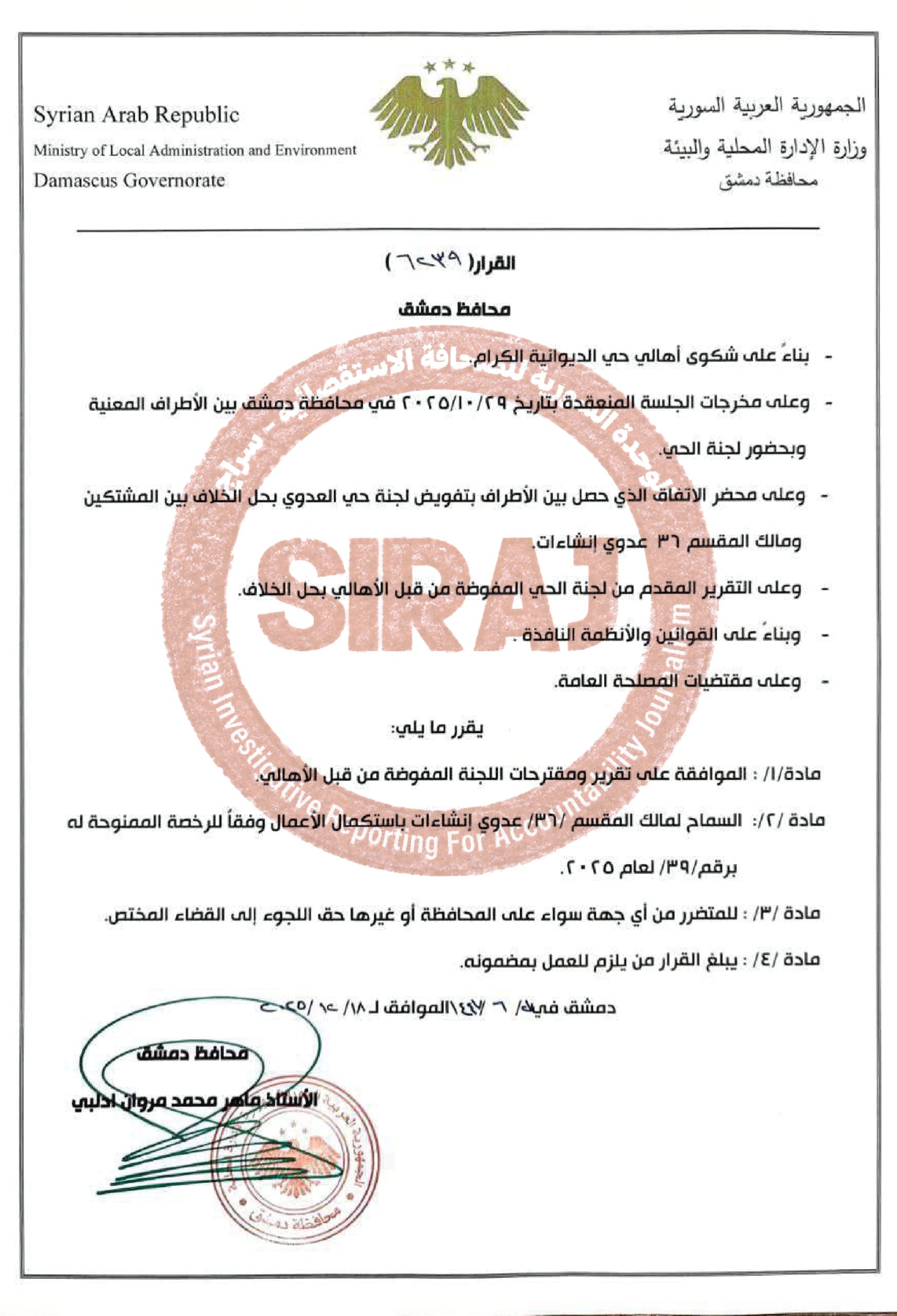
Residents interviewed by SIRAJ, however, describe the committee very differently.
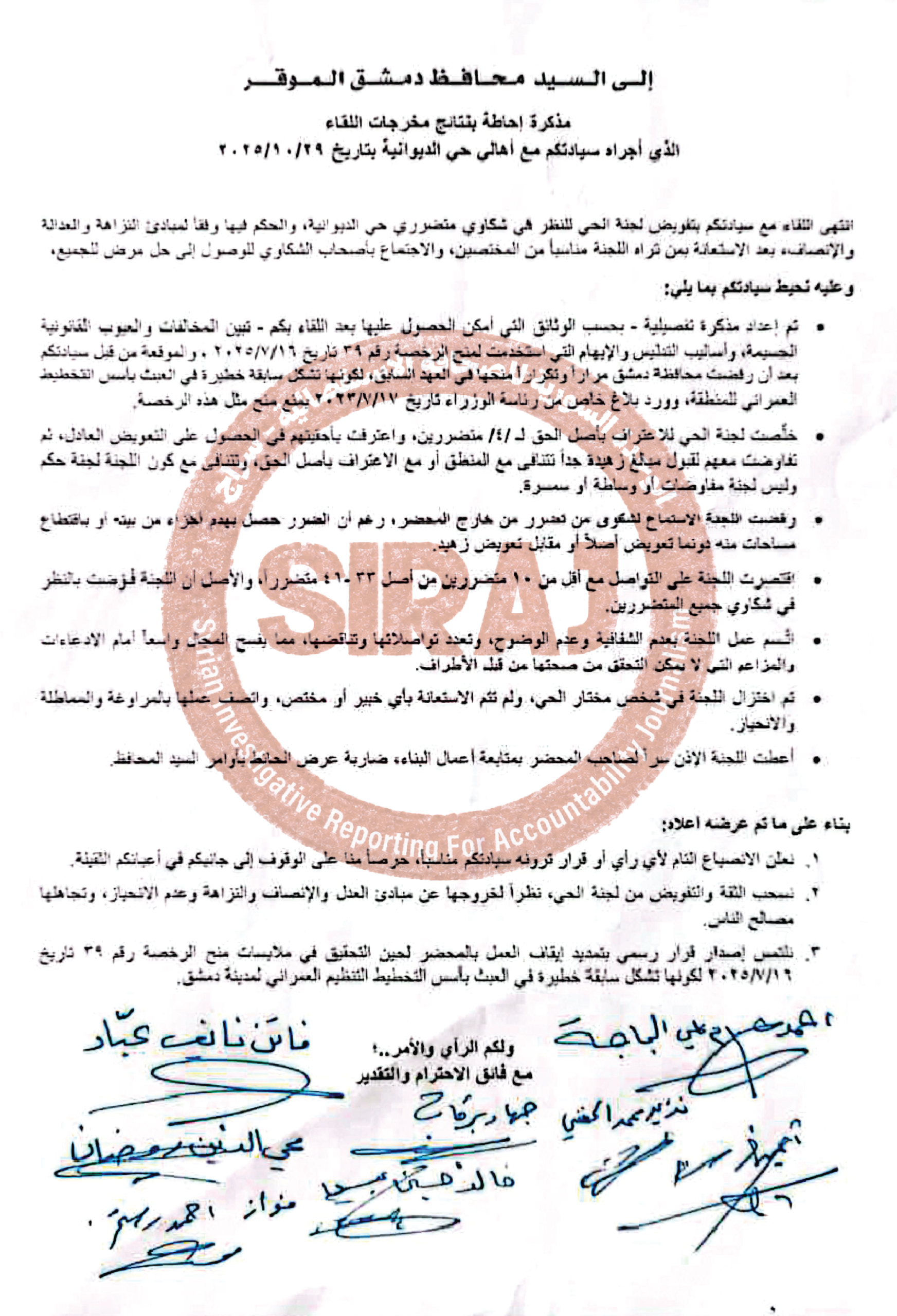
In a memorandum submitted to the Governor of Damascus in October 2025, several residents said the committee failed to hear from all affected families, limiting its review to only a small number of cases.
Some residents argue that, in practice, the Committee became a mechanism for managing the dispute rather than serving as an independent body to resolve it.
Jihad Barakat said the committee initially offered several displaced families replacement apartments in the Barzeh Housing Complex. The proposal was later withdrawn after one resident challenged the legal status of the properties, arguing that ownership was based on a court judgment rather than a final registered title deed.
According to Barakat, the objection resulted in the entire process being frozen for all remaining families without consultation or the presentation of alternative housing options.
Several residents also told SIRAJ that the Committee relied primarily on the neighborhood mukhtar (local administrative head) to assess individual cases, without involving independent legal or technical experts. Some viewed this as evidence that the Committee did not provide balanced representation for all parties affected by the project.
In response to SIRAJ’s questions, the Damascus Governorate said the remaining cases are legally classified as “non-compliant applicants” because the individuals failed to complete the required procedures within the legally prescribed deadline. The Governorate added that it would implement any court rulings issued in their favor in the future.
The Developer’s Response
The SIRAJ investigative team contacted Anas al-Halabi, son of businessman Mohammad Khair al-Halabi, the owner of Planning Parcel No. 36, by telephone, through WhatsApp, and later met him in person in Damascus.
During the meeting, Anas al-Halabi declined to allow the interview to be recorded or to provide written responses. He maintained, however, that he and his father had compensated approximately 50 families.
He said the eviction and compensation process was carried out lawfully and documented through notarized agreements. He presented only one example—a release and discharge agreement signed by Faisal Mohammad Sweid, whom the investigation team also interviewed.
When contacted by phone, Sweid confirmed that he voluntarily vacated his home in 2023 and signed the release without coercion. He said al-Halabi gave him the choice between receiving an apartment in Ain Tarma or accepting financial compensation, the amount of which he declined to disclose. Sweid said he chose the cash payment so he could rent a home within Damascus.
Responding to residents who insist they never received compensation, al-Halabi argued that some were making such claims in an attempt to obtain additional financial benefits to which they were not entitled.
“I have fulfilled my obligations before God and before the occupants,” he said.
He further argued that responsibility for carrying out the evictions rested with the Damascus Governorate under Article 46 of Urban Planning Law No. 9 of 1974.
Regarding his father’s commitment to provide alternative housing under Decision No. 695/M.T, Anas al-Halabi said the undertaking was consistent with the decision’s provisions, which state that when an occupant is deemed non-compliant, the Governorate may allocate one of its designated replacement apartments, provided the beneficiary pays its assessed value according to the applicable procedures.
Addressing claims that some of the donated apartments were uninhabitable, al-Halabi rejected the allegation.
“The Damascus Governorate does not accept a donated apartment without first inspecting it and verifying that it meets all technical and legal requirements,” he said.
He also denied allegations that security restrictions affecting individuals classified by the Governorate as non-compliant prevented them from taking possession of replacement housing, specifically in the case of Jihad Barakat.
“Absolutely not,” he said. “His sons had nothing to do with obtaining a security clearance. In fact, no security approval is required before the ownership transfer.”
Al-Halabi cited Article 2 of Decision No. 492/M.T of 2022, which provides that when legal obstacles temporarily prevent the transfer of title, beneficiaries may instead submit a notarized declaration confirming their acceptance of the donated apartment and their agreement to vacate the occupied property until ownership can be formally transferred.
Asked why his father had originally undertaken the evictions under Decision No. 695/M.T of 2018, rather than Decision No. 492/M.T of 2022, al-Halabi said the newer decision superseded the earlier one and became the governing regulation once it entered into force.
When questioned about the alleged legal and administrative irregularities surrounding Permit No. 39, including the requirement to comply with Legislative Decree No. 5, he declined to comment.
“I am not the competent authority to assess those issues,” he said. “That is for the administrative authorities to determine and process.”
He added that his father had executed a notarized undertaking to vacate the occupied properties based on Decision No. 695/M.T and Decision No. 7/M.D, which, he said, authorized the granting of additional floors in accordance with applicable law before the eviction process began.
Regarding the lawsuit currently pending before the Cybercrime Court, al-Halabi said:
“I concluded that the proper course was to seek a fair legal remedy.”
Asked whether he had attempted to resolve the dispute before turning to litigation, he replied: “We complied with the process established by the body appointed by the governorate after liberation to resolve the dispute,” referring to the Al-Adawi Neighborhood Committee.
Finally, when asked whether he remained willing to reach a settlement with residents over the compensation claims, al-Halabi said that any future court ruling would be binding on all parties.
Cybercrime Charges Instead of a Settlement?
As residents’ protests intensified and some began using social media to share their accounts of the evictions and compensation process, the dispute entered a new phase—one that shifted from administrative conflict to the courts.
A group of affected residents created a social media page called “The Displaced of Diwaniyah”, where they published documents, personal testimonies, and updates related to the redevelopment project.
Those online activities were later followed by a series of legal actions.
Businessman Mohammad Khair al-Halabi filed a complaint before Syria’s Cybercrime Court, based on Cybercrime Branch Report No. 842, dated November 17, 2025, alleging “online threats.”
The case, which remained pending at the time this investigation was published, names several residents as defendants.
Court records reviewed by the SIRAJ investigative team while accompanying some of the defendants during court proceedings in May 2026 show that the charges include online threats, defamation, and libel.
Several residents told SIRAJ that the proceedings deepened their sense of pressure and intimidation, particularly because they see themselves as individuals seeking compensation, alternative housing, or legal review of the construction permit.
Additional documents reviewed by SIRAJ also reveal that in November 2025, the Al-Adawi Neighborhood Committee submitted a proposal to the Damascus Governorate recommending that the State Litigation Department and the Directorate of Legal Affairs pursue lawsuits for online defamation and libel against anyone found to have insulted the governorate, the governor, or the neighborhood committee through social media.
Ultimately, while the Damascus Governorate maintains that Permit No. 39 was issued as part of an effort to complete a long-stalled development project, many residents affected by the decision argue that the central issue extends far beyond the approval of four additional stories.
They contend that the real dispute lies in how the decisions on eviction, compensation, and the granting of additional planning privileges were made—without adequately addressing the rights and claims of those who lost their homes.
Jihad Barakat summarizes his experience in a single sentence that reflects the erosion of his hopes:
“I don’t want anything more than the home I was promised.”
- This investigation was produced as part of the 2026 SIRAJ Fellowship Program for Syrian Journalists, with support from the French Media Development Agency (CFI).
- A version of this investigation was also published by Daraj Media
- Creative Production and Visual Design: Radwan Awad