

In late 2023, in the upscale Al-Maliki neighborhood of Damascus, a man stepped into a maroon Chevrolet to meet its driver and exchange Syrian pounds for U.S. dollars. The driver was active in the area as a money transfer agent, operating cautiously with clients who wanted to convert foreign currency, especially dollars, into Syrian pounds.
His work, described as “close to suicide,” was nevertheless in high demand. Exchanging foreign currency through official channels rarely reflected its real value on the parallel market. Most people holding foreign currencies, particularly dollars and euros, who wished to sell or even buy them turned to the parallel market to avoid suspicion, especially after several laws criminalized first the trading of dollars and later even their possession.
Despite the heavy security pressure and the regime’s attempts to criminalize dealings in foreign currency, the driver did not know that the passenger who had entered his car was an informant working with Military Intelligence Branch 251 (the Al-Khatib branch).
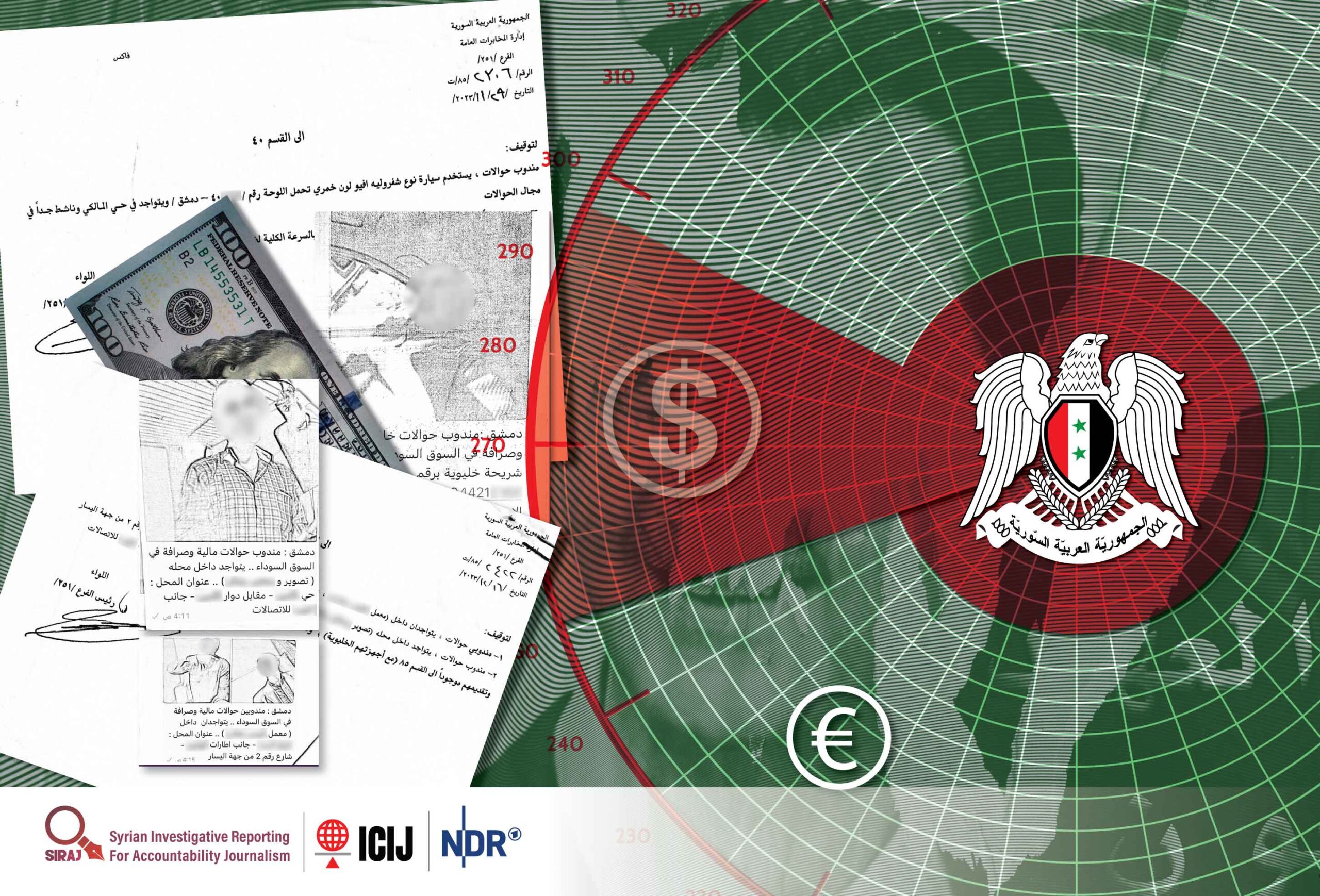
During the exchange, the informant took a photo of the agent inside the car and sent it to his superior in the branch via WhatsApp. A screenshot of that message later appeared in an official document signed by the head of Branch 251 and addressed to Department 40 on 29 November 2023, ordering the immediate arrest of the transfer agent, his handover to a police department, and the confiscation of the phones in his possession “with utmost urgency for the purpose of investigation.”
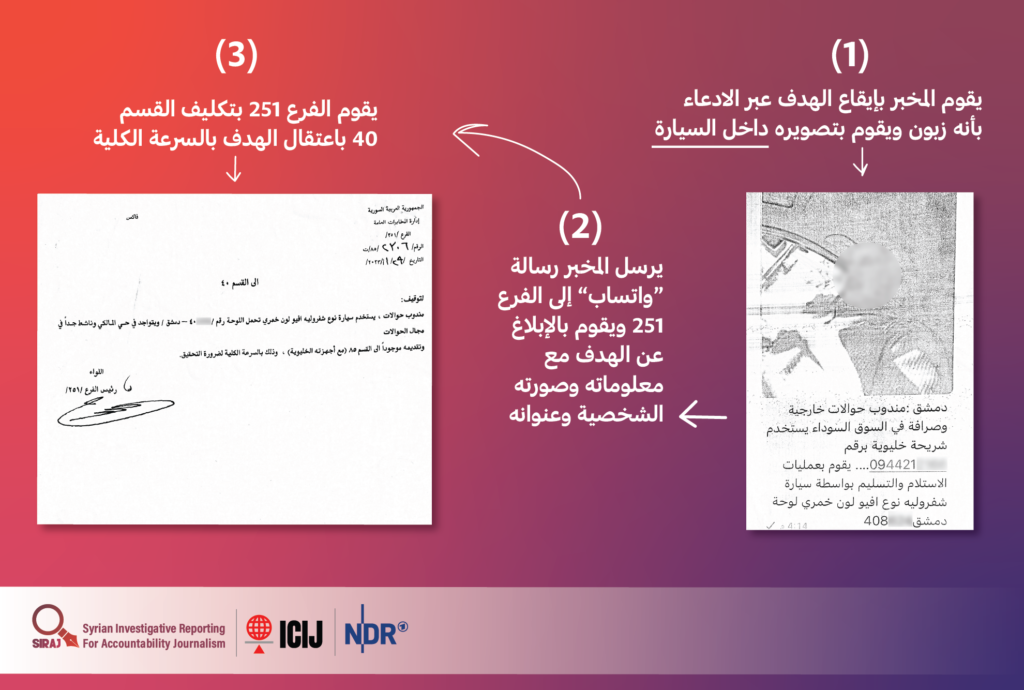
This currency exchange agent was not the only one arrested. The former Syrian regime deployed all available tools to track down and detain anyone dealing in foreign currencies, whether exchanging them or, later on, merely possessing them after issuing a series of laws aimed at centralizing control over hard currency in Assad’s hands.
Economic researcher Khaled al-Turkawi says that all the measures taken by the Assad regime were designed to extort anyone holding dollars or other foreign currencies, forcing them into two choices: either exchange their money through the regime at the rate it dictated, or face legal prosecution. He notes that these laws had little to do with economic policy and were instead intended to extract funds to sustain military operations and pursue victory.
As part of the “Damascus Dossier” project, the Syrian Investigative Reporting for Accountability Journalism – SIRAJ reviewed digital copies of numerous documents showing how the Assad regime used its intelligence agencies to track and arrest anyone dealing in U.S. dollars or other foreign currencies following Decree No. 3 of 2020, issued by the deposed Syrian president Bashar al-Assad, which criminalized transactions in any currency other than the Syrian pound.
The “Damascus Dossier” is a collaborative investigative project led by the International Consortium of Investigative Journalists (ICIJ) in partnership with the German public broadcaster NDR. It brings together journalists from around the world to uncover disturbing new details about one of the most brutal state-run killing systems of the 21st century: the regime of former Syrian president Bashar al-Assad.
ICIJ, NDR, and 126 journalists from 24 media organizations across 20 countries spent more than eight months organizing and analyzing these documents, consulting experts, and interviewing Syrian families still searching for loved ones who disappeared under Assad’s rule.
The Damascus Dossier investigations reveal the inner workings of Assad’s security apparatus and its links to foreign governments and international organizations. The leak consists of more than 134,000 files, mostly written in Arabic, amounting to approximately 243 gigabytes of data.
The documents span more than three decades, from 1994 to December 2024, and originate from Syria’s Air Force Intelligence and General Intelligence Directorates.
Both agencies have been subject to extensive U.S. and European sanctions due to their brutal practices, including torture and sexual violence.
The documents include internal memoranda, reports, and correspondence revealing the day-to-day operations of Assad’s surveillance and arrest network, as well as its coordination with foreign allies such as Russia and Iran, and communications with United Nations agencies operating inside Syria.
The highly sensitive database also contains the names of numerous former Syrian intelligence officers.
Recruiting Informants to Seize the “Dollar”
In a document dated 16 December 2023, the head of the Military Intelligence Branch 251 ordered Department 40 (Al-Khatib Branch) to arrest three money transfer agents operating in different areas of Damascus on charges of dealing in foreign currencies.
The document includes detailed information about the locations where the agents worked and businesses they used as cover to provide money transfers, as well as photographs secretly taken by intelligence officers during currency exchange operations. It also contains personal details such as phone numbers and other identifying information.
As in the previous document, the branch chief attached screenshots that appear to have been sent directly by the officers responsible for surveillance and reporting during the operation.
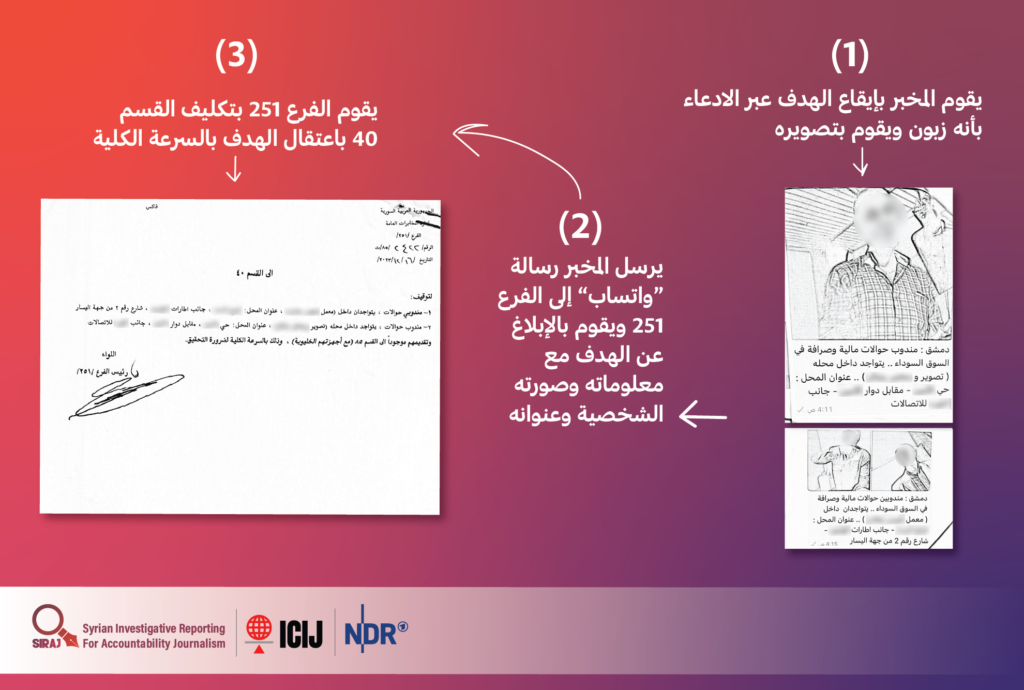
These operations were not only aimed at enforcing decrees and laws issued by the regime’s authorities. According to economic researcher Khaled al-Turkawi, they also served a much broader economic objective: monopolizing foreign currencies in the country and redirecting them to sources close to the regime and individuals within Assad’s inner circle.
After Assad banned trading in U.S. dollars and other foreign currencies, Syrians began using coded language to refer to the dollar in personal conversations and over the phone. They used nicknames such as “the forbidden one,” “parsley,” “the green,” or “number one.”
However, this strategy did not escape the Syrian intelligence services under Assad. One intelligence document summarizing surveillance of specific phone numbers indicates that Syrian intelligence identified a man in Sweida province as dealing in U.S. dollars after he asked about the price of “number one,” a coded reference to the dollar during what appeared to be a wiretapped phone conversation.
Criminalizing the Trade and Possession of Foreign Currency
Possessing foreign currency, especially U.S. dollars, had long been considered taboo in Syria. Even carrying $100 in one’s pocket could expose a Syrian to questioning, as holding such currency was considered illegal.
As a result, working in currency exchange outside the control of the Syrian regime was widely viewed as a “suicidal profession” because of the extreme risks involved, particularly in recent years, when the regime’s need to extract additional funds intensified.
Trading in the U.S. dollar and foreign currencies was first officially banned in Syrian markets in 1986, through Law No. 24 of 1986, issued under Hafez al-Assad. The law criminalized buying or selling foreign currencies outside licensed banks and exchange companies, as well as possessing large amounts of dollars without authorization. Violators faced prison sentences and financial penalties. This law laid the foundation for the criminalization of foreign currency trading in the local market.
Law No. 24 remained in effect until 2013, when Bashar al-Assad, two years after the outbreak of the Syrian uprising, issued Law No. 29 of 2013, titled “Combating Illegal Dealings in Foreign Currencies.” The law criminalized trading foreign currencies outside official channels, including licensed banks and exchange companies.
It also criminalized buying or selling dollars or other foreign currencies on the parallel market, as well as transferring money or speculating on exchange rates. Notably, the law imposed harsher penalties, including prison sentences ranging from three to ten years, depending on the severity of the offense, in addition to substantial fines.
In 2020, the Syrian pound experienced a sharp collapse. For the first time in its history, the exchange rate reached 1,000 Syrian pounds per U.S. dollar in January 2020, and by the end of that year, the dollar had risen to approximately 3,000 Syrian pounds.
This collapse prompted Assad, on 4 October 2020, to claim that the fundamental reason for the pound’s decline was the freezing of billions of dollars in deposits belonging to Syrians in Lebanese banks following Lebanon’s banking crisis in 2019.
During a visit to the “Producers 2020” exhibition, Assad stated that between $20 billion and $42 billion of these deposits may have been lost in the Lebanese banking sector, describing the figure as “terrifying” for Syria’s economy. He added: “They took the money and placed it in Lebanon, and we paid the price.”
Yet this statement was not Assad’s only response. Earlier that same year, he had already tightened restrictions on Syrians holding foreign currencies through Decree No. 3 of 2020. For the first time, the decree explicitly used the phrase “prohibition of possessing foreign currencies.”
Article 1 of the decree states that “it is prohibited to deal in any currency other than the Syrian pound as a means of payment or for any type of commercial transaction.” The decree significantly increased penalties and introduced legal provisions allowing authorities to confiscate foreign currencies involved in such transactions.
Dominating Hard Currency
It appears that the Syrian regime’s aim behind these laws was not to regulate the flow of currency in the market, nor even to protect the Syrian pound, but rather to secure Assad’s share of every dollar entering Syria, according to economic researcher al-Turkawi.
“The purpose of all these laws was to centralize the sale of dollars through the Central Bank. The regime wanted all foreign currency transactions to take place through the Central Bank for three main objectives.”
The first objective, according to al-Turkawi, was the collapse of the Syrian pound, which had effectively become unacceptable for international trade, as foreign suppliers increasingly demanded payment exclusively in U.S. dollars. This made it difficult for the regime to finance the army or settle payments to Russia or Iran without dollars, as well as to pay for essential imports such as food supplies.
- Creative coordination and visual solutions: Radwan Awad