On the morning of February 14, 2005, nearly two tons of TNT exploded in Beirut. The blast, which left a massive crater in the heart of the Lebanese capital, targeted the convoy of former Lebanese Prime Minister Rafik Hariri, killing him and 22 others.
The assassination marked a turning point in Lebanon’s history as well as the Syrian-Lebanese relations, ultimately leading to the withdrawal of the Syrian army from Lebanon on April 30, 2005, as fingers were pointed at the Syrian regime and its allies for responsibility for the crime.
Today, two decades later and after the fall of the Assad regime, long accused of orchestrating the assassination, digital copies of documents from Syrian intelligence, obtained by the Syrian Investigative Reporting for Accountability Journalism – SIRAJ, Zaman Al-Wasl newspaper, and Daraj website, reveal for the first time the strategy devised by Syrian intelligence chief Ali Mamlouk and the security agencies under his command to confront the accusations.
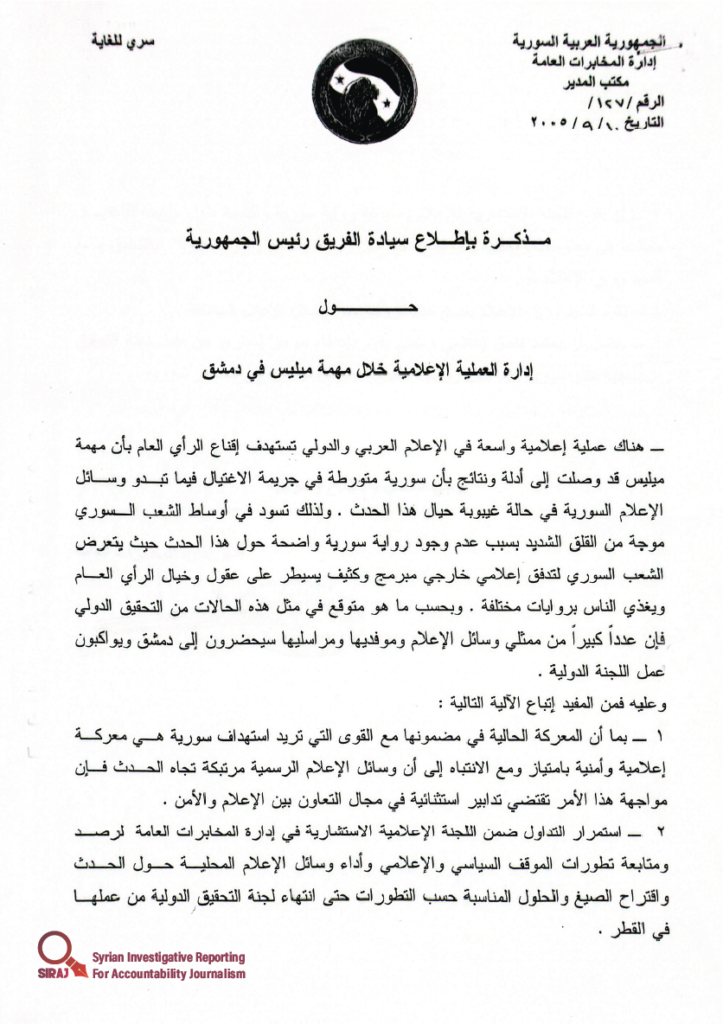
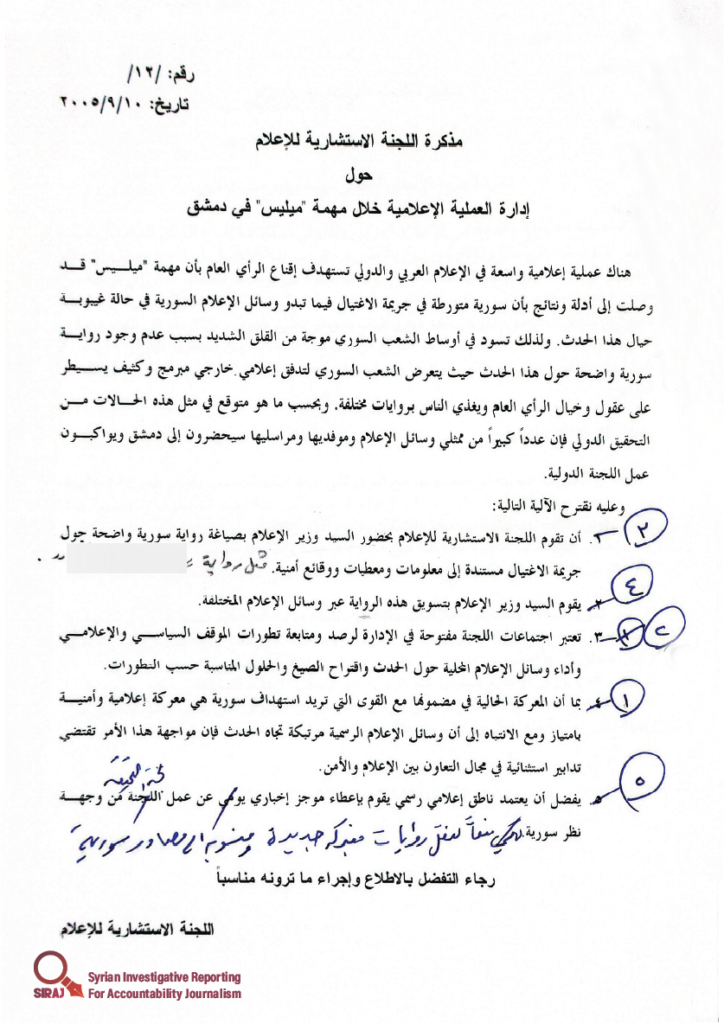
On October 10, 2005, Mamlouk, then head of the General Intelligence Directorate (GID), sent a briefing memo to Bashar al-Assad describing Syrian media outlets as being “in a state of coma regarding the event,” namely, the possibility that the International Investigation Commission into the assassination could reach evidence implicating Syria.
According to Taleb Qadi Amin, who served as Deputy Syrian Minister of Information between 2002 and 2008, “It wasn’t only Ali Mamlouk saying this. Even the head of the regime himself said it. When asked whether he followed Syrian television, he would say he did not. He knew very well what existed within his media institutions.”
Mamlouk’s criticism of Syrian media was followed by security coordination aimed at manipulating and spreading conflicting information to confuse the investigation, as revealed in another document summarizing a meeting between the International Commission investigating Hariri’s assassination and Syrian security officers.
According to the document, the behavior of those officers was characterized by “openness to cooperation. And their conduct appeared spontaneous, responsible, and serious. Their answers did not seem pre-coordinated despite prior coordination and instructions.”
It remains unclear what exactly was meant by “prior coordination and instructions.” What is known, however, is that in 2006, Mamlouk informed Bashar al-Assad about a meeting between the Syrian side and the Investigation Commission, during which Syria proposed a “third possibility” regarding the bombing of Hariri’s convoy, namely, an aerial attack.
This theory was later hinted at by then-Minister of Defense General Mustafa Tlass and later stated more explicitly by Hezbollah Secretary-General Hassan Nasrallah, who accused Israel and the United States of being behind the assassination.
“In the Hariri assassination case, the Syrian regime relied on constructing a fabricated narrative,” Lebanese academic Ziad Majed says. Regarding the regime’s strategies, Majed, a professor of political science at the American University of Paris, explains that the Syrian regime consistently relied on several methods in cases of political violence, assassinations, and killings. However, in major operations, there was always a broad accusation based on repeating the same rhetoric about conspiracies, the United States, and Israel, to maintain its self-proclaimed position of “resistance.” Thus, the regime framed any killing or sabotage as an attack on national security or stability, or as an attempt to direct accusations toward Syria.
According to Majed, there was also another discourse adopted by the regime: one that did not directly deny the crime, especially when the regime believed the cost of carrying it out would not be too high. By avoiding outright denial and leaving room for speculation, the regime sought to project power, immunity from accountability, and indifference to consequences. This ambiguity signaled to its own institutions and loyalists that it knew exactly what it was doing and did not fear repercussions.
The Internationalization of Hariri’s Assassination
Following the assassination of Rafik Hariri, both local and international developments accelerated rapidly. On April 7, 2005, the United Nations announced the formation of an “International Independent Investigation Commission” pursuant to the UN Security Council Resolution 1595.
With the establishment of the Commission, headed by German prosecutor Detlev Mehlis, the political and criminal dimensions of the case shifted onto an international track, coinciding with the withdrawal of the Syrian army from Lebanon.
The Commission’s first report accused Syria of destabilizing Lebanon’s security and interfering in its governance, stating that the Syrian government “bears primary responsibility for the political tension that preceded the assassination of former Prime Minister Hariri.” The report also described how Bashar al-Assad allegedly threatened Hariri and Progressive Socialist Party leader Walid Jumblatt with “physical harm” if they refused to support the extension of President Emile Lahoud’s term during a ten-minute meeting in Damascus in 2004.
In its 2008 report, the Commission stated that it “confirms, based on the available evidence, that a network of individuals collaborated to carry out the assassination of Rafik Hariri.”
The report added that the Commission “appreciates the logistical and security arrangements undertaken by the Syrian authorities… and, in general, Syria continues to cooperate satisfactorily.”
During that period, Lebanon witnessed the practical implementation of a new strategy. Media outlets close to Hezbollah and the Assad regime launched a campaign promoting the idea that groups affiliated with al-Qaeda were behind the assassination. This narrative was preceded by the story of a videotape allegedly “sent” to journalist Ghassan Ben Jeddou, then director of Al Jazeera’s Beirut office and now head of Al Mayadeen TV.
The video featured Ahmad Abu Adas claiming responsibility for the assassination. Later, the narrative shifted toward accusing Israel and the United States, culminating in a press conference by Hezbollah Secretary-General Hassan Nasrallah in which he presented what he described as evidence of Israeli involvement in the assassination.
Syrian Intelligence-Media Operations
On September 7, 2005, the Syrian GID sent a briefing memo to Bashar al-Assad regarding the participation of S.T., a former member of parliament and head of a research center who later became an opposition figure based in the UAE, in a conference on “Gulf Security and Middle East Security.”
According to the memo, S.T. relayed information from R.D. about a meeting attended by Hermann Pirchner, the founding President of the American Foreign Policy Council (AFPC).
The meeting, held in Paris, was attended by representatives of the French Foreign Ministry, the European Union, and the British and American foreign ministries. According to the document, Mehlis stated during the meeting that he had “reached evidence strongly suggesting the involvement of Syrian officials in Hariri’s assassination.”
This declaration by the international investigator, and his explicit indication of Syrian regime involvement, prompted Damascus to mobilize and sound the alarm, operating simultaneously on political, diplomatic, media, and security levels in preparation for confrontation, according to exclusive documents reviewed in digital form by the journalists working on this investigation.
One week after Mehlis’ statement, the GID sent Bashar al-Assad a draft memorandum of understanding between Syria and the United Nations concerning the Hariri investigation and Resolution 1595.
Then, on September 10, 2005, another memo from the GID was sent to Assad regarding the “management of the media operation during Mehlis’ mission in Damascus.” The memo described Syrian media as being “in a state of coma regarding the event” and “confused by the event,” calling for “exceptional measures in the field of cooperation between media and security.”
This coordination was to continue “within the advisory media committee in the General Intelligence Directorate.” The initial plan relied on promoting a Syrian narrative via the Minister of Information at the time, Mehdi Dakhlallah, who would do so through media outlets. The memo stressed that this narrative had to be based on “security information, data, and facts.”
At the time, Dakhlallah told Al Jazeera Channel that accusing Assad of involvement in the assassination was “a provocation of instincts and cheap demagoguery.”
Notably, the same document included a handwritten reference to the “story of Mohammed Zuhair Siddiq,” whom Syrian authorities later cited through the spokesperson of the Syrian judicial committee investigating the case, as proof that the international investigation had “collapsed” and suffered a “knockout blow.”
This referred to the testimonies of Siddiq or Hossam Hossam, the so-called “masked witness,” who later claimed, after fleeing to Syria, that he had provided false testimony under torture and sedation in Lebanon. He later appeared on Syrian television, describing the alleged coercion.
Syrian journalist Samira al-Masalmeh, who at the time served as managing editor of a private Syrian newspaper, told us that following news of the assassination, a clear state of confusion spread throughout Syrian media circles, reflected in delays in the initial coverage.
Within a short time, however, the media narrative settled around describing Hariri as a “martyr,” while directing accusations toward Israel as the primary beneficiary of his assassination.
“The media discourse at the time shifted toward directly confronting any political or media opinion that raised questions about possible Syrian responsibility or referred to tensions in the relationship between Damascus and Hariri. Responding to and refuting such opinions became a clear priority and an obligation. Headlines and editorial directions were communicated to us through the relevant authorities in newspapers, and the coverage took on a predominantly defensive and aggressive tone, portraying these views as political campaigns targeting Syria,” al-Masalmeh says.
An Inadequate Media Machine
It became clear that Syrian state media was not prepared for the scale of the moment. On September 11, 2005, the GID sent a memo to Bashar al-Assad titled: “Regarding Mehlis’ Mission and Its Potential Repercussions – Preliminary Political Ideas for the Required Media Plan.”
The “ideas” outlined in the document appeared to directly target Detlev Mehlis himself, describing him as someone who “tends to display a friendly attitude at first… only to later launch calculated strikes that combine the traits of personal success for a criminal investigator with a media blow.” The memo later emphasized that Mehlis “did not act with friendliness or understanding toward Syria.”
Journalist al-Masalmeh recalls: “On March 13, 2005, I was summoned, along with a lawyer, to one of the security branches. While waiting in the branch chief’s assistant’s office, I noticed a delegation in religious attire leaving the building. I was told they represented Hezbollah. Accompanying them was someone I personally knew, identified as ‘Y.N.,’ who later became a member of parliament.”
Al-Masalmeh later referred to a meeting organized by lawyer Imad al-Zoubi, who later served as Syria’s Minister of Information between 2012 and 2016, with Hossam Hossam, the main witness in the Rafik Hariri assassination case.
“During the meeting, I noticed that Hossam Hossam constantly threatened to escape. He had already retracted the testimony he had given before the International Commission more than three times in front of the lawyer, while the latter kept telling him to calm down. Hossam was in an intense state of anger and agitation, and he told me literally: ‘If I tell the truth, I will destroy the country.’”
Al-Masalmeh says that when al-Zoubi briefly left the room, she asked Hossam to tell her the truth. He replied: “If you knew it, you would die.”
On September 19, 2005, Ali Mamlouk’s office at the GID sent another cable to Bashar al-Assad concerning “confronting media challenges surrounding the work of the International Investigation Commission into Hariri’s assassination,” in preparation for Mehlis’ visit to Damascus and for creating “a parallel media operation capable of keeping pace with developments.”
The cable, reviewed by journalists working on this investigation, proposed a strategy for Syrian media to ensure that “Syrian sources become the primary source of news regarding the investigation.” Among the recommendations was relying on the “semi-official Syrian level,” including “media outlets known for their ties to Syria” as well as “indirect Arab and international media.”
The goal was to “present the Syrian political position,” highlight the “dimensions of the ongoing conspiracies,” and “avoid questioning the Commission or insulting witnesses.” One of the central features of the proposed “media discourse” was the emphasis on “Syria’s fears over the politicization of the investigation.”
On October 2, 2005, the Syrian GID sent another cable to President Bashar al-Assad informing him of a meeting Mamlouk held with “security liaison officers” from Russia, Algeria, Turkey, and Italy. The purpose, according to the document, was to deliver a message to those states that Syria was being subjected to a “malicious media campaign” and had “no connection whatsoever to Hariri’s assassination.”
The cable further stated that Syrian authorities had “cooperated with the International Investigation Commission” and pointed to evidence allegedly implicating “a deserter from the Syrian army living in Lebanon, involved in fraud and scams, and married to a Lebanese woman related to Lebanese MP Marwan Hamadeh,” referring to Mohammed Zuhair Siddiq.
Days later, Mehlis publicly declared that it was “difficult to imagine the assassination taking place without the knowledge of Syrian intelligence.” He added that “after a short hesitation, Syrian authorities cooperated only to a limited degree with the Commission, while some individuals interviewed by the Commission attempted to mislead the investigation by providing false or inaccurate information.”
According to the United Nations, Mehlis also stated that Syrian Foreign Minister Farouk al-Sharaa had “provided incorrect information.”
Manufacturing Propaganda Through Intelligence Networks
In an effort to coordinate previous intelligence operations, control the official narrative, and manage the handling of suspects, the Syrian GID submitted a memo for Bashar al-Assad’s review. The document included a handwritten letter from H.M., a Syrian-Palestinian based in Lebanon who worked in cultural and political circles focused on anti-Zionist activism and who had previously met Bashar al-Assad, addressed to “His Excellency the Combatant General Ali Mamlouk.” The letter was later transformed into an official briefing memo presented to Assad on September 15, 2005.
The memo proposed producing a documentary film about Detlev Mehlis titled “The International Investigator,” in cooperation with a German publishing house and an independent British media organization. The 45-minute documentary, according to the proposal, could be completed in less than two weeks if approximately €20,000 were transferred to Berlin, where meetings would take place with some of the film’s participants. Additional accommodation costs, estimated at $5,000-$6,000, were listed separately from the production budget.
The documents include a detailed outline for the documentary’s scenario. Rather than functioning as an investigation or explanatory piece, the film was designed as a tool to reframe the assassination narrative within a broader map of enemies and allies.
According to one of the documents, the scenario presented to Mamlouk aimed to reconstruct the narrative to align with the logic of the Syrian security apparatus. It relied on foreign sources and intelligence-style storytelling to appear as a “neutral” attempt at presenting an alternative account. The film’s core objective was to undermine Mehlis’ investigative methods and question his “legal credibility,” using human rights reports that criticized his previous work and accused him of “leaking information” and “manipulating witness testimonies” in earlier investigations.
The documents also reveal how H.M. secured approval from a publishing house to promote the film. The same publisher had previously released a book on Hariri’s assassination, accusing the US and Israel of orchestrating the killing.
Days after H.M.’s letter, another memo was sent from General Intelligence to Bashar al-Assad regarding the documentary, in which S.T. assumed a separate role. According to the memo, S.T. traveled to Berlin, met with officials from the publishing house, and introduced himself as a member of H.M.’s organization. Once again, discussions focused on stripping Mehlis of credibility by revisiting previous cases he had handled.
We sent questions to both H.M. and S.T. regarding the appearance of their names in the documents and the roles they played during that period, but received no response by the time this investigation was published.
“Jund al-Sham” and the “Third Scenario”
On the day of the assassination, Al Jazeera Network broadcast a video recording of Ahmad Abu Adas, who appeared claiming responsibility for the attack on behalf of “The Group for Support and Jihad in Bilad al-Sham.” From that moment, suspicions began shifting toward Islamist extremist groups.
The recording, aired on February 14, 2005, just hours after Hariri’s assassination, carries a striking backstory.
In its response to the Investigation Commission, Al Jazeera stated that Ghassan Ben Jeddou, then head of the network’s Beirut bureau, received the tape after being contacted by an unidentified source. Later, the Lebanese newspaper As-Safir interviewed Abu Adas’ brother, Khaled, who said: “In appearance, it was my brother Ahmad. But in terms of the content, the expressions, and the tone of voice, he was someone unknown and strange to me, despite us living together in the same house.”
He added, “I am certain that my brother Ahmad was forced by an external power to read the statement through torture, coercion, or some other method. My brother Ahmad was very simple and peaceful, and easy to manipulate.”
On September 7, 2006, another memo from GID to the Syrian presidency documented the Investigation Commission’s request to meet 13 “wanted terrorist elements” whom Syrian intelligence had presented to the commission.
The memo explained that the Commission requested the meeting because it had no prior knowledge of those suspects, noting that “the information provided by Syrian authorities was new and extensive.”
In the same memo, Syrian officers denied knowing Ziad Ramadan, a friend of Ahmad Abu Adas, except through media reports, stating that it was the International Commission that had interrogated him. The memo also referred to the possibility of allowing the Commission to meet “Osama al-Shousha, detained by Political Security.”
Another notable detail was the suggestion that the committee might provide Syrian authorities with a copy of Ahmad Abu Adas’ video to determine “whether the discourse reflected in it genuinely represented Salafi rhetoric or was fabricated.”
What stands out in the comments is that they went beyond portraying Syria as an expert on jihadist groups. In fact, the GID stated:
“It became apparent that the Syrian officers were open to cooperation and that their behavior [was] spontaneous, responsible, and serious. Their answers did not appear to have been coordinated in advance (despite prior coordination and instructions).”
At the time, “Jund al-Sham” and several of its alleged members were mentioned in Mehlis’ report. The accusations increasingly shifted toward a radical Islamist organization. Syrian authorities arrested several individuals linked to the group, including Ziad Ramadan, whom Amnesty International urged Assad in 2009 to release. He was later sentenced to six years in prison in 2011.
The broader objective of these meetings appeared to be linking the assassination to extremist organizations. Syrian intelligence emphasized that the suspects named in the Commission’s report were known only by their aliases, such as “Mohammed Osama al-Shousha” and “Abu Muhjan (Ahmad al-Saadi),” while repeatedly stressing that Syria itself was fighting terrorism and that there were 13 suspects allegedly tied to al-Qaeda. Discussions also touched on Ahmad Abu Adas, whom Syrian intelligence claimed it did not know.
On July 13, 2006, following Mehlis’ resignation and the appointment of Serge Brammertz as his successor, another GID briefing memo to Bashar al-Assad documented a meeting between Brammertz and Syrian officials.
The Syrian delegation included Major General Deeb Zeitoun, Brigadier Zuhair Hamad, Brigadier Ali Makhlouf, and Colonel Munir Shalabi, while S.T. served as translator for the Syrian side.
The memo described the meeting as a “Syrian initiative to enrich cooperation,” particularly because “information concerning terrorist elements had been received from the Political Intelligence Branch.” The ultimate objective, according to the document, was to introduce a “third scenario” for the bombing of Hariri’s convoy, namely, the possibility that the attack had been carried out from the air.
Tracking the “Living Witness”
The Syrian regime did not stop at attempting to recruit witnesses and public figures with media and legal expertise to produce a documentary aimed at undermining the narrative and efforts of the international investigation into Hariri’s assassination. Rather, it operated with a security and intelligence mentality that extended for years after the assassination itself, all with the objective of distancing suspicion from the regime as the orchestrator of the killing.
On December 20, 2014, a man named Abdul Basit Bani Odeh appeared in a televised interview on Lebanon’s Al Jadeed TV channel during the program “Lel Nashr” (“For Publishing”). He was later described as the “Israeli witness” in the Hariri case.
During the live broadcast, Bani Odeh spoke about his activities, his work, and his alleged relationships with Syrian and Lebanese security and intelligence figures. He also claimed to possess sensitive photos and documents related to the case.
The Syrian security apparatus responded immediately by launching efforts to track him down.
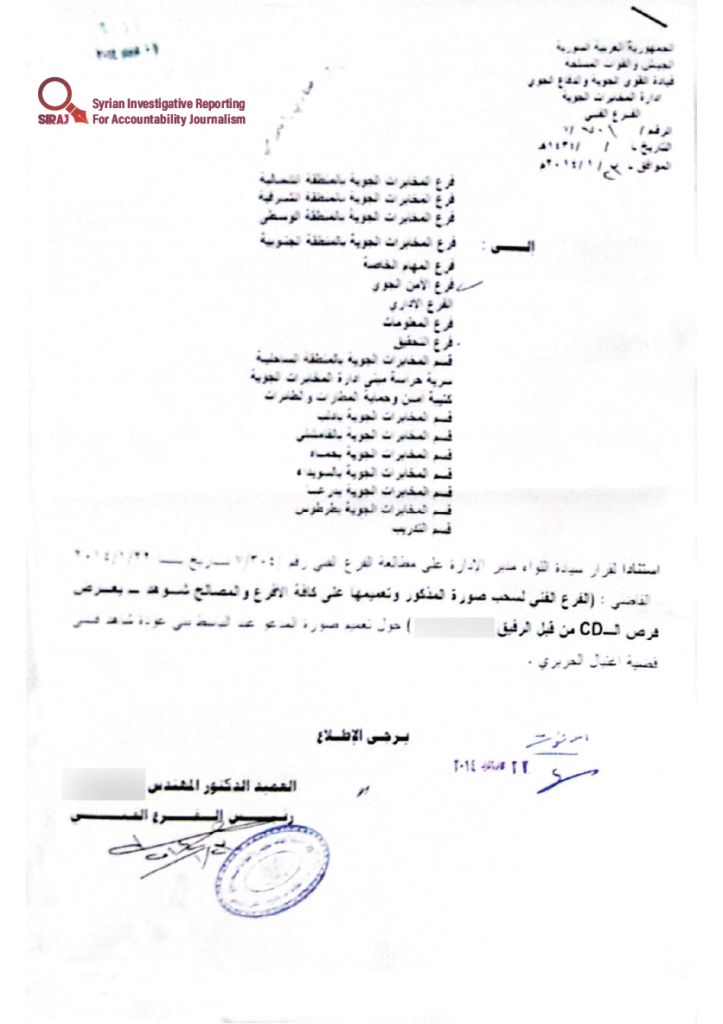
On December 23, the “Technical Branch” of Syrian Air Force Intelligence, headed by Brigadier General Mouin Qassem, circulated information, photographs, and four screenshots taken directly from the Al Jadeed broadcast showing the witness’s face, along with a full audio recording of his interview.
These materials were attached to an internal intelligence memorandum distributed to 19 Syrian security branches. The witness’s image and voice were circulated on a CD for identification and tracking purposes.
More than two decades after Hariri’s assassination, a central question remains: why did the Syrian regime resort to these methods of confrontation? And why did it take upon itself the task of countering the global narrative accusing it of involvement in Hariri’s assassination?
What the documents and correspondence reveal is that the Syrian regime attempted to fight back through a form of “soft power,” producing films and broadcasting them on television screens. It reflected a security-media mindset aimed at shaping perceptions and influencing public opinion, a pattern that would repeat itself throughout the years of the Syrian uprising until the regime’s fall in December 2024.
Put differently: why would the Syrian regime have sought to wage such an extensive campaign of confrontation if it had no role in the assassination?
The Special Tribunal for Lebanon ultimately concluded that Hezbollah operatives were behind the assassination. Yet the evidence reviewed in this investigation suggests that the former Syrian regime may have been entrusted with the task of managing the disinformation campaign surrounding the crime and its aftermath.
- Creative direction and visual design: Radwan Awad