

A few months ago, Najwa noticed a lump on the face of her nine-year-old daughter, marking the beginning of a new chapter in the family’s ongoing tragedy.
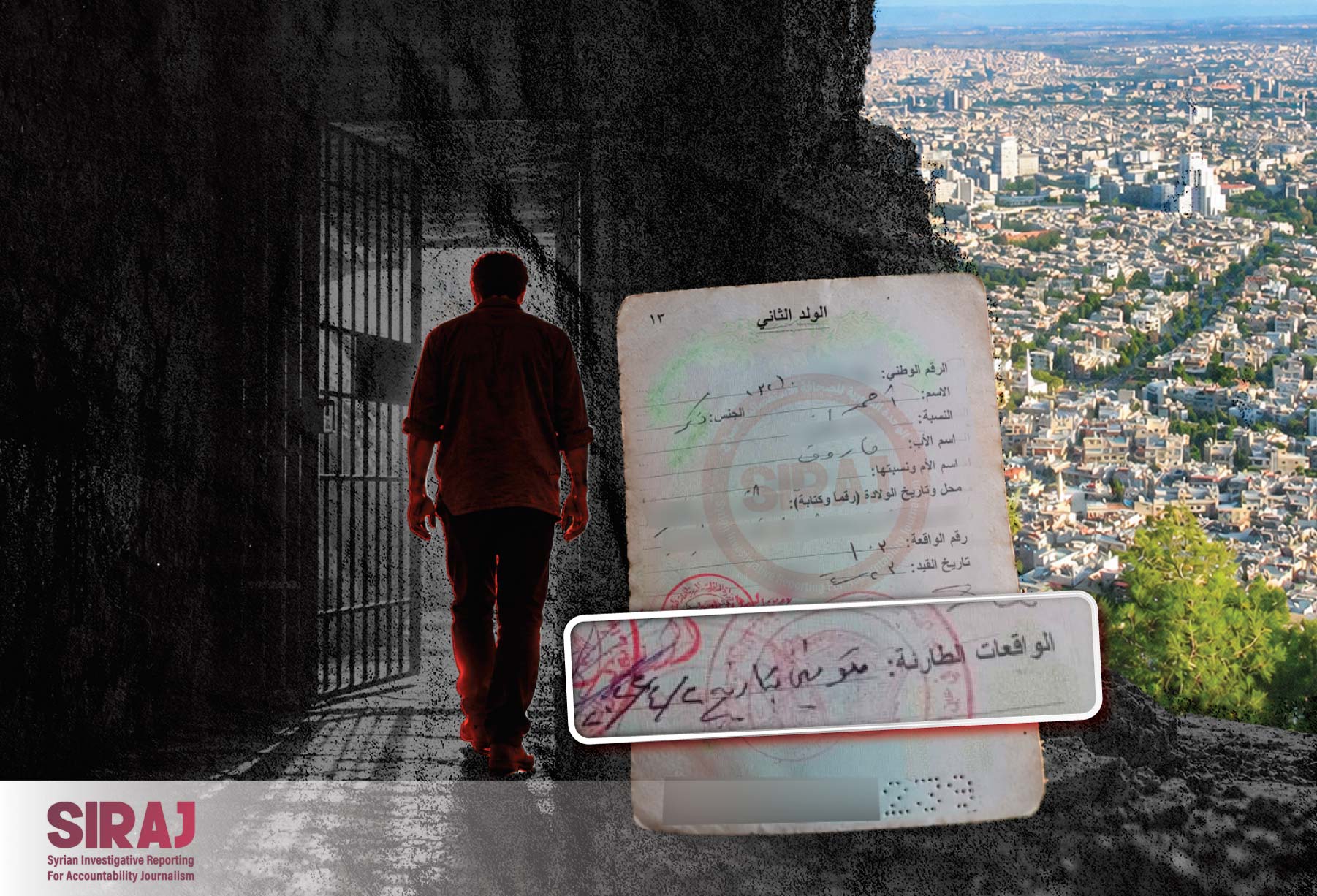
Alongside the poverty that left public hospitals as the mother’s only option for treatment, another obstacle emerged: the need for official documents that the child does not possess, through no fault of her own, but because she and her younger brother were born from Najwa’s marriage to a man whose true identity was never known before he later disappeared.
Najwa (a pseudonym) says, “The girl’s condition was critical. The mass was pressing on one of her eyes, and she urgently needed surgery. But the hospitals refused to admit her. After several disputes and arguments with the [hospital] administration, it admitted her exceptionally, as an act of help, under the name of one of her relatives.”
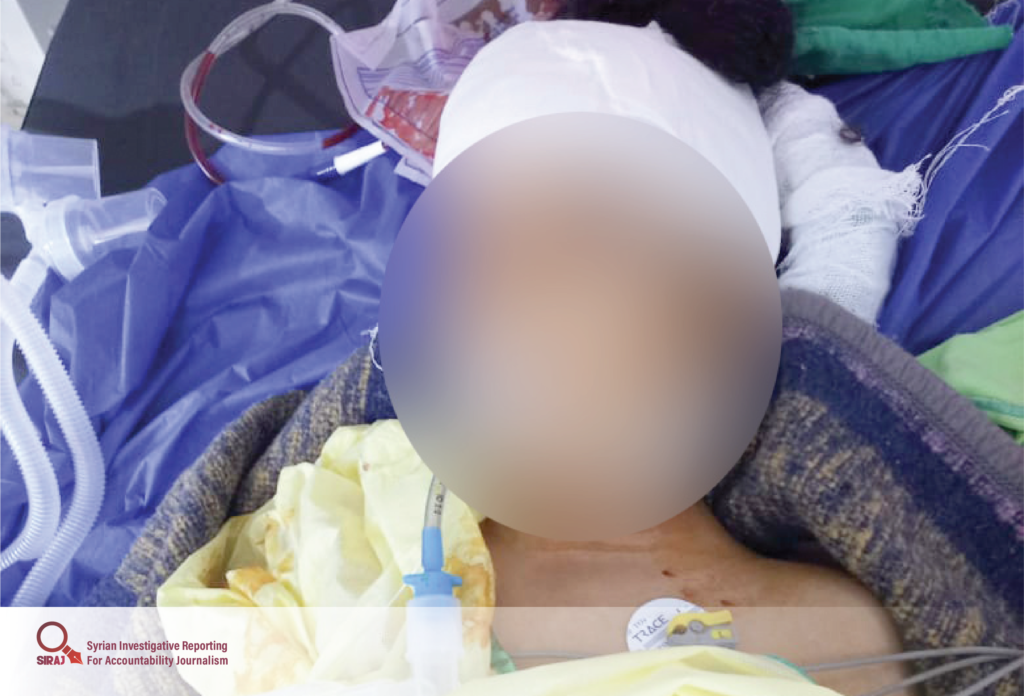
Najwa’s daughter after undergoing surgery to remove a tumor from her face – SIRAJ
After several days of delay due to overcrowding at the hospital, the operation was finally performed. The child is now recovering, though the results of the surgery revealed that she requires chemotherapy and radiation treatment.
What worries Najwa most is that this temporary solution will not always work. She says she desperately needs a permanent legal resolution for her children’s situation.
In 2014, Najwa, then a 16-year-old girl living in extreme poverty with her mother in the town of Al-Bab in the Aleppo countryside, married a Libyan man affiliated with ISIS.
The marriage was conducted through a “Sheikh’s contract,” an informal religious marriage not officially registered in court, as was common in areas under the group’s control at the time.
In 2018, her husband decided to travel to Turkey. Since then, she has lost all contact with him.
Najwa became the family’s sole provider, struggling not only with poverty but also fighting to obtain civil registration documents for her two children that would officially recognize their existence as human beings and secure for them the most basic rights, primarily education and healthcare, under Syrian law.
Bigger Than ISIS
The issue of Syrian women marrying foreigners during the years of the Syrian revolution is often portrayed as being mainly linked to women who married ISIS fighters during the group’s control over eastern Syria between 2014 and 2017. However, the problem and its consequences, especially the price paid today by Syrian wives and their children, extend beyond marriages to ISIS fighters alone, as illustrated by the story of Um Saad.
Um Saad, who is in her forties now and living in Idlib, married a man from Uzbekistan during the uprising. But in 2019, just one year after their marriage, he disappeared.
All she knows about him is that he worked as a “Sharia official” within an armed faction in the area. Given the sensitivity of his situation, the marriage took place through a religious ceremony conducted by the faction’s sheikh.
At the time, the husband concealed his true identity for fear of “spies,” a move that later prevented Um Saad from legally registering the marriage in court.
This reality, she says, deprived her and her son, whose father disappeared when he was only two months old, from receiving aid or assistance, especially programs designated for widows and divorced women. Her marriage and her child remain unrecognized by Syrian authorities because the marriage was never officially documented in a recognized court. Most critically, her son possesses no civil registration records whatsoever.
The ideological factor, namely extremism or radicalization, does not appear to have been the primary driver behind Syrian women marrying foreign fighters.
Civil activist Fayhaa Al-Shawash from the Idlib countryside explains:
“The phenomenon of Syrian women marrying foreign fighters spread because of poverty, the loss of breadwinners, and the growing number of widows in war-affected areas. There was also fear that unmarried daughters over the age of eighteen would be labeled as ‘spinsters,’ so many families viewed foreign fighters as an opportunity to provide someone who could take care of them.”
Many women, according to several interviews conducted in rural Idlib for this investigation, were encouraged to marry foreigners because of their modest demands and because they often expressed willingness to sponsor orphans and take care of the children of divorced women.
These same circumstances pushed Um Omar to marry a man from the Republic of Dagestan.
She had previously divorced a Syrian husband, forcing her to return to her family home, where she lived in cramped conditions alongside her displaced brothers’ families during the war.
She explains that she suffered from severe hardship and helplessness, which is why she accepted marriage to the Dagestani man after being introduced to him through a relative who recommended her to a man seeking to marry a widow or divorced woman and help raise her children.
Um Omar describes the single year she lived with her Dagestani husband as “very good.” She says he treated her three children kindly and never hesitated to bring joy into their lives. Later, she became pregnant.
But during that period, her husband traveled to Turkey and was unable to return to Syria.
“My husband hopes the nationality issue will eventually be resolved so our son can obtain Syrian citizenship and a passport, allowing us to travel to him,” she says.
“He constantly asks me: Why am I not Syrian? Why am I Dagestani? He also suffers from bullying because of his father’s nationality.”
Because she possesses her husband’s identity documents and knows his real name and lineage, Um Omar was eventually able to register her marriage through a court affiliated with the Salvation Government, which administered Idlib before the fall of the former Syrian regime in December 2024.
Still, the process took her two full years.
She ultimately obtained a family statement renewed every three months, confirming her son’s lineage. That document allowed her to enroll her son in school, but it remains insufficient for obtaining a national ID card or passport.
Beyond these wartime cases, there are also children of Syrian women who have remained stateless since before the revolution itself.
Feminist activist Sawsan Zakzak, a board member of the Syrian Women’s League, explains that this issue often stems from marriages between Syrian women and Gulf nationals during tourism seasons.
Such marriages were frequently conducted through unofficial “sheikh contracts,” meaning they were never formally registered either in the husband’s country or at his country’s embassy in Syria, leaving children born from those unions without nationality.
In other cases, the marriage may have been officially recognized in Syria but not accepted in the husband’s country.
Saudi Arabia, for example, requires prior government approval for Saudi men to marry non-Saudi women.
Zakzak adds: “Political tensions between the Syrian state and other countries also contributed to this phenomenon, as was the case with Iraq during certain periods.”
“During Ba’ath Party rule in Baghdad, large numbers of Iraqi opposition figures sought refuge in Syria and married Syrian women, but they could not officially register those marriages in the civil records of the husband’s country, especially given the absence of embassies between the two states.”
Stateless: No Education, No Work
Facing the hardships of daily life, Um Saad had hoped she might at least be able to grant her son Syrian nationality so he could live a normal life like other children.
“I am the sole person responsible for my son because his father is absent,” she says. “He was born here, raised here, and lived off the goodness of this country. He knows nothing about foreign fighters. He only knows that he is Syrian. His father is missing, and in any case, he would never be able to grant him citizenship because he is classified as a terrorist in his own country.”
But Um Saad soon discovered that granting her child Syrian nationality was not an option either.
Syrian law does not grant mothers the right to pass citizenship to their children. This right is reserved exclusively for fathers, which causes a problem for hundreds of Syrian women, not only those who married “foreign fighters” during the revolution, but also women married to non-Syrians before and after the conflict.
Syrian nationality is governed by Legislative Decree No. 276 of 1969.
Article 3(a) of the law limits automatic acquisition of Syrian nationality by birth to anyone “born inside or outside the country to a Syrian Arab father.”
Meanwhile, Article 3(b) states that a person “born in the country to a Syrian Arab mother whose legal paternity has not been established” may obtain Syrian nationality. The same applies, under Article 3(c), to children born to unknown parents.
According to lawyer Rahada Abdoush, this discriminatory provision in Syrian law against women is unjustified because it contradicts constitutional principles that have consistently affirmed that “citizens are equal before the law in rights and duties,” while also emphasizing that “the family is the fundamental unit of society and is protected by the state.”
These principles, she adds, were reiterated in the Constitutional Declaration issued on March 13, 2025, whose Article 10 states: “Citizens are equal before the law in rights and duties, without discrimination based on race, religion, gender, or lineage.”
Abdoush explains that: “The former regime used to justify denying women this right by citing the issue of non-naturalized Kurds, and Palestinian refugees and the need to preserve their right of return, in addition to reasons related to national security.”
However, according to the lawyer, who specializes in women’s and children’s rights, these arguments are no longer valid.
“The situation changed after the issuance of the decree granting Kurds the right to obtain Syrian nationality. The concept of national security itself has also changed, and most Palestinians around the world now hold other nationalities.”
The suffering of stateless children becomes especially visible once they reach school age.
Najwa says schools agreed this year to enroll her two children “reluctantly,” on the condition that she provide official civil registration documents next year if they are to continue their education.
This means their educational future remains uncertain if she fails to obtain those documents.
The difficulties facing children of Syrian mothers and non-Syrian fathers living in Syria continue even after they complete their education, notes activist Sawsan Zakzak.
They are subject to the same restrictive labor regulations applied to foreigners.
Most of those children are also barred from practicing professions regulated by Syria’s professional syndicates law, since careers such as law or medicine require membership in their respective syndicates.
Membership itself is governed by the principle of “reciprocal treatment” between states. Even those who meet that requirement are denied access to the syndicates’ social benefits because they are considered non-Syrians.
Zakzak adds: “They are not allowed to own property except under the Law on Arab and Foreign Ownership, which pushes families to register property under the Syrian mother’s name. If the mother dies, the children must dispose, within one year, of any inherited shares exceeding what is permitted under the foreign ownership law.”
In addition to these restrictions, residency remains another major problem.
Researcher Rasha Al-Tabashi, founder of the campaign “My Nationality Is My Right,” explains that children of Syrian mothers do not receive permanent residency. Instead, they are treated under Law No. 2 of 2014 regulating the entry and residency of Arabs and foreigners in Syria.
The law defines five categories of residency permits: special, ordinary, temporary, tourist, and work residency.
Under Article 19(2), children of Syrian mothers are granted only an “ordinary residency” permit valid for three years.
Beyond depriving them of any sense of long-term stability, Al-Tabashi argues that these residency permits also impose financial burdens.
Each ordinary residency permit costs 150,000 (old) Syrian pounds (roughly 12 US dollars), with no exemptions or exceptions for vulnerable groups such as stateless children or the sons and daughters of Syrian women.
Transcending Borders and Regimes
In 2018, Syrian activists launched the campaign “Who Is Your Husband?” in Idlib province, western Aleppo countryside, and northern Hama countryside. The campaign aimed to shed light on the phenomenon of Syrian women marrying foreign fighters and to raise awareness among women about the risks such marriages posed to them and their children.
The campaign included billboards, leaflets, wall writings, graffiti art, discussion sessions, and both individual and group meetings at women’s and children’s support centers, alongside a parallel social media campaign.
Although some young women who were more aware of the risks married men whose origins and nationalities were known, many underage girls and women living in displacement camps were married off without understanding the consequences or with families deliberately overlooking those dangers because of the harsh conditions they faced, according to Idlib-based activist Fayhaa Al-Shawash.
There are no precise statistics regarding the number of children born to Syrian mothers who remain stateless.
However, a 2023 needs assessment of women in areas outside Assad regime control conducted by “Al-Warsha” in partnership with the “My Nationality Is My Right” campaign documented around 600 cases involving more than 1,200 children, according to campaign founder Rasha Al-Tabashi.
Most of those children lack official documents.
The assessment also revealed cases in which some children within the same family were officially registered while others were not, largely because of multiple marriages.
Furthermore, Al-Tabashi explains that the campaign’s work revealed that the nationality issue is not limited to children born to wives of foreign fighters.
Displaced Syrian women who married in Jordan or Lebanon through unofficial “sheikh contracts” also face similar legal complications.
Nor has the fall of Assad and the political transition in Syria so far eased the problem. If anything, it may have made things worse.
Before the collapse of the Assad regime, Najwa, for example, had not fully grasped the consequences of having an unregistered marriage to a man of unknown identity.
Today, everything has changed from trying to enroll her children in school to securing her daughter’s right to medical treatment.
While Um Omar and Um Saad lost contact with their husbands, there are likely hundreds of women who still live with their “foreign fighter” spouses without knowing what future awaits them.
Many of those husbands, once fighters within opposition factions, are now permanently injured from war wounds.
At the same time, these women do not know what future awaits their children, since many fathers are unable to pass on their nationality because they are classified as terrorists in their home countries, as in the case of Um Maryam, a 27-year-old woman.
Um Maryam, who lives in Idlib city and is originally from the province’s countryside, was previously married to a Syrian man.
Five years ago, she married a man from Uzbekistan and has since given birth to a daughter. She is currently pregnant with another child.
Her husband, she says, suffered three injuries during separate battles.
Although he remains formally a fighter, his mobility is severely limited, and he needs treatment that is difficult to secure due to the family’s limited income.
He is also unable to find other work because he lacks Syrian nationality, and employers refuse to hire him.
According to her husband, he once owned homes in his country but abandoned everything to come and help Syrians.
In Um Maryam’s opinion, these men should be helped rather than persecuted or marginalized.
“If something happens to my husband,” she says, “I want to have at least a family booklet proving my marriage and my children’s lineage, because the current family statement paper proves nothing and guarantees nothing.”
Waiting for Permanent Solutions, the Crisis Deepens
The pressures faced by women because of their stateless children have driven many of them to invent “solutions” that, while temporarily easing the problem, may create even greater disasters in the future, warns Omaya Shaker Al-Mousa, head of legal affairs at Mazaya Women’s Organization.
One such “solution” involves registering children under the name of the mother’s father or brother. In legal terms, her son effectively becomes her “brother” or her “nephew,” resulting in serious distortions of family lineage.
Al-Mousa stresses the need to “develop permanent solutions instead of resorting to temporary fixes that will create catastrophic consequences in the long run.”
Among those who resorted to such a solution is Layla, a 28-year-old woman living in rural Aleppo.
For the past seven years, she has spent long hours at a physical therapy center treating her nine-year-old daughter, who was born under bombardment and suffered oxygen deprivation that affected her ability to walk and speak.
Layla (a pseudonym) married through a “sheikh’s contract” in 2014, when she was only 17, to a 23-year-old Saudi man.
She gave birth to a daughter and a son, both of whom suffer from health problems. In addition to the girl’s disabilities, the boy suffers from a perforated eardrum caused by shelling, as well as malabsorption issues.
“My children’s health conditions were the reason I discovered the problem of marrying a non-Syrian man,” she says.
Hospitals refused to admit the children for treatment because they lacked official documents. When she approached the court to obtain civil registration records for them, she says officials told her it was impossible because “ISIS members have no papers.”
Initially, her husband fought with Jabhat al-Nusra (later became known as Hayat Tahrir al-Sham) before defecting to ISIS. He was later captured by the Kurdish-dominated Syrian Democratic Forces (SDF) and eventually died of tuberculosis in prison.
As her circumstances worsened, Layla says her only option was to register the children under her father’s name.
She fully understands that her children’s lives are now legally built on falsified identities. They carry her family name, while her father is officially registered as their father rather than their grandfather.
But she says she had no other solution that would allow her to treat the children or enroll her son in school.
Beyond these forms of falsification, the wives of foreign fighters have also begun pressuring Syria’s new government directly.
They have organized themselves through a WhatsApp group that currently includes more than 500 women.
Um Omar, one of the group’s founders, explains that they are working on every possible level to make their voices heard through meetings and media appearances, especially because some of the children are now fourteen years old and have reached the age at which they should receive national identity cards.
Every day, Um Omar communicates with the group members as they work to document cases and demonstrate the scale of the problem.
She insists their issue does not concern one or two women, but hundreds. “They are Syrian women who lived through extremely difficult wartime conditions, and it is unjust to burden them with new suffering.”
One member of the group, Shaimaa, says: “Our children should obtain our nationality, the nationality of our land. Our children are here. We spent ten years enduring oppression and suffering, and in the blink of an eye, ten years of our lives disappeared. But today, after liberation, our children have the right to live stable and happy lives.”
Shaimaa married a fighter from Tajikistan when she was only 17 years old.
She lives in rural Idlib and says she endured severe wartime hardship and poverty before finding stability with her husband, with whom she now has four children.
Her two sisters also married “foreign fighters.”
All of them, she says, dream of educating their children and allowing them to live normal lives. But every dream remains suspended until the issue of nationality is resolved, a reality that motivated them to support the women’s group and organize their collective efforts.
“After the decree granting citizenship to the Kurds was issued, we hoped we would also be included,” Shaimaa adds, “and that a decree would finally grant Syrian women the right to pass their nationality on to their families.”
Earlier this year, President Ahmed Al-Sharaa issued Presidential Decree No. 13 of 2026, granting Syrian citizenship to all Kurdish origin who had previously been denied nationality based on the 1962 census conducted in Al-Hasakah province.
Sharia Supports Syrian Mothers’Right to Nationality
For more than two decades, civil society efforts advocating for Syrian women’s right to pass their nationality to their children have never ceased.
The first movement to launch this campaign was the Syrian Women’s League in 2002.
Activist Sawsan Zakzak explains that the League’s campaign, titled “My Nationality Is a Right for My Family and Me,” was part of a broader regional initiative carrying the same name.
The campaign began by conducting two studies.
The first was a legal study demonstrating the discrimination embedded in Syrian nationality law against women.
The second was a field study involving interviews with women directly affected by this discrimination, as well as conversations with their children to document the impact of legal inequality on families where the mother is Syrian, and the father is not.
Following these studies, the campaign began working toward amending the nationality law, Zakzak says.
Ten members of the Syrian parliament formally submitted a proposal to amend the law, including the legal justifications for the change. However, according to Zakzak, the Speaker “put it in a drawer” and never presented it before parliament.
Zakzak explains: “Our campaign relied on two main references. First, the UN Convention on the Rights of the Child, which affirms that every child has the right to a nationality. Second, the Convention on the Elimination of All Forms of Discrimination Against Women (CEDAW), which includes a clause affirming women’s right to pass their nationality to their children.”
“We encountered difficulties because Syria had entered a reservation to Paragraph 2 of Article 9 concerning nationality.”
According to Dr. Mohammad Habash, professor of Islamic jurisprudence at Abu Dhabi University and a former member of the Syrian parliament who publicly supported the “My Nationality Is a Right for My Family and Me” campaign at the time, several parliamentarians succeeded in bringing the proposed amendment to discussion. Still, parliament never approved referring it to the legal committee.
The main justifications offered by representatives of the former authorities, he explains, centered on rejecting the naturalization of children born to Palestinian fathers and Syrian mothers, arguing that this would result in the loss of Palestinian nationality and, consequently, the Palestinian cause itself.
In response to objections based on Islamic law, Habash says supporters of reform presented Quranic evidence affirming the mother’s right in this matter.
“The Quran explicitly attributes children to their mothers in two places,” he explains.
“In Surat Al-Baqarah, God says: ‘Mothers shall breastfeed their children,’ and again in Surat Al-Mumtahanah: ‘Nor shall they kill their children or fabricate falsehoods.’”
According to Habash, attributing children to their mothers is entirely normal within the Quranic tradition and also appears frequently in the Prophetic Sunnah.
“I do not believe there is any religious obstacle preventing justice for Syrian women and for children who deserve this right,” he says.
Habash considers it deeply disappointing that no Arab country has managed to make a real breakthrough on this issue over the past twenty years.
After Algeria granted women in 2005 the unrestricted right to pass nationality to their non-Algerian husbands and children, Tunisia also introduced reforms. However, their scope remained limited because Tunisian mothers can grant nationality to their children only under certain conditions.
“I believe it is unfortunate that Arab states have failed to make meaningful progress in this direction,” Habash says. “But today we will once again raise the same demands we raised in the past, and Syria should lead the way on this issue.”
Following the fall of the Assad regime, the work of the “My Nationality Is My Right” campaign entered a new phase.
Its activities are no longer limited to Idlib and its countryside or rural Aleppo, but have expanded into Damascus, Aleppo, and Homs.
The campaign has formed a team of Syrian women directly affected by the nationality issue to serve as ambassadors advocating for their cause.
Rasha Al-Tabashi and her team are also attempting to establish something resembling a lobbying group with newly elected members of parliament, given that any legal reform in Syria ultimately requires parliamentary approval.
Al-Tabashi and her colleagues have already contacted several newly elected MPs who are expected to join parliamentary sessions once the new parliament convenes.
The initiative hopes to prepare the political ground for passing an amended nationality law with majority support.
Among those now publicly supporting the campaign is Nour Al-Jandali, a parliament member representing Homs.
Al-Jandali recently participated alongside fellow MPs in a workshop organized by the Hawiyati Organization and UN Women.
“I will support amending the law as quickly as possible, with clear wording that leaves no room for interpretation,” she says.
“At the same time, it is important to address fears associated with this law and work toward procedural safeguards without denying the right itself.”
Al-Jandali argues that it is unacceptable for society and the law to grant men the right to pass nationality to their children while denying women the same right.
“By doing so,” she says, “they treat mothers as second-class citizens. This is an injustice and a structural flaw in the construction of a true citizenship-based state.”
Dr. Fadi Al-Halabi, a neurosurgeon and newly elected MP for Damascus, echoes this position.
Beyond granting children of Syrian mothers full rights in education, healthcare, property ownership, and public services, he argues, the reform would also “contribute to social stability.”
Meanwhile, as the Syrian Women’s League continues its advocacy efforts, Zakzak emphasizes that the League’s campaign predates both the Syrian uprising and the issue of foreign fighters.
She therefore fears “that the issue of granting Syrian nationality to children of Syrian mothers will become tied to the fate of foreign fighters.”
She stresses: “Our demand concerns the children only. As for the fighters themselves, that is a matter for the state to decide whether to permit or deny their status.”
Zakzak notes that most countries do not automatically grant nationality to spouses upon marriage, but instead impose conditions and restrictions.
As for Um Omar and the many Syrian mothers who share her struggle, what they ultimately seek, she says, is simply “the right to life” for their children.
This investigation is part of the 2026 Journalism Fellowship Program for Syrian journalists at SIRAJ, supported by the French Media Development Agency (CFI).
An Arabic version of this investigation was also published on Daraj Media.
Creative coordination and visual solutions: Radwan Awad.