

In the early morning hours of May 3, the oil tanker JIN HUI was moving slowly through the Baltic Sea, flying Syria’s new national flag, when Swedish authorities intercepted it off the port of Trelleborg.
For the Swedish Coast Guard, this was no routine maritime transit. Behind the Syrian flag were signs of a far more complex network: a suspected fraudulent registration and an opaque ownership structure.
The tanker, which appears on European Union, United Kingdom, and Ukrainian sanctions lists in connection with Russia’s so-called shadow fleet, was sailing in ballast, meaning it was carrying no cargo.
According to EU sanctions records dated December 19, 2025, the vessel was designated for transporting crude oil, petroleum products listed in Annex XXV, or mineral products originating in or exported from Russia, while engaging in irregular and high-risk shipping practices as described in International Maritime Organization Assembly Resolution A.1192(33).
An official document from the European Union’s EUR-Lex legal database shows the designation of JIN HUI (IMO 9430272) on December 19, 2025, under EU sanctions targeting Russian oil transportation and activities associated with the shadow fleet.
The tanker was escorted to an anchorage area off Trelleborg, where Swedish authorities launched an investigation extending beyond routine administrative violations to examine its potential links to Russia’s shadow fleet.

An official document from the European Union’s legislative database (EUR-Lex) showing that the tanker “JIN HUI” (IMO 9430272) was added to the EU sanctions list on December 19, 2025, as part of sanctions targeting Russian oil transportation and activities linked to the “shadow fleet.”
Recent estimates suggest that the shadow fleet comprises more than 1,000 vessels, making it one of the world’s largest opaque maritime networks. These ships are used to circumvent international sanctions, including restrictions on Russian oil exports.
A record of JIN HUI’s changes in name, flag, and ownership in recent years, based on International Maritime Organization data and vessel-tracking platforms.

Record of Changes to the Names, Flags, and Ownership of the “JIN HUI” Tanker in Recent Years, According to Data from the International Maritime Organization (IMO) and Vessel-Tracking Platforms
An Official Investigation — and a Recurring Pattern
Sweden’s Minister for Civil Defense, Carl-Oskar Bohlin, announced the interception and subsequent escort of the tanker, amid indications that the incident was not isolated but part of a series of recent interventions involving vessels with similar characteristics.
Daniel Stenling, deputy head of operations at the Swedish Coast Guard, warned that ships suspected of being unseaworthy and failing to meet established maritime standards were continuing to operate in Swedish waters.
“Vessels suspected of lacking adequate seaworthiness and failing to comply with established standards continue to sail through our waters. This is unacceptable,” Stenling said.
“We have intervened before, and we are intervening again.”
The operation marked the fifth such intervention by Swedish authorities and the third focused specifically on seaworthiness concerns, underscoring growing official alarm over the risks posed by these vessels.
JIN HUI’s route through the Baltic Sea before its interception by Swedish authorities, based on maritime vessel-tracking data.
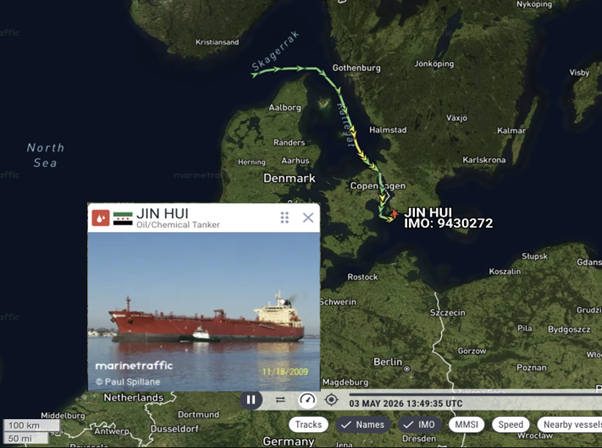
The Route of the “JIN HUI” Tanker in the Baltic Sea Before Its Interception by Swedish Authorities, According to Maritime Tracking Data
A Fake Flag and a Recent Ownership Transfer Raise Suspicions
Vessel-tracking reviewed by the Syrian Investigative Reporting for Accountability Journalism (SIRAJ) reveals a recurring pattern of identity changes involving the oil tanker JIN HUI, a practice widely associated with so-called shadow fleets.
The tanker, and measuring approximately 182 meters (597 feet) in length, has a history of Russian connections. It has not always sailed under its current name.
Over the years, the vessel has operated under several names and flags, including ALPINE ETERNITY under the Singaporean flag, CELSIUS ROSKILDE under the Marshall Islands flag, and YI BAO under the Liberian flag, before emerging as JIN HUI, flying Syria’s national flag.
But official records do not support the vessel’s claim of Syrian registration.
According to maritime ownership and management records published by Marine Vessel Traffic, JIN HUI was owned and commercially managed by Jinhui Shipping Ltd, a company registered in the Marshall Islands, until June 28, 2024.
By December 2025, however, the vessel’s safety management information was listed as “unknown.”
The disappearance of technical or operational management information is a potential red flag for maritime regulators, particularly when a vessel is subject to sanctions or suspected of operating within a shadow fleet. Complex ownership and management structures can make it difficult to establish legal responsibility or identify the vessel’s ultimate beneficial owner.
Ukrainian sanctions records also identify the company among entities subject to sanctions over alleged involvement in shipping networks associated with sanctions evasion, including suspicions concerning the transportation of goods and products from Russian-occupied Ukrainian territories.
A vessel-tracking record documenting the movements of the “JIN HUI” tanker between ports in Russia, India, Libya, and Algeria in the months preceding its interception by Swedish authorities. The vessel’s route reveals a complex and recurring pattern of movement between multiple ports and maritime areas, amid suspicions of its involvement in Russia’s so-called “shadow fleet,” used to circumvent Western sanctions on Russian oil exports.
The investigative team was unable to identify any functioning official contact channels for Jinhui Shipping Ltd in the Marshall Islands. As a result, the company could not be reached for comment on its relationship with JIN HUI or the vessel’s purported Syrian registration.
Data from the International Maritime Organization (IMO) and its Global Integrated Shipping Information System (GISIS) indicate that JIN HUI changed its flag to Syria in March 2026, just weeks before Swedish authorities intercepted it off the country’s coast.
A vessel’s IMO number serves as a permanent identifier, allowing investigators and regulators to track its history despite changes in name, flag, or ownership.
JIN HUI’s IMO number is 9430272.
A source at Syria’s General Directorate of Ports, who requested anonymity because they were not authorized to speak to the media, confirmed that neither the Syrian Chamber of Maritime Navigation nor the General Directorate of Ports had records establishing that JIN HUI was registered as part of Syria’s commercial fleet.
Ian Ralby, an expert in maritime security and international law, said the use of fraudulent flags is no longer unusual but has become part of broader sanctions-evasion practices.
“If the flag is fake, meaning it has not been legitimately authorized by the state whose flag the vessel claims to fly, the vessel is considered stateless and can be treated as a ship without nationality,” Ralby told the investigative team.
Under the international maritime legal framework, a vessel deemed stateless can face significant legal and security consequences. Without a valid flag state, it loses the protections ordinarily associated with nationality and may face greater exposure to inspection, interception, or detention by maritime authorities.
Eyad Khalil, a Syrian journalist from Latakia who specializes in maritime transportation, told SIRAJ that no vessel named JIN HUI appears in Syria’s maritime registry.
“There is no vessel registered under that name in Syrian maritime records,” he said. “In fact, there is currently no vessel legally flying the Syrian flag.”

Record of Changes in the Ownership and Management of the “JIN HUI” Oil Tanker Since 2009, Before Its Ownership Was Registered Under an Undisclosed Entity in December 2025, According to Maritime Tracking Data
Khalil added that Syrian maritime authorities are still working to reactivate the country’s ship registration system, raising serious questions about the legality of vessels claiming Syrian nationality during this period.
Vessel-tracking footage showing JIN HUI’s movements between ports in Russia, India, Libya, and Algeria in the months before its interception by Swedish authorities. The route reveals a complex pattern of repeated movements between ports and maritime regions, amid suspicions of links to Russia’s shadow fleet, which is used to circumvent Western sanctions on Russian oil exports.
Such repeated changes are not necessarily routine commercial decisions. They can be associated with sanctions-evasion networks in which a vessel’s legal identity is repeatedly altered to obscure its ownership and operations.
An Undisclosed Buyer and an Opaque Ownership Structure
Ownership records obtained through specialized maritime databases, including Equasis, reveal another significant development in JIN HUI’s recent history.
Since December 2025, the tanker’s ownership has been recorded under the designation “Rptd Sold Undisclosed Interest.”
The notation generally indicates that a vessel has reportedly been sold to an undisclosed party. It does not identify the ultimate beneficial owner.
In some records, a corporate entity may still appear as the vessel’s registered owner or manager, even when the individuals or entities exercising ultimate control remain unclear.
In JIN HUI’s case, the designation raises questions about whether intermediary companies or opaque corporate arrangements are being used to conceal beneficial ownership and complicate regulatory scrutiny.
IMO and GISIS records also indicate that the tanker switched to the Syrian flag in March 2026, only weeks before its interception near Sweden.
The vessel’s permanent IMO number, 9430272, makes it possible to trace these changes despite its shifting identity.
A source at Syria’s General Directorate of Ports, speaking anonymously because they were not authorized to address the media, reiterated that neither the Syrian Chamber of Maritime Navigation nor the General Directorate of Ports had records confirming JIN HUI’s registration in the Syrian commercial fleet.
Such ownership arrangements are not merely administrative details. They are among the indicators maritime investigators examine when assessing whether corporate structures may be used to conceal beneficial ownership or avoid international scrutiny.
Ralby emphasized that undisclosed ownership structures are not inherently illegal. However, they can make it substantially harder to identify and hold a vessel’s actual owner accountable, particularly in cases involving sanctions or maritime violations.
“The fundamental problem arises when illegal conduct occurs in national or international waters,” he said. “It becomes extremely difficult to identify the vessel’s true owner and hold them accountable.”
Although a company named Jinhui Shipping Ltd appears in some vessel records and is not directly listed under that name on certain sanctions lists, open-source sanctions data links it to other internationally sanctioned vessels, including ships identified by Ukraine and other monitoring bodies as part of Russia’s shadow fleet.
Shadow Fleet Secrets: How Greek tankers were used to transport Russian oil – Solomon
Changes in JIN HUI’s ownership and management since 2009. Maritime-tracking records indicate that the vessel was reportedly transferred to an undisclosed party in December 2025.
The uncertainty extends beyond the vessel’s flag.
Khalil said no company named Jinhui Shipping Ltd is registered in Syria, despite the company appearing in some records associated with the tanker.
In a statement published by the Swedish Coast Guard, Daniel Stenling, the agency’s deputy head of operations, identified several factors that had drawn the authorities’ attention to the vessel.
“There are several reasons why this vessel is of interest, including its inclusion on sanctions lists and the uncertainty surrounding its registration and flag,” Stenling said. “These circumstances raise questions about whether it meets seaworthiness requirements.”
Russia’s shadow fleet consists largely of oil tankers, many of them aging vessels, that frequently change flags, routes, and nominal ownership arrangements. These practices can allow Russian oil exports to continue despite international sanctions.
Countries such as Panama, which accounts for approximately 16% of global ship registrations, are commonly used for vessel registration and reflagging, according to data from the United Nations Conference on Trade and Development (UNCTAD).
An Undisclosed Buyer and an Opaque Ownership Structure
Ownership records obtained through specialized maritime databases, including Equasis, reveal another significant development in JIN HUI’s recent history.
Since December 2025, the tanker’s ownership has been recorded under the designation “Rptd Sold Undisclosed Interest.”
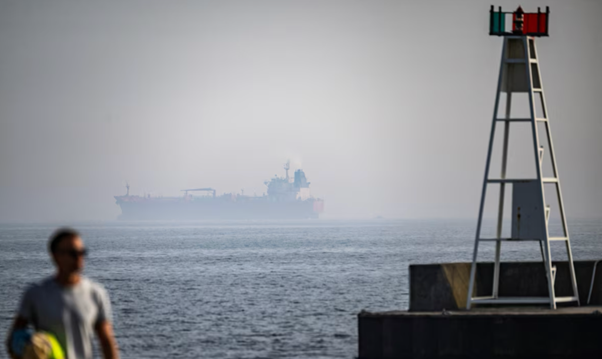
The “JIN HUI” Vessel Flying the Syrian Flag Despite Having No Official Registration in Syrian Maritime Records. Source: Swedish News Agency.
The notation generally indicates that a vessel has reportedly been sold to an undisclosed party. It does not identify the ultimate beneficial owner.
In some records, a corporate entity may still appear as the vessel’s registered owner or manager, even when the individuals or entities exercising ultimate control remain unclear.
In JIN HUI’s case, the designation raises questions about whether intermediary companies or opaque corporate arrangements are being used to conceal beneficial ownership and complicate regulatory scrutiny.
IMO and GISIS records also indicate that the tanker switched to the Syrian flag in March 2026, only weeks before its interception near Sweden.
The vessel’s permanent IMO number, 9430272, makes it possible to trace these changes despite its shifting identity.
A source at Syria’s General Directorate of Ports, speaking anonymously because they were not authorized to address the media, reiterated that neither the Syrian Chamber of Maritime Navigation nor the General Directorate of Ports had records confirming JIN HUI’s registration in the Syrian commercial fleet.
Such ownership arrangements are not merely administrative details. They are among the indicators maritime investigators examine when assessing whether corporate structures may be used to conceal beneficial ownership or avoid international scrutiny.
Ralby emphasized that undisclosed ownership structures are not inherently illegal. However, they can make it substantially harder to identify and hold a vessel’s actual owner accountable, particularly in cases involving sanctions or maritime violations.
“The fundamental problem arises when illegal conduct occurs in national or international waters,” he said. “It becomes extremely difficult to identify the vessel’s true owner and hold them accountable.”
Although a company named Jinhui Shipping Ltd appears in some vessel records and is not directly listed under that name on certain sanctions lists, open-source sanctions data links it to other internationally sanctioned vessels, including ships identified by Ukraine and other monitoring bodies as part of Russia’s shadow fleet.
Shadow Fleet Secrets: How Greek tankers were used to transport Russian oil – Solomon
Changes in JIN HUI’s ownership and management since 2009. Maritime-tracking records indicate that the vessel was reportedly transferred to an undisclosed party in December 2025.
The uncertainty extends beyond the vessel’s flag.
Khalil said no company named Jinhui Shipping Ltd is registered in Syria, despite the company appearing in some records associated with the tanker.
In a statement published by the Swedish Coast Guard, Daniel Stenling, the agency’s deputy head of operations, identified several factors that had drawn the authorities’ attention to the vessel.
“There are several reasons why this vessel is of interest, including its inclusion on sanctions lists and the uncertainty surrounding its registration and flag,” Stenling said. “These circumstances raise questions about whether it meets seaworthiness requirements.”
Russia’s shadow fleet consists largely of oil tankers, many of them aging vessels, that frequently change flags, routes, and nominal ownership arrangements. These practices can allow Russian oil exports to continue despite international sanctions.
Countries such as Panama, which accounts for approximately 16% of global ship registrations, are commonly used for vessel registration and reflagging, according to data from the United Nations Conference on Trade and Development (UNCTAD).
Environmental Risks Beyond Politics
warned that incidents involving suspicious vessels in European waters are no longer isolated events but part of a recurring pattern.
“What we are seeing is not simply the passage of sanctioned vessels, but an entire network exploiting legal and regulatory loopholes,” the analyst said. “These ships do more than change their flags. They reinvent their identities and disappear from tracking systems whenever they choose.”
The risks extend well beyond sanctions violations, the analyst added, posing a direct threat to the marine environment.
“When we talk about tankers without insurance or clearly identifiable owners, we are talking about floating environmental time bombs,” the analyst said. “If an oil spill occurs, there may be no identifiable party to assume responsibility or pay compensation.”
Since Western sanctions were imposed on Russia following its full-scale invasion of Ukraine in 2022, the so-called shadow fleet has expanded to more than 1,000 vessels, accounting for an estimated 17% of the global oil tanker fleet.
Ian Ralby, a maritime security and international law expert, warned of the dangers posed by vessels operating without adequate insurance or effective oversight from their flag states.
“A catastrophic oil spill from a tanker could cause damage lasting for generations,” Ralby said. “The consequences would affect not only the marine environment, but also surrounding coastal communities, maritime navigation, and the economic activities that depend on them.”
Although the fleet’s primary purpose is to sustain Russian oil exports, some vessels associated with it have increasingly come under suspicion over activities involving underwater infrastructure.
Suspected shadow fleet vessel Jin Hui banned from sailing | Sweden Herald
The JIN HUI, which flew the Syrian flag despite the absence of an official registration in Syria’s maritime records. Photo: Swedish News Agency.
In a statement reported by Reuters, Adrian Combier-Hogg, a senior Swedish prosecutor, announced the detention of a Chinese captain who had been commanding JIN HUI.
The captain, whose identity was not disclosed, would be questioned as part of the ongoing investigation, the prosecutor said.
Russia has not issued an official statement on this particular case, although Moscow has previously described the interception of its vessels as a “hostile act.”
Russia’s Shadow Fleet: Circumventing Sanctions
Security analysts say Russia relies on a shadow fleet comprising hundreds of vessels to circumvent Western sanctions imposed on its oil exports following the outbreak of the war in Ukraine.
The controversy surrounding the fleet extends beyond economics. Some of its vessels have been accused of posing serious environmental risks because they are aging tankers that may lack basic safety standards.
Over the past year, several undersea cables in the Baltic Sea have been damaged. Some analysts have linked these incidents to what is described as “hybrid warfare,” although conclusive evidence establishing direct responsibility has not emerged.
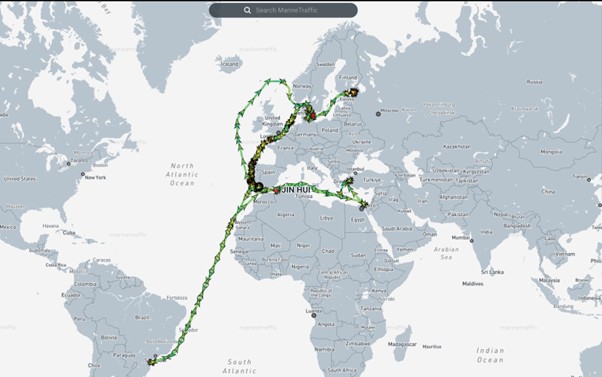
Map Illustrating the Route of the “JIN HUI” Tanker in the Final Weeks Before Its Detention and the Investigation into Its Ownership and Maritime Registration
Swedish Coast Guard Boards and Detains Sanctioned Shadow Fleet Tanker Jin Hui off Trelleborg
Map showing JIN HUI’s movements in the weeks leading up to its interception and the subsequent investigation into its ownership and maritime registration.
Vessels associated with the shadow fleet are often operated through complex networks of shell companies designed to obscure their true ownership and operational arrangements.
Many are registered in jurisdictions with relatively permissive regulatory frameworks, potentially making investigation and accountability more difficult.
During oil shipments, cargoes may be bought and sold multiple times while at sea. Ship-to-ship transfers are also frequently used, sometimes in open waters, making it harder to trace the original source of the oil.
These networks also rely on frequent changes of flag through what are known as flags of convenience, under which vessels are registered in countries with little direct connection to their actual owners.
Such arrangements can make it easier to avoid stringent oversight.
Vessel-tracking data also shows that some tankers engage in what are known as “dark periods,” during which their Automatic Identification System (AIS) transponders are switched off or manipulated.
These gaps in tracking data can occur during cargo transfers or route changes, complicating efforts to monitor vessel movements.
The West Steps Up Its Campaign Against Russia’s Shadow Fleet
European governments are intensifying efforts to disrupt Russia’s shadow fleet, which is believed to help generate revenue supporting Moscow’s war in Ukraine.
Russia has condemned these measures, describing them as hostile.
In March, Kaja Kallas, the European Union’s High Representative for Foreign Affairs and Security Policy, called for tougher action against Russian oil tankers.
She praised measures taken by countries including France, Belgium, and Sweden to inspect and detain vessels sailing under third-country flags.
“Increasing pressure on the shadow fleet is one of the best tools available,” Kallas said.
Ralby believes the warning signs surrounding JIN HUI are not isolated. Instead, they appear consistent with broader tactics used by sanctions-evasion networks to keep Russian oil moving through international maritime trade.
“In this case, the vessel does indeed appear to be part of that broader effort to evade law enforcement and prevent the disruption of sanctioned maritime trade flows, particularly oil,” he said.
Creative Direction and Visual Solutions: Radwan Awad