

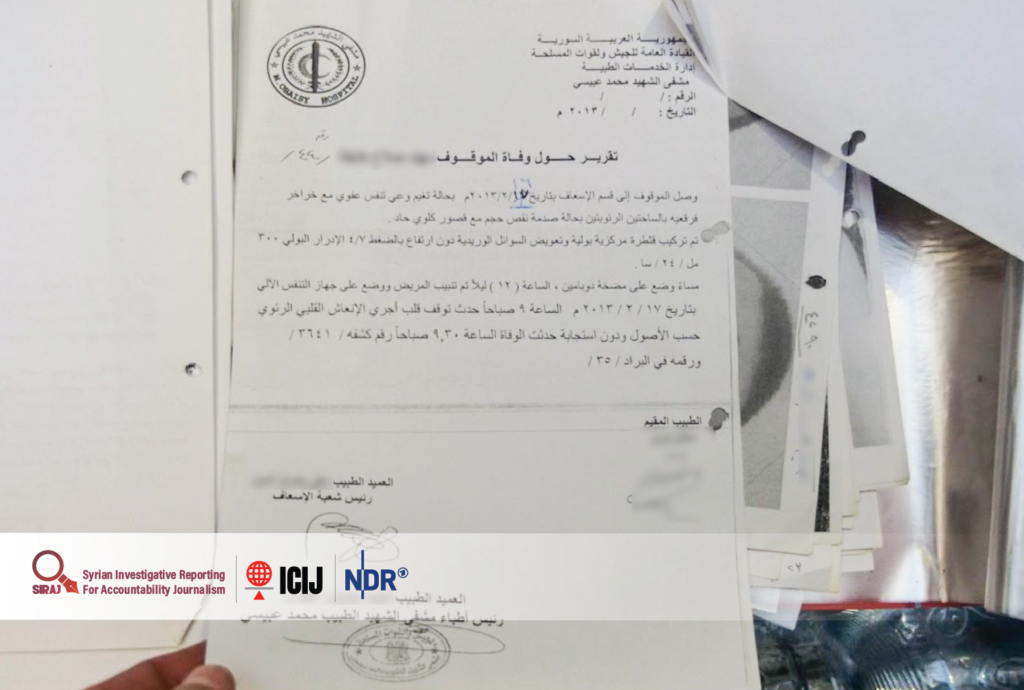
On the Morning of February 12, 2013, a vehicle belonging to one of the security branches of the ousted Assad regime arrived at Harasta Military Hospital, known as “Hospital 600.” Inside the vehicle were the bodies of eight unidentified individuals.
The corpses bore clear signs of torture and starvation. Nevertheless, three doctors at the hospital — a resident physician “S. B.”, the head of the emergency department “A. H.”, and the chief medical officer “M. A.” immediately issued a medical report stating that all eight persons had died of “cardiac arrest and respiratory failure.”
For years, the hospital had enjoyed a “good reputation” among soldiers and their families and was home to some of Syria’s most well-known doctors. Yet behind its walls lay a reality far darker than the image promoted by the Assad regime.
On the hospital’s seventh floor, an entire ward was designated for detainees transferred from security branches. There, systematic torture and mass killing took place, followed by institutionalized falsification of medical reports stating false causes of death, a process in which senior medical staff at the hospital actively participated.
It was no coincidence that eight detainees died of “cardiac arrest.” This phrase functioned as a medical cover formula used by the regime for years, beginning with the outbreak of the Syrian uprising in 2011, to conceal deaths under torture in its prisons and security branches. The regime exploited its control over military hospitals under the Syrian Army’s Medical Services Directorate, relying on doctors who participated in torture and falsified medical reports documenting the deaths of thousands of political detainees.
For these doctors, everything appeared routine: falsifying causes of death, signing official documents to legitimize them according to an exclusive body intake document reviewed by the investigative team, and then transferring the bodies to mass graves. Over time, this falsification became standard practice and an entrenched method carried out by doctors and nurses who still live among us today, whether inside Syria or in Germany, a country that welcomed millions of Syrians fleeing massacres and mass killing. Some of these doctors later fled there, yet we were able to track them, as this eight-month investigation reveals.
This joint investigation by (SIRAJ, the International Consortium of Investigative Journalists (ICIJ), Germany’s public broadcaster NDR, and Süddeutsche Zeitung, as part of the Damascus Dossier project, reveals through exclusive military hospital documents how dozens of doctors, some of whom continue to practice medicine in Germany, participated in the torture of detainees and the falsification of their causes of death in Assad’s prisons and medical facilities.
The documents include more than 70 death certificates issued by Harasta Military Hospital, all signed by doctors from the same institution.
In cooperation with its partners, SIRAJ formed a multidisciplinary team of investigative journalists, open-source researchers, and analysts. By combining documents, survivor testimonies, and witness accounts from former hospital staff, and using open-source investigation techniques, the team obtained evidence indicating that at least 18 Syrian doctors who previously worked at the notorious military hospital are now residing in Germany, some holding senior positions in German hospitals.
Among them is a doctor alleged to have performed surgery without anesthesia on a detainee, called Nael, interviewed by the investigative team. l.
The investigation is part of the Damascus Dossier, a collaborative investigative project led by the ICIJ in partnership with NDR, involving 126 journalists from 26 media organizations across 20 countries, who spent over eight months organizing documents, analyzing evidence, consulting experts, conducting interviews, and tracing the doctors now hidden behind white coats that conceal their past in Assad’s military hospitals.
Official estimates indicate that approximately 7,000 Syrian doctors are currently registered in Germany.
From Harasta Military Hospital to Germany
From the moment the documents were obtained, the investigative team began tracing the identities of the doctors to determine their whereabouts and roles following the fall of the Assad regime, and their involvement in the machinery of torture and killing that crushed the lives of thousands of Syrians over the years of revolution.
The team interviewed Dr. “A,” currently residing in Germany, and was accused by a former detainee of torturing him and performing surgery without anesthesia at Harasta Military Hospital. The doctor acknowledged that he had access to the seventh floor and admitted that systematic torture took place there. However, he strongly denied committing any crime or violating medical ethics, claiming he never breached professional standards during his tenure, a narrative cast into doubt by the harrowing details provided by the survivor.
It remains unclear whether these doctors acted voluntarily or were coerced due to their positions within hospitals where detainees were systematically executed.
Documents reviewed by the investigative team show that 36 doctors across four military hospitals signed death certificates listing “cardiac arrest” and “respiratory failure” as causes of death for 92 detainees, including 38 unidentified individuals. Except for one case, the documents do not indicate that bodies were handed over to families or clarify their fate.
These records strongly suggest that the doctors actively participated in concealing evidence of the Assad regime’s killing of thousands of Syrians under torture.
The team verified documents signed by Dr. “A” during his tenure at Harasta Military Hospital and found that he signed reports stating that 14 detainees died of “cardiac arrest” and “respiratory failure,” including unidentified bodies transferred from the notorious Al-Khatib Branch (Branch 251) of the State Security apparatus.
Investigators also traced the doctor’s social media activity, uncovering close ties with another resident physician, Dr. “S”, at Harasta, a doctor who signed the death certificates of eight unidentified detainees and was repeatedly named by survivors who accused him of torture.
One of his Facebook posts shows him bidding farewell to colleagues at the hospital, confirming his employment there. In another post dated July 3, 2013, he shared a photo of a phone he claimed to have taken from a “wounded fighter,” writing:
“There is always time to ask a wounded fighter questions unrelated to war, death, terrorism, and revolution to pull him out of Tora Bora. I see what I see. I ask, and he answers.”
According to documents, Dr. “S” signed medical reports stating that eight individuals died of “cardiac arrest” and “respiratory failure.”
Human rights expert Moatasem Al-Kilani stated: “Issuing death certificates that misrepresent the true cause of death places doctors under direct criminal liability for complicity in killings under torture and for concealing evidence, pursuant to Article 4 of the Convention Against Torture.”
By reviewing employment records, investigators confirmed that all named doctors worked at Harasta Military Hospital and that their signatures matched those on detainee death certificates. No evidence was found contradicting survivor and witness testimonies.
To further corroborate accounts and verify signatures, the team conducted multiple interviews with former Harasta doctors now living in Germany. All confirmed survivors’ accounts of systematic torture on the hospital’s seventh floor, citing screams they heard or emaciated bodies they saw.
Initially, all doctors denied participating in torture and claimed restricted access to the detainee ward. Others asserted they “only practiced medicine” and that decisions were controlled by military personnel.
Commenting on the evidence, Swedish prosecutor Reena Devgun said: “This type of evidence is crucial for building cases, whether to establish the systematic nature of crimes, a key requirement for crimes against humanity, or to establish the responsibility of medical staff who should have known what was happening, given the massive scale of torture and deaths.”
The Seventh Floor: Torture Without Purpose
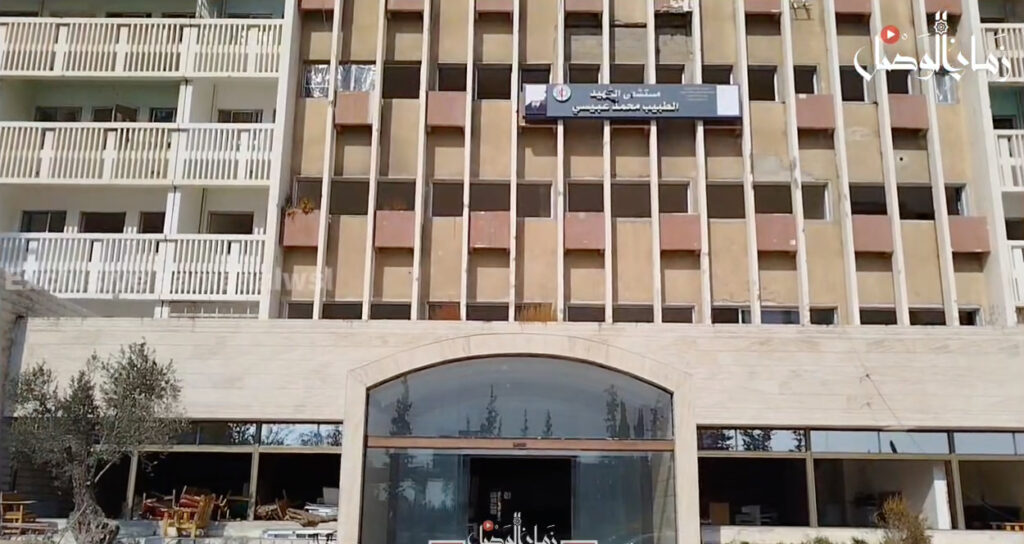
The seventh floor of Harasta Military Hospital was supposedly designated for treating detainees transferred from security branches due to illness or injury. However, testimonies from survivors and interviews with over 12 witnesses, including doctors and nurses, confirmed it functioned as a permanent torture chamber.
Firas Al-Shater, one of the few survivors, describes Harasta as a “medical slaughterhouse.” Transferred there in 2012, he was assigned a number, blindfolded, and thrown onto a bed with other detainees.
He recalls: “In security branches, they torture you to extract confessions. In Harasta, they torture you 24 hours a day for no reason.”
Al-Shater and others describe constant beatings by the army and security personnel. Medical staff also participated. He remembers a nurse extinguishing a cigarette on his foot and estimates that more than 200 cigarettes were put out on his body without receiving any treatment.
He believes the morgue often overflowed, forcing doctors to place bodies in hallways. “I called it the hospital of death.”
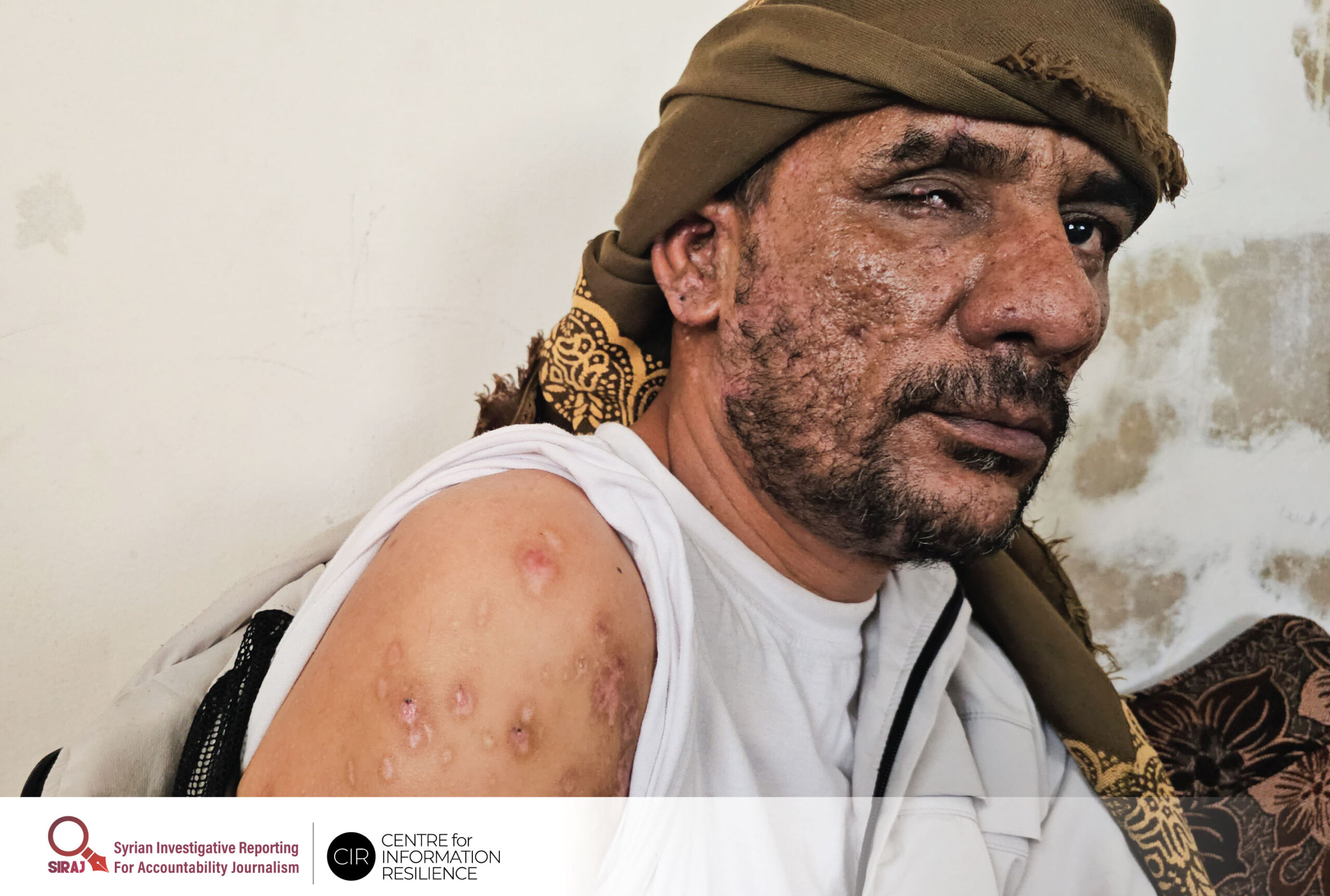
Nail Al-Maghrebi, who now lives in Stuttgart, Germany, was also among the victims of torture at Harasta Military Hospital. In 2012, Syrian army soldiers shot him at close range, wounding him in the leg. He was then tortured, filmed, and the video was published on social media.
Following his injury, Nail was transferred to Harasta Military Hospital, where he says he was tortured by a doctor identified as “A,” who inserted metal screws into the bones of his leg without anesthesia. “I screamed in pain until I lost consciousness,” he recalls. The doctor then poured alcohol under Nail’s nose to revive him before continuing the painful procedure. “One of the guards told me that pain is a requirement for treating detainees.”
Harasta Military Hospital has remained closed since the fall of the Assad regime in December 2024. Yet its corridors undoubtedly still hold thousands of documents pointing to the names of those involved in torture and killing crimes committed against the regime’s victims over the years of the Syrian revolution.
The Journey of Death
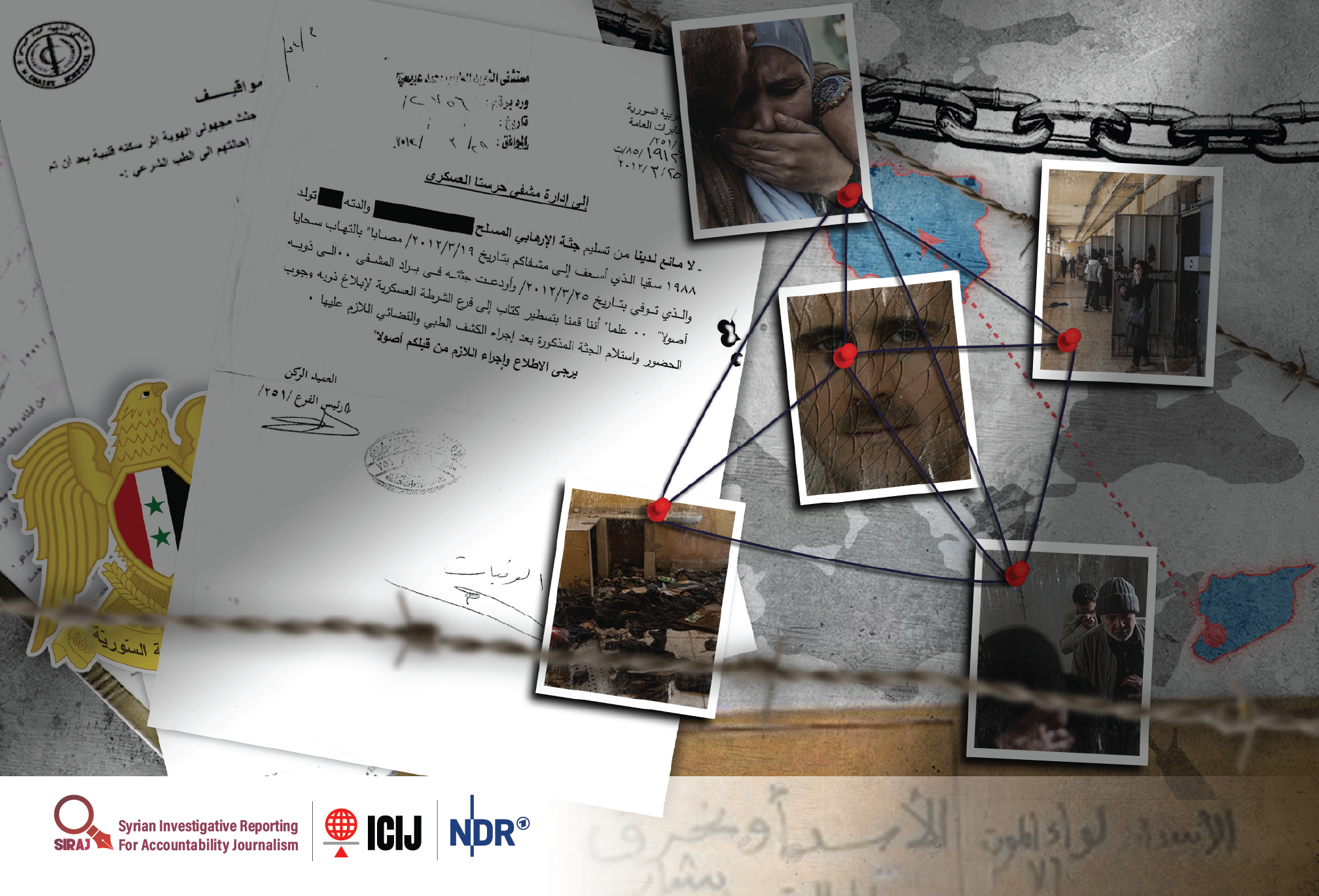
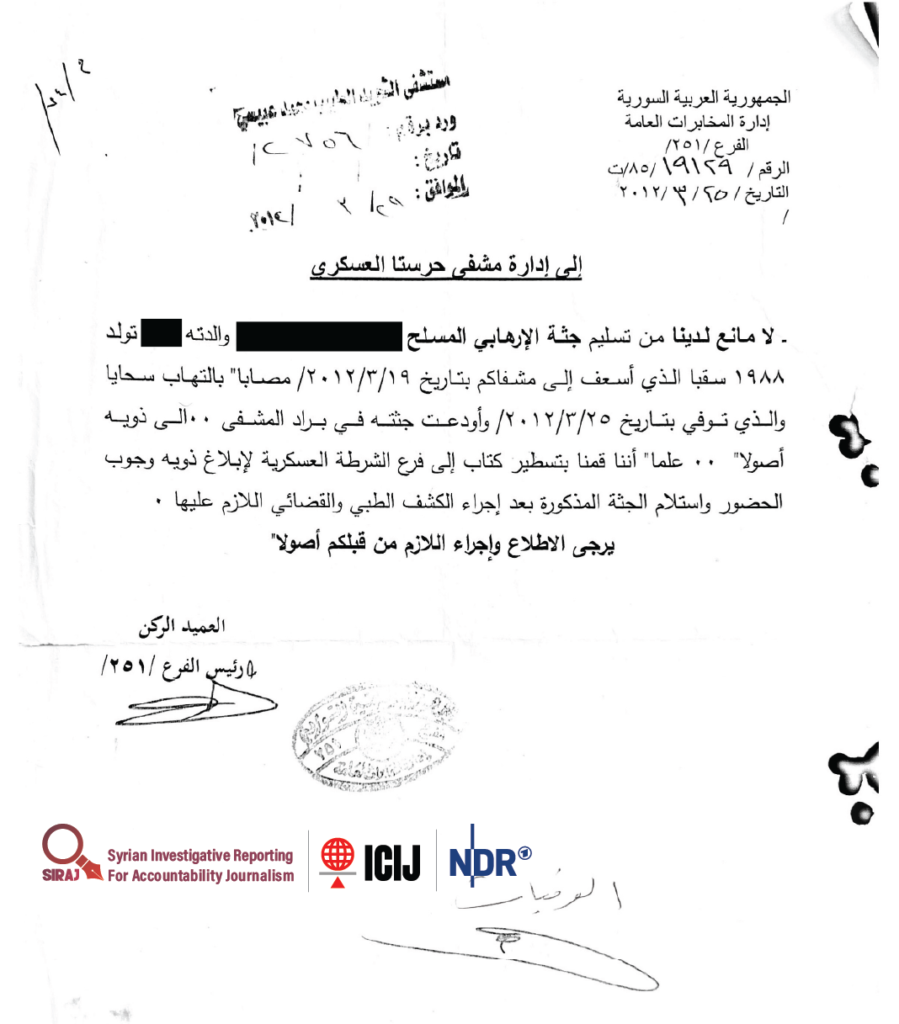
On March 19, 2013, a detainee held by Branch 251 of the State Security Directorate, known also as the “Al-Khatib Branch,” was transferred to Harasta Military Hospital.
According to a document issued by the head of the branch, the detainee described as an “armed terrorist” died on March 25, 2013, allegedly due to “meningitis,” and his body was placed in the hospital morgue.
Based on orders from the Branch chief, the hospital administration was authorized to hand over the body to the family through a notification issued by the military police.
This family was the only one allowed to learn the fate of their son and receive his body, according to dozens of documents reviewed by the investigation team. Meanwhile, countless other families remain unaware of what happened to their loved ones or the atrocities that led to their deaths before the causes were falsified in military hospitals.
The investigation team reviewed dozens of documents issued by four military hospitals affiliated with the Military Medical Services Administration and the Ministry of Defense under the former Assad regime:
- Harasta Military Hospital (“Hospital 600”)
- Tishreen Military Hospital in rural Damascus
- Mezzeh Military Hospital (Hospital 601) in Damascus
- Red Crescent Hospital on Baghdad Street in Damascus
The documents reveal the deaths of 92 detainees, including 38 unidentified bodies, most of them detainees held by the Al-Khatib Branch.
Swedish prosecutor Reena Devgon stated that the materials being revealed today, including photographs, documents, and medical reports, are of exceptional importance because they not only demonstrate the scale of violations but also prove the systematic nature of torture within Syrian intelligence units and military hospitals.
“This type of evidence is what legally allows us to build cases involving war crimes and crimes against humanity,” Devgon added.
A clear pattern emerges in medical reports issued by military hospitals and signed by resident doctors, on-call physicians, and heads of emergency departments. Detainees brought in from security branches are recorded as arriving dead from the General Intelligence Directorate. Doctors then document and sign medical reports repeatedly citing causes of death such as “cardiac arrest” and “respiratory failure,” despite photographic evidence showing clear signs of torture and extreme emaciation resulting from starvation in detention centers.
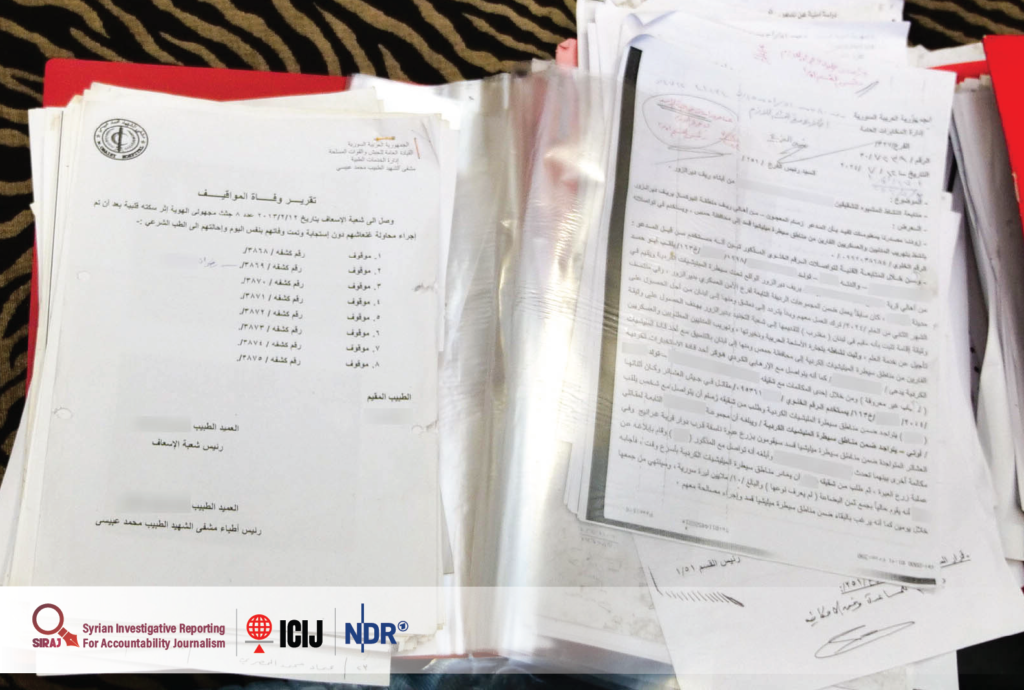
The former regime’s systematic policy of falsifying evidence was not limited to issuing medical reports. In numerous cases reviewed by the investigation team, documents from Mezzeh Military Hospital (601) were signed by doctors as “witnesses” to detainees’ deaths on specific dates, again attributing them to heart and respiratory failure and claiming the detainees arrived dead.
The documents and administrative orders do not specify the fate of these bodies afterward. However, testimonies and evidence gathered from witnesses and open-source investigations point to a single destination: mass graves.
Mapping the Machinery of Death
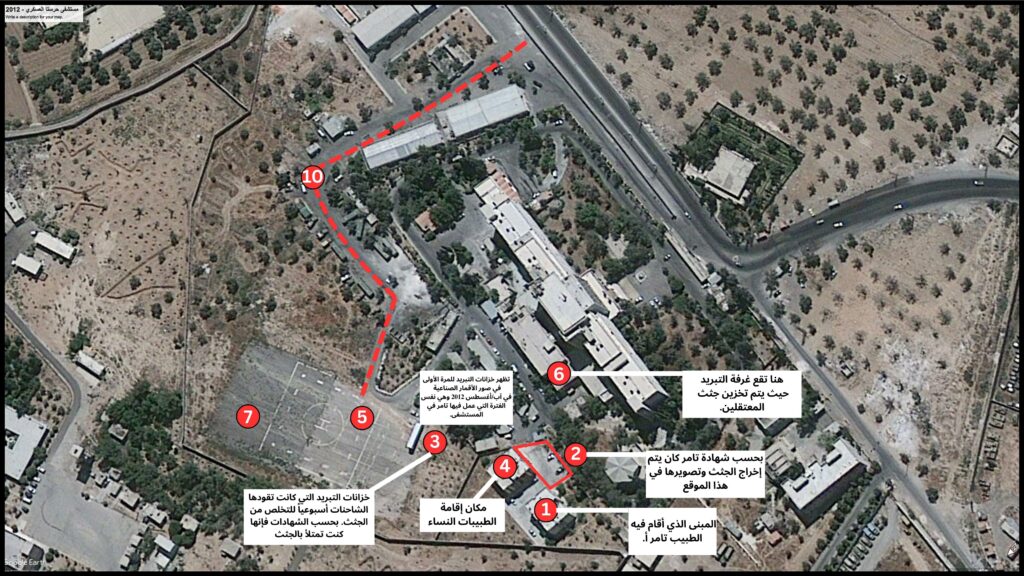
The investigation team interviewed a doctor who served for six months at Harasta Military Hospital in 2012, the same year referenced in dozens of reviewed documents. During his service, he witnessed horrifying details of how detainees’ bodies were brought to the hospital, photographed, loaded onto trucks, and transported to mass graves.
This testimony enabled the team to reconstruct a complete map of body transportation operations at Harasta Military Hospital by matching the details with satellite imagery from 2012 and 2013.
Satellite image of Harasta Military Hospital showing body storage, photography sites, and refrigeration trucks used to transport bodies to mass graves – Source: Maxar
The doctor confirmed that in 2012, he personally observed white refrigerated containers (Site 3) being filled with black body bags, leaving the hospital clearly visible from the doctors’ residential building (Site 1).
When he asked a soldier why the containers were placed on the helicopter landing pad, the soldier replied that it was to keep the smell of decomposing bodies away from the hospital.
Bodies were placed into bags at two different locations: behind the morgue’s rear entrance (Site 6) or near a location where bodies were photographed (Site 2). Due to limited space, many photos were taken directly on the helicopter pad (Site 5), facing the doctors’ residence.
According to the doctor, trucks did not arrive empty; they already contained bodies and remained on the helicopter pad for days after being loaded with corpses from Harasta Military Hospital.
He stated that the hospital processed a fixed number of bodies, approximately 1,180 corpses per week. One soldier was responsible for registering deaths and driving refrigerated containers to collect bodies from the hospital.
That soldier later “committed suicide,” though the doctor suspects he was killed because he knew too much and had spoken to others about the body transfers.
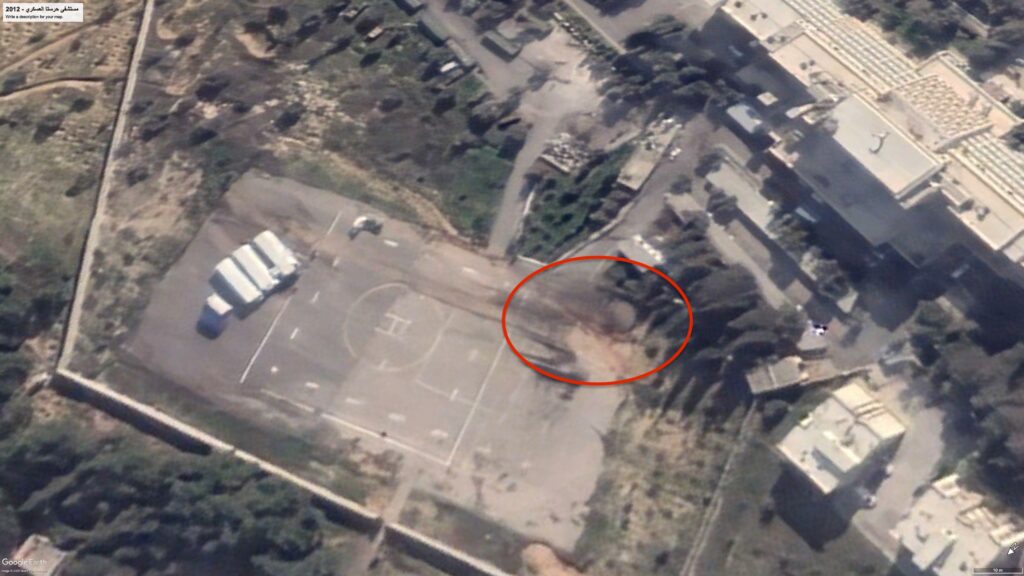
The doctor also recalled frequently seeing a “red liquid” leaking from the refrigeration containers, believed to be bodily fluids. Satellite images corroborate his testimony, showing red stains at former container locations after they were moved to another part of the helicopter pad.
Torture on the Hospital Bed
Harasta Military Hospital was only one station in a medical system transformed by the regime into a direct extension of secret human slaughterhouses.
One former detainee, arrested on charges of planning to defect, said he was transferred from Sednaya Prison to Tishreen Military Hospital in 2012 or 2013 for “treatment” of severe scabies.
He was not alone. He was transported alongside three living detainees, six corpses, and four individuals “between life and death.”
Upon arrival, hospital staff handed him ten body bags and ordered him to place the “patients” inside them.
At first, he thought the number of bags exceeded the number of bodies. He soon realized why: hospital staff strangled the four detainees who were still breathing and then ordered him to bag them as well. He was forced to drag the bags down the stairs and throw them into a large container prepared for this purpose.
Afterward, he was taken to an upper floor and examined by a doctor who provided no treatment other than two ibuprofen pills, despite his severe condition. He recalls constant humiliation and abuse by medical and military staff. When he went to the bathroom, he was shocked to see dozens of bodies piled on top of each other.
International Accountability
The trial of Syrian doctor Alaa Mousa, who was sentenced to life in prison in Germany, continues to weigh heavily on those involved in human rights violations under the Assad regime, especially those who fled to Europe.
The historic Frankfurt trial was groundbreaking: it was not a prosecution of a military officer or intelligence official, but of a doctor. It paved the way for broader accountability of all participants in the killing machine, including medical professionals who helped conceal evidence or extract confessions, under universal jurisdiction laws.
Syrian international criminal law expert Moatasem Al-Kailani stated: “International law criminalizes participation in torture, whether through direct involvement, complicity, or even silence. Conduct such as performing medical procedures without anesthesia or participating in interrogations violates professional medical ethics and constitutes clear breaches of the UN Convention Against Torture.”
Commenting on the investigation’s findings, Dr. Susan Jonah, Vice President of the German Medical Association, said German authorities must urgently follow up on the evidence and examine all materials presented.
“Syrian doctors are an indispensable part of Germany’s healthcare system,” she added. “But it is essential to identify the few who participated in torture in Syria. No doctor involved in torture should be allowed to practice medicine in Germany in any capacity.”
Due to the unique nature of international criminal law, Germany’s Federal Prosecutor can prosecute perpetrators for crimes committed abroad even if the victims are not German nationals.
Creative coordination and visual solutions: Radwan Awad
Research and data collection: Mawadda Klass