

Widad’s story began before the outbreak of the Syrian uprising. Her husband had purchased a plot of land in Douma in partnership with his older brother, but the property was registered solely in the brother’s name. After the uprising began, Widad’s husband was killed. The land remained registered under his older brother’s name, but during the siege of Douma, which lasted from 2013 to 2018, the brother decided to transfer the deceased man’s share to his two sons, who had lost their father.
Everything seemed to be going smoothly. But the situation changed after the uncle died and Assad’s forces entered Douma in 2018.
Douma was among the Syrian cities subjected to relentless bombardment and killings. The Assad regime imposed a prolonged siege on the city, forcing a large portion of its population to flee while others remained. The city’s population fell to approximately 125,000, down from around 300,000 before the siege. Widad and her two sons were among those who stayed.
Beyond the killings and siege, Assad’s regime pursued a strategy of collective punishment through legal institutions and legislative decrees designed to deprive residents of their homes and land. Among the most significant was Decree No. 11 of 2016, which suspended the registration of real property rights at legally authorized land registry offices that had been closed because of emergency security conditions.
In a 2020 report, the Syrian Network for Human Rights described this decree, along with other legislative measures, as part of a broader strategy of “property seizure.” The report argued that these measures amounted to forced eviction and an attempt to manipulate the country’s demographic and social composition.
Land Records Under Siege
During the siege, Douma was controlled by the armed opposition faction Jaysh al-Islam, also known as the Army of Islam.
“From the beginning of their control, they were determined to preserve the land records,” said Adnan Taha, who served as director of Douma’s land registry during the period when opposition factions controlled the city.
Between the establishment of the opposition-run land registry in 2013 and the Assad regime’s recapture of Eastern Ghouta in 2018, approximately 11,000 property transactions were documented in Douma, including 9,000 purchase and sale agreements, according to lawyer Samir Taameh, who served as a civil judge in Douma during the uprising.
Despite the siege, property transactions continued, effectively disregarding Assad’s decree.
After the regime regained control of Douma, the wife of Widad’s deceased brother-in-law took advantage of Decree No. 11. She denied that her husband had transferred the land to Widad’s sons and proceeded to sell the property.
Widad said she was unable to challenge the sale in regime-controlled courts.
“They used intimidation and thuggish tactics against me. They terrorized me,” she recalled.
Her vulnerability was compounded by the fact that she was the widow of a man whom the regime had labeled a “terrorist.”
Instead of selling the land to purchase a home for herself and her children, as she had hoped, Widad found herself living at her parents’ house.
Nayef al-Kahhal, known as Abu Mohammad, owns a real estate office in Douma. He lived through the uprising, the siege, and the subsequent entry of Assad’s forces into the city.
He said property sales continued even during the harshest years of the siege.
“Life goes on. Some people sold their properties just to survive during those terrible years,” he said.
“But many people didn’t sell. About 10 percent sold their properties, while 90 percent held on to what they owned.”
Adnan Taha described how land registry officials worked to protect property records during opposition control of Eastern Ghouta.
“We took the original land registry books from the regime era and kept them in a safe place,” he said.
The registry came under repeated attacks, including attempts to set it on fire and strikes by multiple rockets.
“We often saw doors moving and walls shaking,” Taha recalled, describing the intensity of the bombardment.
“Our office was near the Grand Mosque, which was the most dangerous place in the world. But we fortified our archive and stored it in a basement beneath the mosque.”
The staff went to extraordinary lengths to preserve the documents.
“We dug a pit and placed salt inside it to absorb moisture. That’s what protected our records,” he explained.
After 2017, registry employees also began digitizing the entire archive. According to Taha, those electronic records are still being preserved.
Protecting the documents was only part of the challenge. Registry officials also had to decide how to record new property transactions without jeopardizing the integrity of the original records.
At first, newly issued contracts were attached to the property registration pages using small fastening beads, rather than being written directly into the official ledgers.
Taha explained that the employees working at the time were not recognized by any authority outside Douma.
“We used to say that someone would come after us, once we won, to review what we had done and formally validate it,” he said.
Eventually, however, the registry staff changed their approach and began entering transactions directly into the land registry books.
They feared that regime employees could easily remove attached documents in exchange for bribes.
There was also a symbolic reason behind the decision.
“We wanted to say: The revolution passed through here,” Taha said.
Meanwhile, al-Kahhal took his own precautions to preserve the property contracts handled by his real estate office.
For every transaction, he prepared three copies: one for the seller, one for the buyer, and a third retained at his office.
That practice later proved invaluable when displaced residents returned to Douma. If someone had lost their copy during displacement, al-Kahhal could provide a replacement from his archive.
Decree No. 11 was issued in 2016, while Eastern Ghouta, including Douma, remained under siege.
The decree was not limited to Douma. It applied to areas outside the Assad regime’s control where land registry offices had been closed because of what the decree described as “emergency security conditions.”
Under its provisions, the registration of real property rights was suspended at the legally authorized offices responsible for maintaining ownership records.
The decree also stipulated that the start and end dates of the suspension would be determined by the relevant minister, based on a proposal from the governor and after consulting the appropriate directorate.
Crucially, it stated that any registration or entry made in land registry records during the suspension period would not be legally recognized.
The decree came as a shock to residents of areas outside regime control and prompted officials overseeing Douma’s land registry to reconsider their procedures.
Previously, new contracts had been attached to property registration pages using fastening beads. After the decree was issued, registry employees began writing new transactions directly onto the official property records, according to Taha.
The Regime Returns to Douma
After Assad’s forces entered Douma, property ownership became increasingly chaotic. Some residents welcomed the decree because it effectively restored their ownership claims, allowing them to sell properties or land again to new buyers. In some cases, they took advantage of the absence of those who had purchased the properties during the siege—whether because they had been detained or forcibly displaced. Others benefited from pressure exerted by Assad loyalists who had become active in areas brought back under regime control.
According to lawyer Samir Taameh, however, at least 8,000 property owners involved in these transactions took the initiative to resolve their disputes and formalize the sales.
“In approximately 1,000 cases, some sellers objected that they had sold their properties for too little and received additional compensation,” Taameh said. “Others exploited this legal loophole and refused to honor the sales.”
He added that regime loyalists spread the claim that all property sales conducted during the siege were invalid, even though the decree specifically stated that entries made in the land registry during the suspension period would not be legally recognized.
“This was a limited group,” he said. “If we conducted an accurate count, I believe the number would be fewer than 1,000 cases. These are my personal estimates.”
Under Syrian law, registering a property sale with the land registry is not necessarily a prerequisite for the validity of the sales contract, according to lawyer Mohammad Ali Taqi al-Din.
He explained that the general legal principle is that transactions are permissible unless expressly prohibited. Accordingly, property sales remain valid unless a court issues a ruling invalidating them on grounds such as forgery, coercion, or extortion.
In practice, Decree No. 11 required property transactions to undergo renewed legal procedures to establish ownership.
Taameh explained how the process worked.
“If both the seller and buyer were in Douma, the buyer could present a copy of the transaction that the seller had authenticated with a fingerprint at the local council, or they could draw up a new contract,” he said. “The buyer would then file a lawsuit to confirm the sale, and ownership could be transferred smoothly and relatively easily, even if the original transaction had taken place during the siege.”
The greatest difficulties arose when one of the parties had been detained, displaced, or was facing security-related accusations.
Others, particularly vulnerable residents, were intimidated by regime loyalists.
“Several lawyers in Douma became involved in extortion,” Taameh said. “They pressured sellers into transferring properties under the threat of being accused of dealing with terrorists.”
Then the Regime Fell
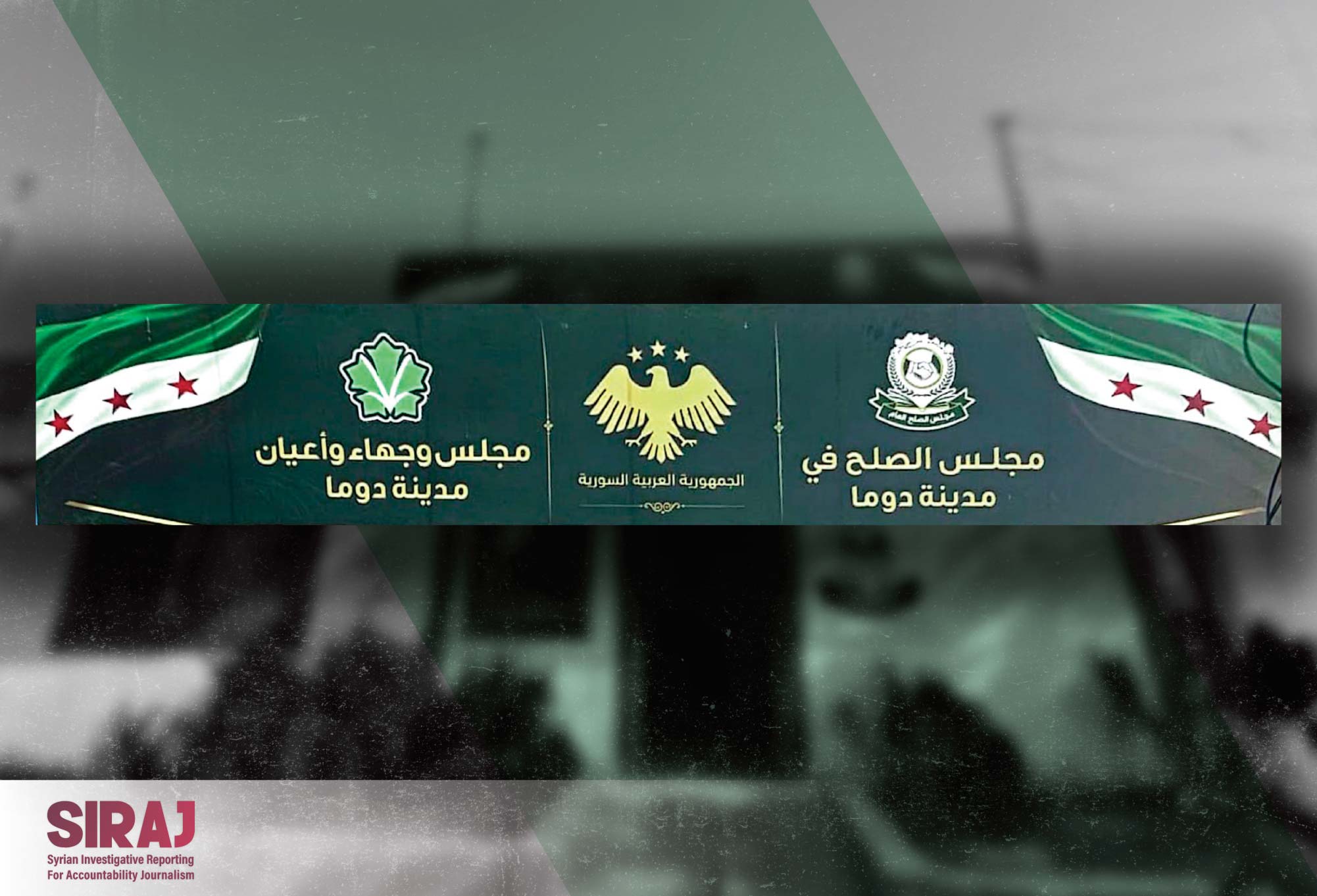
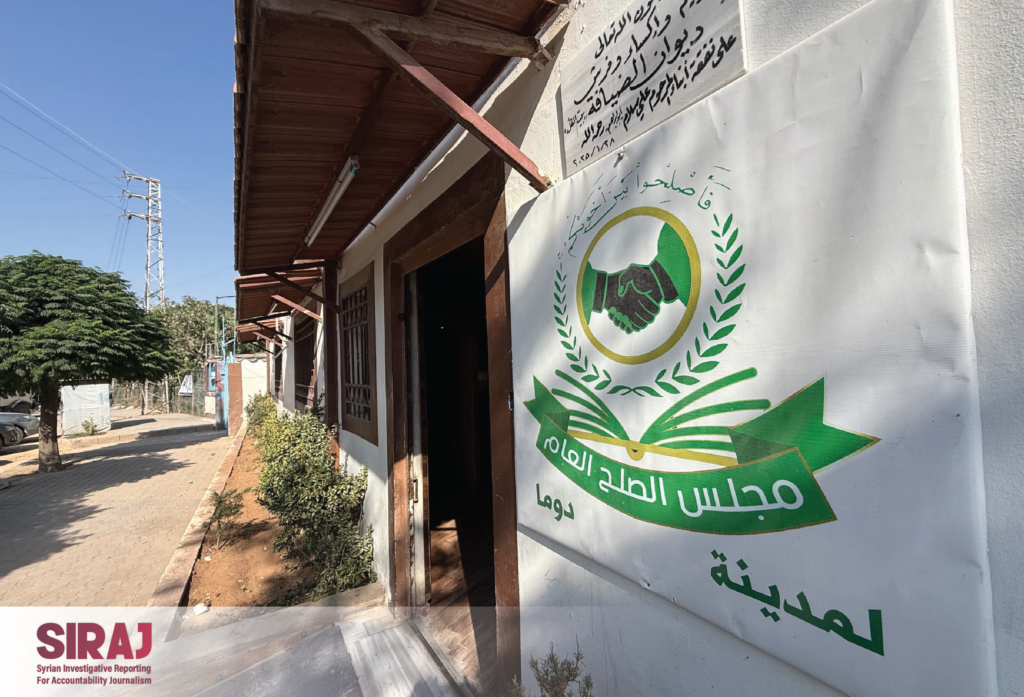
Following the fall of the Assad regime, several prominent figures in Douma established a Reconciliation Council, setting up its headquarters in the city’s Municipal Square.
The council is one of approximately 500 reconciliation councils established during the uprising and after the country’s liberation. These councils operate in various parts of Syria under a central administration that includes legal and religious affairs departments, public relations units, and other specialized offices.
More than 7,000 volunteers reportedly work with these councils across Syrian cities and towns.
Their purpose is to resolve disputes through mediation and mutual agreement, outside the formal court system. The cases they handle include property disputes, family disagreements, and financial conflicts.
Douma’s council is chaired by Nizar Samadi, a consulting architect and longtime resident of the city. After years working in engineering, Samadi was forcibly displaced from Douma to northern Syria and later moved to Turkey. He returned following the regime’s fall.
One of the council’s principal challenges, according to Taameh, who serves as a member, is its lack of enforcement authority.
It cannot compel a person accused of wrongdoing to attend a hearing or comply with a settlement.
Samadi nevertheless believes the councils possess a different kind of influence.
“Although the councils have no enforcement powers, they carry moral authority,” he said. “Both parties come voluntarily to resolve their dispute, which means they are willing to accept a solution. Implementation therefore rests on moral and ethical commitments.”
But agreements are not always honored.
“Some people may change their minds afterward,” Samadi explained. “In that case, the other party can turn to the courts, which may consider the reconciliation agreement when issuing a ruling.”
The council also lacks the authority to summon anyone who refuses to participate or to force parties to implement its decisions.
For that reason, council members take precautions to improve the likelihood that settlements will be honored.
“If the dispute involves money, for example, the debtor can sign promissory notes that remain with the Reconciliation Council as a guarantee of the creditor’s rights,” Samadi said.
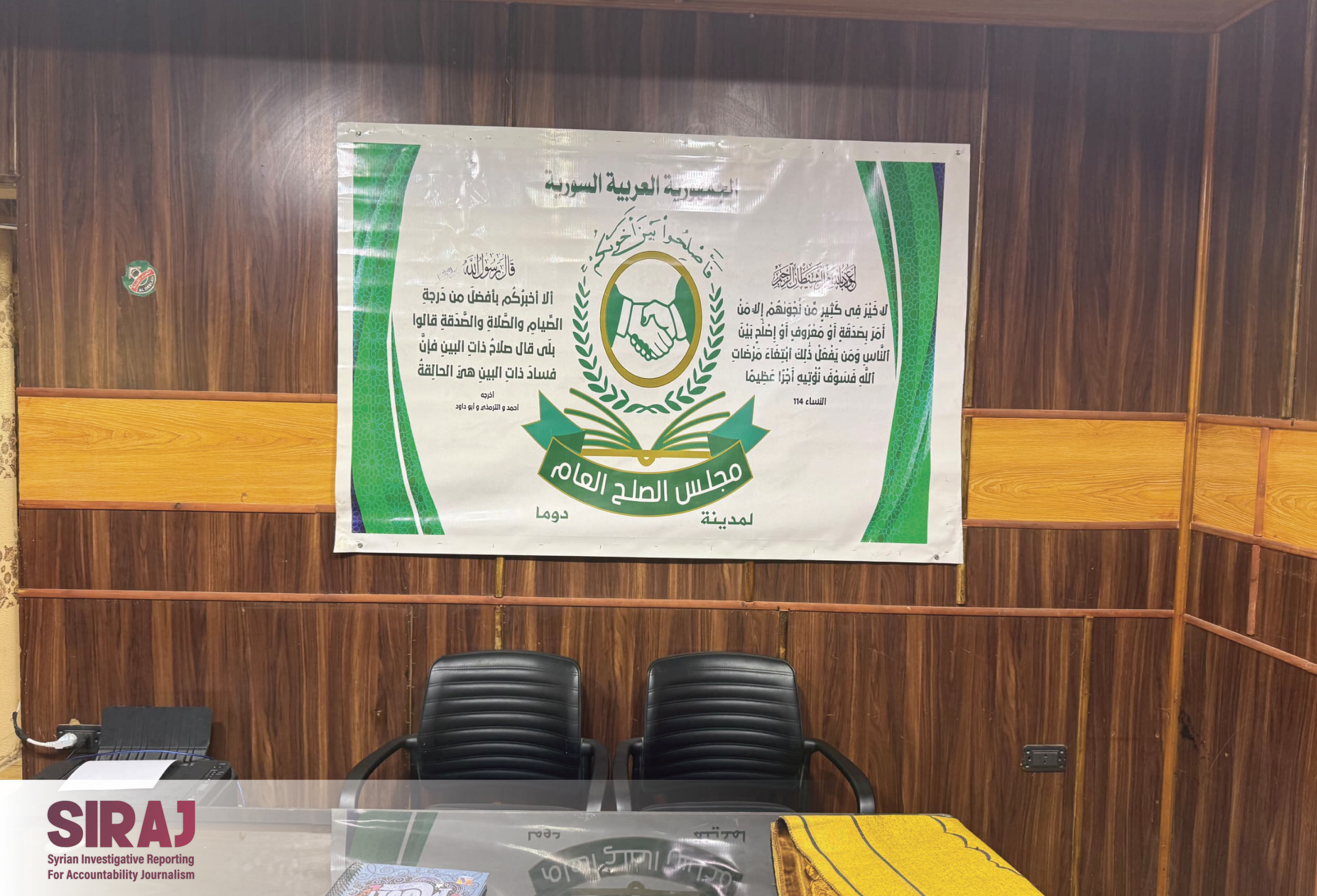
Douma Reconciliation Council headquarters — SIRAJ
- The council was established following the liberation, in February 2025.
- It has successfully resolved more than 800 documented cases, including disputes involving bloodshed, inheritance, real estate, financial matters, family issues, and others.
- Its services are not limited to residents of Douma. The council can resolve disputes regardless of the governorate from which the parties originate. For example, it successfully settled a dispute between two individuals who traveled from Qamishli.
- The primary motivation for turning to the council and similar reconciliation bodies is to save time for both disputing parties and the judiciary, while reducing the effort and costs associated with conventional litigation. These councils also play an important role in strengthening social cohesion and preserving civil peace.
- How the Council Operates
- At least one of the disputing parties visits the council’s office to register the details of the dispute.
- The council then contacts the other party and schedules a hearing.
- Certain cases, particularly those involving physical assault or other forms of aggression, are given priority and scheduled for urgent hearings.
- Both parties attend the scheduled hearing, where each presents their account of the dispute.
- The council then issues either an arbitration ruling or a reconciliation agreement to resolve the dispute. The settlement document always explicitly states that both parties have voluntarily agreed to the settlement, after which its terms are implemented.
- The judiciary recognizes the outcomes of reconciliation agreements reached between the parties. If either party fails to comply with the agreed terms, the affected party can seek legal recourse based on the officially documented settlement agreement.
- In financial and real estate disputes, the parties sign a legally binding arbitration agreement. While the agreement may be challenged before the courts on procedural grounds, its substantive provisions remain binding, providing the parties with legal safeguards for enforcing the agreed terms.
- The council maintains ongoing coordination with judicial authorities. Some cases are referred to reconciliation councils by the Public Prosecution Office. The council also coordinates with General Security on various matters, as General Security sometimes refers disputing parties to reconciliation councils before filing an official report.
Taameh emphasized that property disputes are particularly complicated.
Some properties sold during the siege were subsequently damaged by shelling. Their new buyers may have invested substantial sums in repairs and reconstruction, sometimes spending amounts comparable to the property’s original value.
In such cases, the council attempts to assess the value of the damaged property, calculate the cost of repairs, and distribute the financial burden among the parties involved: the original owner, the person who purchased the property during the siege, and any subsequent buyer.
“We rely on our relationships with the parties to persuade them to reach an agreement,” Taameh said.
He described one case involving an apartment sold during the siege. The deceased owner’s heirs later sold it to a second buyer, who subsequently sold it to a third.
The final buyer renovated the apartment at considerable expense.
“The apartment is now worth 400 million Syrian pounds,” Taameh explained. “We estimated the renovation costs at 100 million pounds and convinced the first buyer to give up 25 million pounds. That left 275 million pounds, which was distributed among the two subsequent buyers and the deceased owner’s heirs according to agreed proportions.”
The dispute was resolved because the buyers agreed to contribute financially, allowing the losses to be shared among several parties.
The Reconciliation Council continues to meet regularly with residents whose disputes remain unresolved, particularly those involving real estate.
Widad decided to bring her case before the council, hoping it could finally restore her family’s rights.
The council brought together the parties involved in the land transaction.
During the proceedings, the wife of Widad’s deceased brother-in-law acknowledged the sale and expressed willingness to repay the five million Syrian pounds she had received for the land.
But the property’s value had changed dramatically since the original transaction.
“Anyone who buys a property knows its history,” Widad said. “Everyone, including the witnesses, confirmed that they had told the new buyer there was a dispute over the land. I told him myself, too, but it made no difference.”
The council has not yet fully resolved Widad’s case because of its complexity, according to Adnan Taha, who is also a council member.
Taha said the council had managed to secure an agreement requiring the buyer to return Widad’s share of the land.
However, the buyer has not identified the exact location of that share.
Although her sons’ portion of the property had previously been established, its boundaries are now unclear.
Widad continues to pursue the case through the Reconciliation Council, hoping to recover the land that rightfully belongs to her family.
Assad’s Legal Legacy and Transitional Justice
At the council’s headquarters, another widow sits waiting for a resolution to a property dispute that has remained unresolved for years.
Her husband had purchased several properties in one building—three apartments and two commercial units—before dying during the uprising.
After the siege ended, she tried to recover the properties and succeeded in reclaiming two apartments through a lawsuit confirming ownership.
But the original property owner opposed the outcome. Citing Decree No. 11, he refused to complete the transfer of the remaining properties.
Taha questioned whether the council’s conciliatory approach had sometimes worked against those seeking justice.
“Perhaps we made a mistake by starting with reconciliation,” he said. “If we hadn’t approached it this way, maybe those responsible would have feared wrongdoing. But when they saw that we were pursuing reconciliation, it reassured them that people would remain patient and put up with the situation.”
He added that reconciliation councils had served as an outlet for public anger but, in his assessment, had not succeeded in adequately addressing it.
According to Taha, the council had resolved no more than approximately 10 property disputes.
Among the cases it failed to settle was that of Mohammad Rateb al-Sheikh, 53, a gas distributor originally from Douma.
Al-Sheikh lived through a short period of the siege before fleeing to al-Tall, a town in the Damascus countryside.
During his time in the besieged Eastern Ghouta region, he purchased a plot of land in the Tal al-Sawan area.
He said he had some savings and feared losing their value during the war, so he invested them in property.
He paid 3.5 million Syrian pounds for a plot measuring approximately 1.5 dunams. At the time, he said, the U.S. dollar was worth around 200 old Syrian pounds.
The property had a fence, a small room, and a water well.
Al-Sheikh documented the sale through the local council. The seller placed his fingerprint on the contract to confirm receiving the full purchase price, and witnesses also attested to the transaction.
The land remained inside the besieged area, in a location considered dangerous because of the security situation.
In 2018, after Assad’s forces entered Eastern Ghouta, al-Sheikh returned to inspect his property.
According to his account, several local men confronted him and forced him to leave.
They claimed the land belonged to them.
Al-Sheikh told them he had already purchased it, but the men, who were armed, insisted they had bought the property from its original owner in 2016.
Unable to resist, al-Sheikh turned to the courts.
He has yet to recover his land.
He also presented his case to the Reconciliation Council, but the new claimants refused to attend its proceedings and insisted that the dispute continue through the judicial system.
“I am demanding my right to the land, and I hope someone will help us,” he said. “I will keep fighting for my rights until I find out what happened to them.”
“Today, I desperately need that land because our financial situation is extremely difficult. I lost a great deal of money trying to secure my brothers’ release from detention, and I was subjected to repeated extortion and exploitation.”
Samadi acknowledged that reconciliation cannot resolve every property dispute.
“The truth is, many of these cases cannot be settled through reconciliation,” he said. “We have resolved only a small number. The rest require court intervention and the repeal of the decree, because this is not a minor issue.”
“We have to be realistic,” he added. “Reconciliation alone cannot solve these disputes because the law is on their side.”
- Calling for the repeal of Decree No. 11 of 2016, while preserving acquired rights that were registered in the real estate registry with the mutual consent of both parties between 2018 and the present.
- Annulment of court rulings based on forgery and fraud by reviewing decisions proven to have been issued on the basis of forged documents or fraudulent procedures, thereby ensuring that the real estate registry is cleared of unlawful transactions.
- Criminalizing the repeated sale of the same property, in accordance with Article 546 of the Penal Code, which criminalizes the sale of property without legal ownership, and reaffirming Court of Cassation Decision No. 10 of 2010, which established that selling property without the buyer’s knowledge constitutes a criminal offense punishable by law.
- Restoring legal recognition to real estate transactions conducted during the revolution, based on the principle of priority of registration. Given the forced displacement of property rights holders, the petitioners proposed that registrations completed during the revolution and subsequently canceled should serve as evidence of the priority of the original transaction and as grounds for annulling subsequent registrations made after 2018.
- Recognizing the legitimacy of transactions conducted under the authority of revolutionary forces and considering them legally valid and enforceable unless proven otherwise.
- Establishing a special judicial committee to examine these cases and criminalizing all individuals involved in the unlawful transfer or concealment of property ownership.
Motasem al-Syoufi, executive director of The Day After, a Syrian civil society organization, said the sheer number of disputes had driven people to seek help from reconciliation councils.
At the same time, Syria’s legal institutions are undergoing a transition, with some still being established.
“They have limited capacity and insufficient human and financial resources,” al-Syoufi said. “They also need the necessary legislative frameworks to be completed before they can function effectively.”
He believes amicable settlements, or agreements that carry social obligations, can help ease the burden on the courts.
Such arrangements can shorten legal procedures, deliver faster results for residents, and reduce costs for the state.
They may also prevent disputes from escalating.
“Harsh legal penalties can have consequences that destabilize social relations,” he said.
Al-Syoufi stressed that reconciliation councils can play a constructive role, provided their agreements become legally binding once ratified by the courts.
He also emphasized that unsuccessful mediation must not prevent people from pursuing legal remedies.
Just as importantly, he warned that settlements must not violate the law or produce injustice through social pressure, such as when women are pressured to surrender their rights.
For property professionals and people who have lost their homes or land, the continued enforcement of Decree No. 11 of 2016 represents the survival of Assad’s legal legacy.
Beyond the personal harm and loss of property rights it has caused, the decree remains a reminder that decisions made under the former regime continue to shape people’s lives despite the revolution’s victory.
Samadi said the Ministry of Justice had not yet issued a measure reversing the decree.
The Douma Reconciliation Council therefore submitted requests to the Ministry of Justice, the Ministry of Local Administration, and the Rural Damascus Governorate.
Council members also planned to send a fourth request to President Ahmed al-Sharaa, seeking action to resolve the problem.
According to Samadi, the council had received no substantive response except from the governorate, which proposed establishing special judicial committees.
These committees, if created, would operate outside the courts’ routine procedures and resolve cases more quickly.
Unlike reconciliation councils, they would have enforcement powers.
The journalist contacted the Directorate of Real Estate Interests for comment on property transfers in Douma and the continuing impact of Decree No. 11 on residents.
The directorate did not provide a substantive response.
Its media officer said that “special studies and arrangements are being prepared” and that officials did not wish to comment until the relevant committees had completed their work.
The Ministry of Justice had not responded to questions by the time of publication.
However, lawyer Radif Mustafa, a member of the National Commission for Transitional Justice and director of its Accountability Department, responded to questions about the issue.
Mustafa said the commission considers these practices part of a broader legacy of violations that must be addressed through transitional justice.
That process, he explained, involves establishing the truth, documenting what happened, restoring rights, providing reparations, and pursuing accountability when the legal requirements are met.
“Violations of property rights cannot be considered in isolation from their broader context,” Mustafa said.
“If evidence establishes that such violations were connected to a pattern of serious abuses, forced displacement, or collective persecution, and if the acts fall within the definition of major economic crimes under the draft transitional justice law, they may be addressed through transitional justice and accountability mechanisms as serious crimes rather than merely as property disputes.”
He explained that the commission’s role includes documenting violations, collecting evidence, interviewing victims and rights holders, identifying patterns of abuse, determining responsibility, and referring each case to the appropriate legal process within the transitional justice framework.
“If the evidence reveals conduct constituting a serious crime within the scope of transitional justice, the case may proceed through accountability mechanisms alongside the restoration of rights and reparations, in accordance with the legal framework ultimately adopted,” Mustafa said.
“The fundamental principle is that the existence of a decision or decree issued under the former regime does not automatically grant immunity to any action. At the same time, overturning an administrative measure does not automatically establish that the person responsible committed a crime.”
“What matters are the facts, the evidence, and the nature of responsibility, while preserving the jurisdiction of the courts and the rights of all parties.”
1. The violations committed by Assad were not limited to people and their lives but also extended to their property. How does the Commission view this issue?
The violations committed by the former regime targeted not only people’s lives, freedoms, and personal security but also their rights and property. In many cases, these violations were linked to forced displacement and collective persecution, accompanied by the confiscation or seizure of property, or the deprivation of owners’ rights to use, benefit from, and dispose of their property.
The Commission considers these practices part of the legacy of violations that must be addressed through transitional justice, including truth-seeking, documentation of violations, restitution of rights, reparations, and accountability where the legal requirements are met.
In this context, violations of property rights are not viewed in isolation from their broader circumstances. If such violations are proven to be linked to a pattern of serious human rights abuses, forced displacement, or collective persecution, and if they meet the definition of major economic crimes under the draft Transitional Justice Law, they may be addressed through transitional justice and accountability mechanisms as serious crimes, rather than merely as real estate ownership disputes.
2. The former regime deliberately complicated property ownership issues in areas outside its control as a form of punishment. What role does the Commission play in resolving these issues and addressing their complexities?
Property ownership is among the most complex issues inherited from the former regime, and it cannot be addressed through a single mechanism due to the overlapping factors involved. These include forced displacement, collective persecution, the loss of documents, manipulation of property records, confiscation and seizure of property, and administrative measures implemented during the years of conflict.
The Commission’s role is to document these violations, collect evidence and relevant documents, hear testimonies from victims and rights holders, analyze patterns of violations, identify responsibilities, and then direct each case toward the appropriate legal mechanism within the transitional justice framework.
At the same time, this does not mean that every property dispute automatically falls within the Commission’s jurisdiction. In clear cases of unlawful seizure or dispossession, the competent administrative authorities, particularly governors acting within their legally granted powers, may take measures to restore possession of the property to its owner or provide temporary protection. However, such measures do not constitute a final determination of ownership, as adjudicating property rights and legal ownership remains the responsibility of the judiciary.
This is where the importance of transitional justice lies: in addressing these complexities without overstepping institutional jurisdictions. This involves documenting violations, protecting victims’ rights, restoring rights where legally permissible, and referring cases requiring judicial rulings to the competent courts. This approach is consistent with the principle of complementary institutional roles that the Commission emphasizes in its work.
3. If an individual is proven to have exploited a decree or certain authority during the former regime to transfer ownership of a property into their own name, how can the Commission address such a case?
The approach depends on the nature of the incident, how the property transfer occurred, its purpose, and the resulting harm, rather than merely on the existence of a title deed, decree, or administrative decision issued during that period.
If evidence establishes that an individual exploited their authority or an administrative procedure to unlawfully seize another person’s property, the first step is to determine the legal nature of the case. Does it involve unlawful dispossession or a dispute over property ownership? Is it a violation linked to forced displacement or collective persecution? Or does it fall within the category of major economic crimes under the criteria to be established by the Transitional Justice Law?
If the case involves clear unlawful dispossession, the competent administrative authorities may, within their legal powers, take the necessary measures to restore the property to its owner. However, this does not constitute a final determination of ownership, which remains within the jurisdiction of the judiciary.
If the evidence reveals an act constituting a serious crime that falls within the scope of transitional justice, the case may proceed through accountability mechanisms, alongside the restitution of rights and reparations, in accordance with the legal framework governing transitional justice.
The fundamental principle guiding our approach is that the existence of a decision or decree issued under the former regime does not automatically grant immunity to any action. Likewise, invalidating the effects of an administrative procedure does not automatically establish criminal responsibility on the part of the individual involved. The determining factors are the facts, the evidence, and the nature of responsibility, while respecting judicial jurisdiction and safeguarding the rights of all parties.
The Commission emphasizes that the draft Transitional Justice Law is still undergoing the legislative process and that it will establish the legal frameworks and criteria for addressing crimes and violations through transitional justice mechanisms.
Creative Direction and Visual Solutions: Radwan Awad