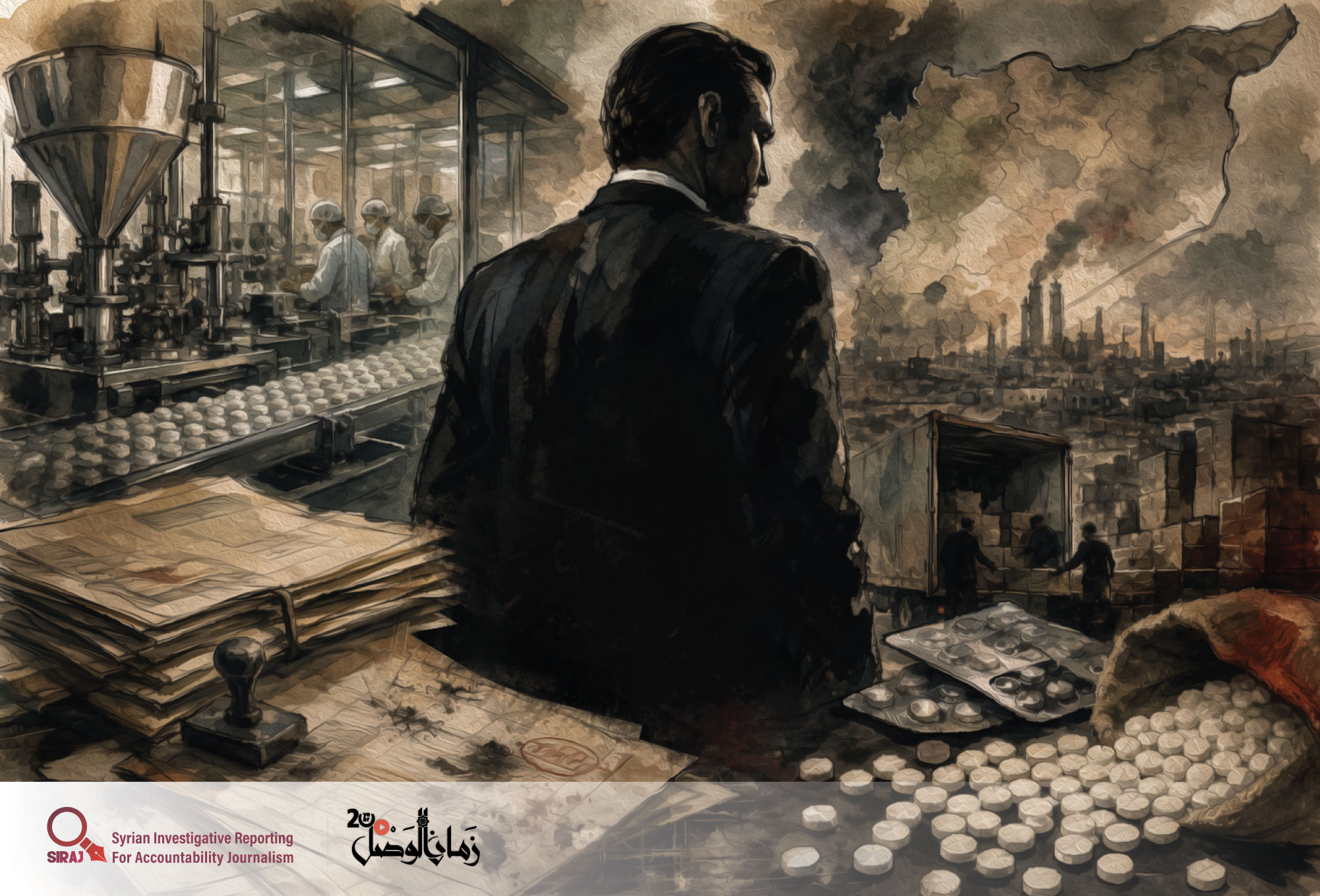


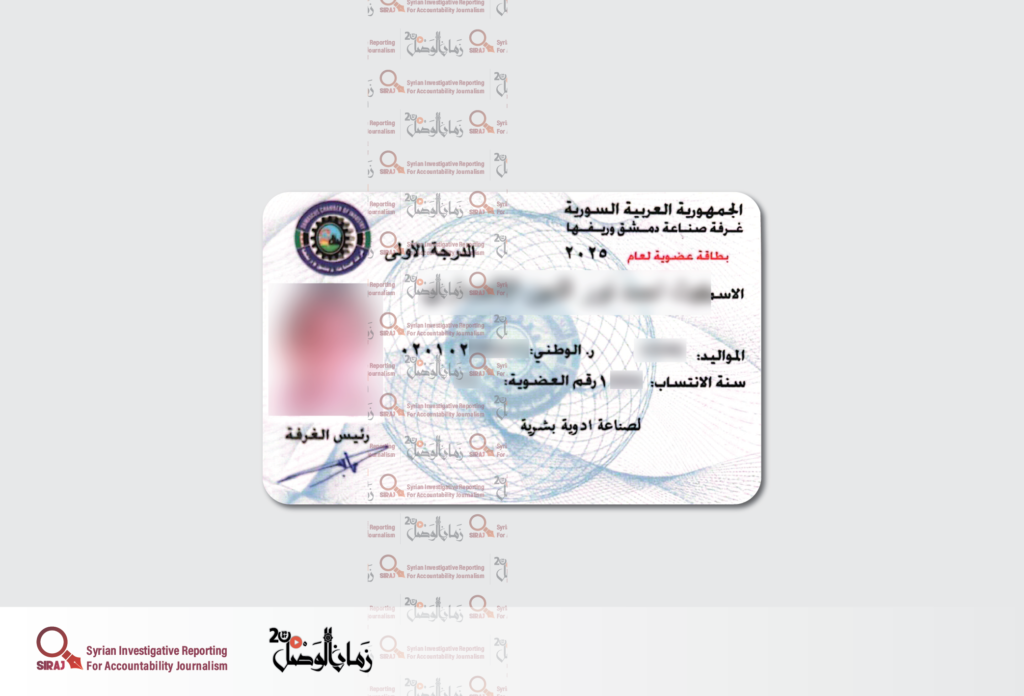
In August 2025, a Syrian businessman was granted an official license to manufacture human pharmaceuticals, according to records from the Damascus and Rural Damascus Chamber of Industry.
The license appeared routine in a sector that should be subject to strict regulatory oversight.
But the businessman had been named in 2017 investigative documents issued by Syria’s Anti-Narcotics Department in connection with a case involving the diversion of sensitive pharmaceutical substances and their sale outside legal channels. Those substances are legitimate pharmaceutical ingredients but can also be used in the production of amphetamine-based drugs, commonly known in Syria and across the Middle East as Captagon.
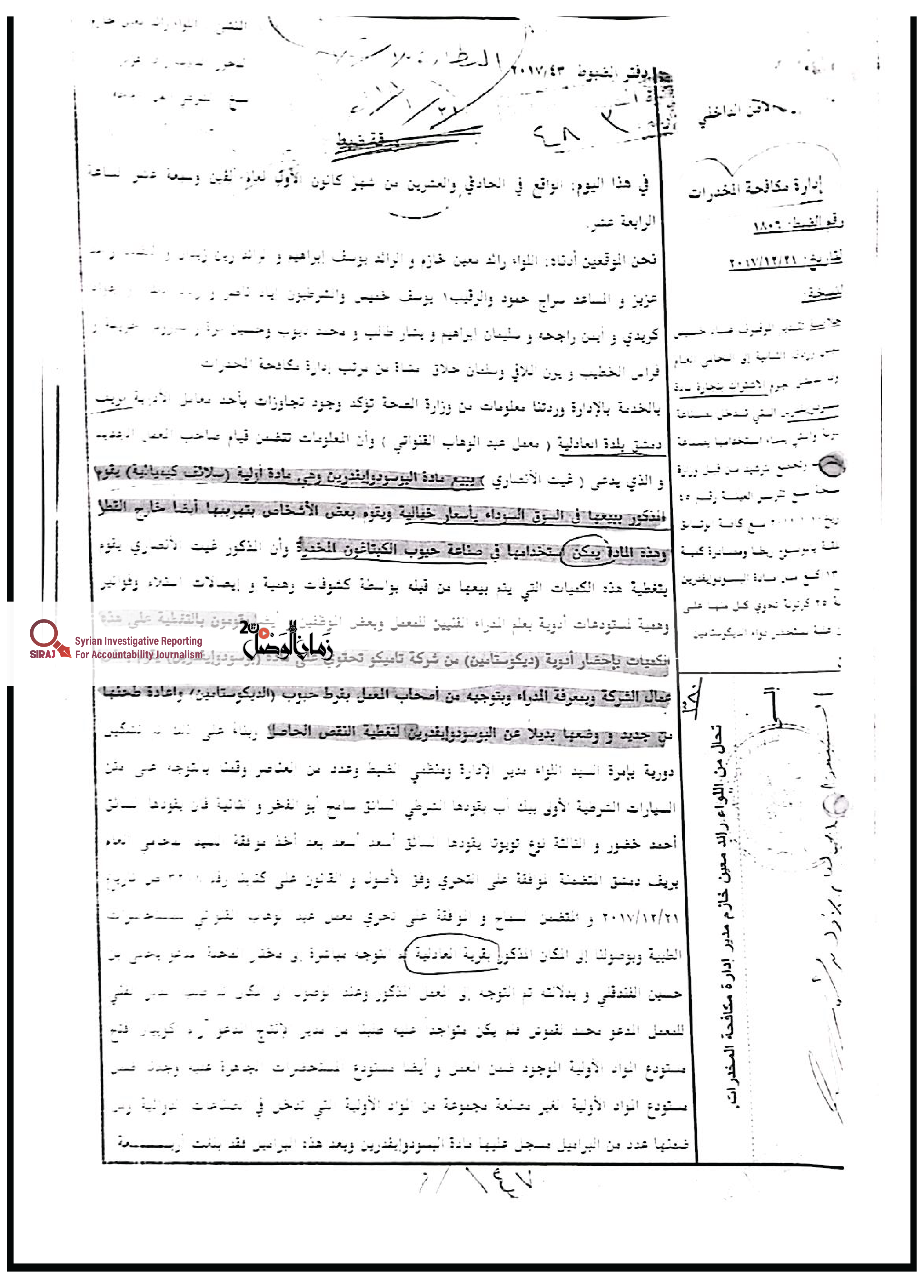
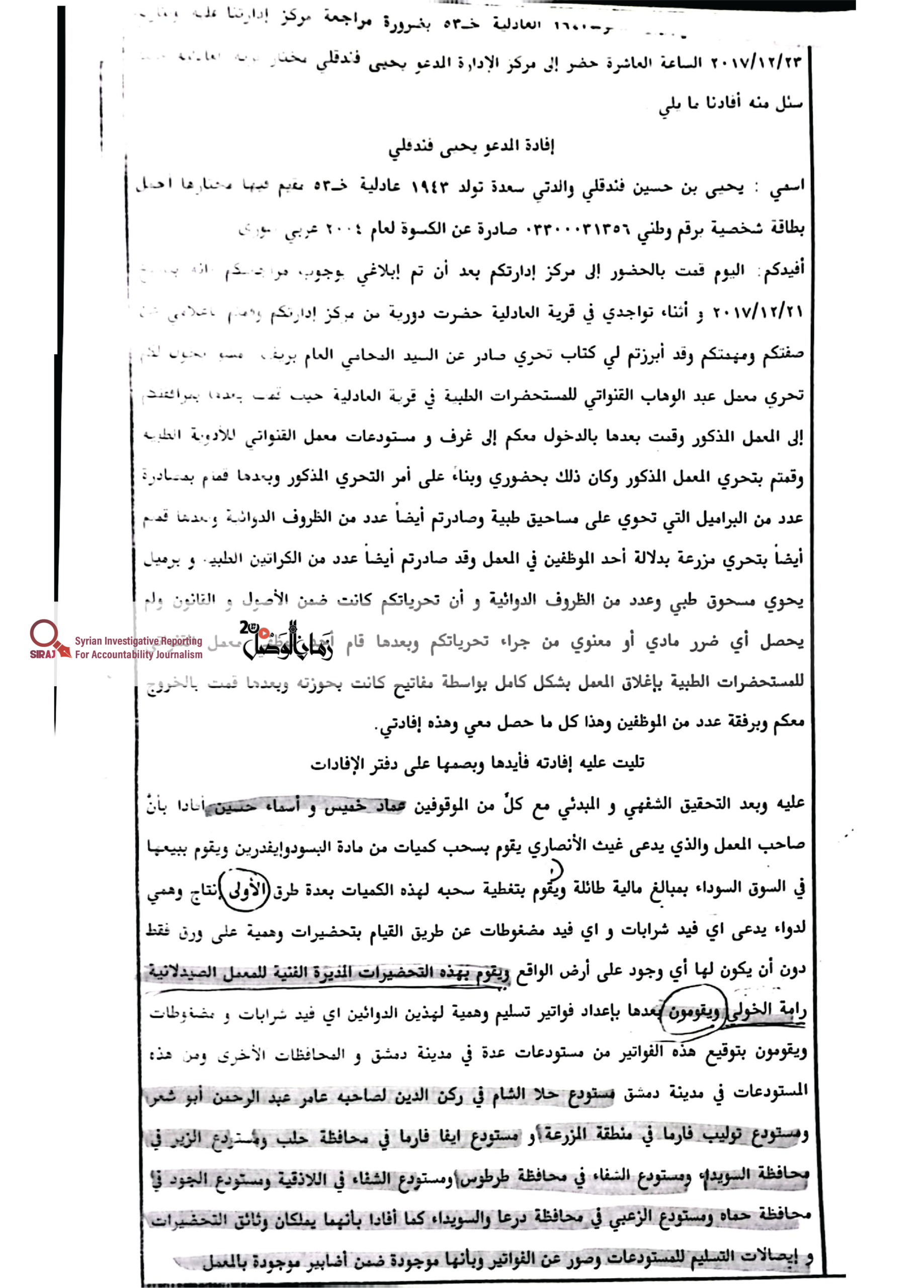
The Syrian Investigative Reporting for Accountability Journalism (SIRAJ) reviewed an official report dated December 21, 2017, prepared by the Anti-Narcotics Department of Syria’s Ministry of Interior.
The report describes an alleged network operating within a pharmaceutical facility that handled pseudoephedrine—a legitimate medicinal compound widely used in cold and allergy medications, but also a key precursor in the illicit manufacture of amphetamine tablets.
The documents raise a central question:
How was businessman Ghayth Nour al-Din al-Ansari—whose name appeared in those earlier investigations—able to return to the same industry and obtain a new license to manufacture pharmaceuticals?
Paper Records, Missing Chemicals
According to documents reviewed by SIRAJ and Zaman al-Wasl online newspaper, the operation went far beyond the diversion of limited quantities of pseudoephedrine.
Instead, investigators say it relied on a coordinated system designed to conceal shortages of controlled pharmaceutical ingredients at Al-Qanawati Pharmaceutical Industries, a factory owned by Ghayth Nour al-Din al-Ansari in the village of Al-Adliyah, in the Damascus countryside.
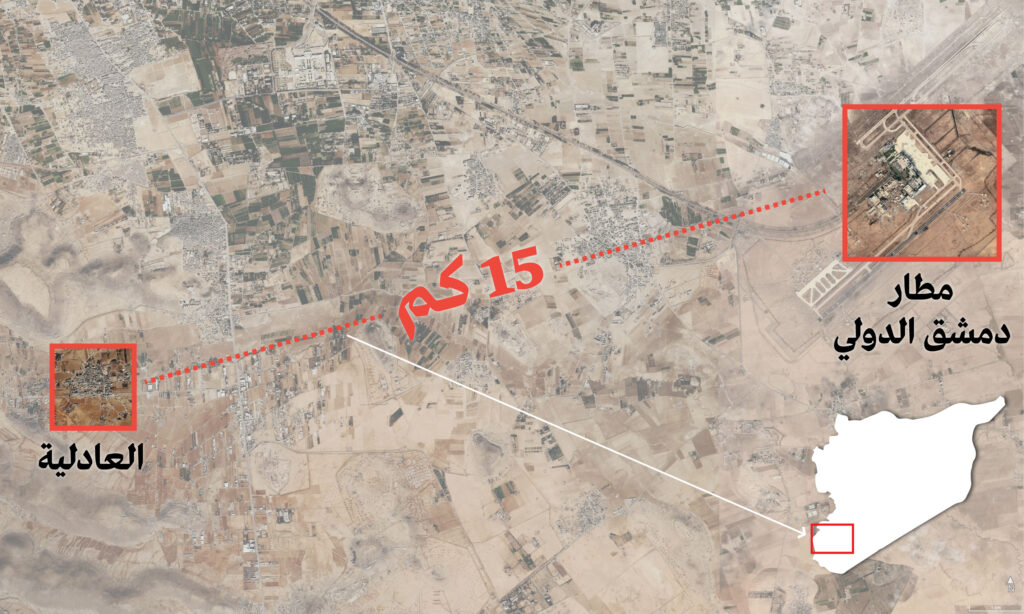
Witness statements and official investigation records indicate that controlled pharmaceutical ingredients were allegedly removed from production lines and sold outside legal channels. The resulting shortages were then concealed through falsified production records, which portrayed the materials as having been consumed during normal manufacturing operations.
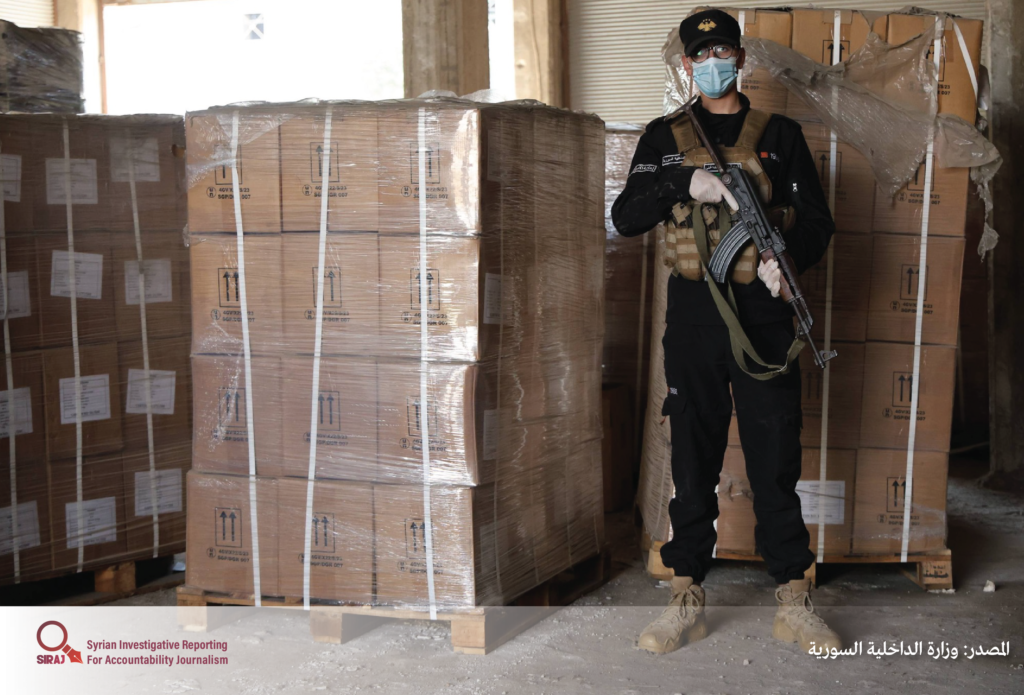
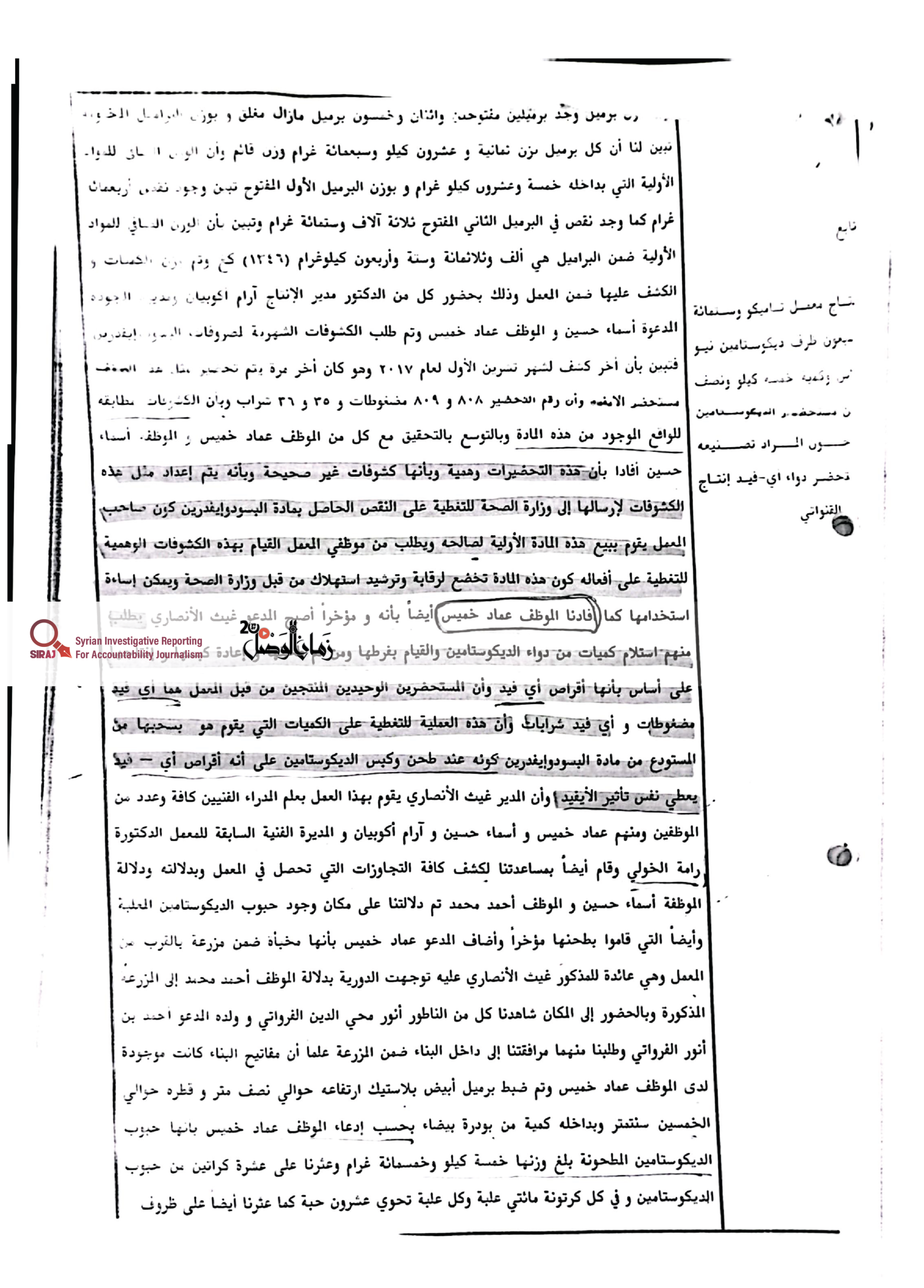
In some cases, according to the investigation report, the network allegedly reprocessed finished pharmaceutical products by grinding tablets into powder and compressing them again so they appeared to be newly manufactured medicines—an apparent effort to reconcile inventory records with the missing raw materials.
According to the official investigation record: “Company workers, with the knowledge of the managers, removed quantities of raw materials and disposed of them outside the production process.”
The report adds that: “The seized materials were confiscated, and an official report was prepared in accordance with legal procedures.”
A previous SIRAJ investigation traced the routes through which precursor chemicals used in the manufacture of Captagon entered Syria via networks linked to the pharmaceutical sector.
That investigation documented how pharmaceutical warehouses and drug manufacturing facilities were allegedly used as cover to move sensitive chemical compounds—including substances used in the production of amphetamine tablets—before they were redirected to Captagon manufacturing sites during the rule of the former Assad regime.
The newly obtained documents point to strikingly similar methods, suggesting that the pharmaceutical sector was exploited through fraudulent invoices, warehouse operations, and falsified inventory records to conceal the movement of controlled substances outside the legal supply chain.
According to a World Bank report published in spring 2024, Syria’s Captagon market generated an estimated $1.9 billion to $5.6 billion annually—a figure approaching the country’s entire gross domestic product in 2023.
The report concluded that actors linked to Syria profited from the Captagon trade at multiple stages of the production and distribution chain, generating hundreds of millions of dollars in annual revenues. (Editor’s note: The source text appears to contain a numerical inconsistency in the reported revenue figure—”506 billion dollars”—which is likely a typographical error and should be verified against the original World Bank report before publication).
Paper Invoices, Phantom Warehouses
Documents from the Syrian Ministry of Interior’s 2017 anti-narcotics investigations, reviewed by SIRAJ, also point to the involvement of pharmaceutical warehouses in several Syrian governorates, including Damascus, Aleppo, and Tartous, where delivery invoices were allegedly issued for shipments that never physically existed.
According to witness statements contained in the investigation files, these invoices were used to give an appearance of legality to the movement of controlled substances that never reached their stated destinations, suggesting a distribution network that extended well beyond a single pharmaceutical factory.
Some testimonies further indicate that portions of the precursor chemicals were never intended for use inside licensed pharmaceutical facilities. Instead, they were allegedly stored at unlicensed locations, including farms and buildings outside the health authorities’ supervision.
The Damascus and Rural Damascus Chamber of Industry, which granted Ghayth Nour al-Din al-Ansari a new pharmaceutical manufacturing license, did not respond to requests for comment. Al-Ansari also did not respond to SIRAJ’s requests for comment before publication.
Following the outbreak of the Syrian uprising in March 2011 and the former government’s violent crackdown on protesters, the European Union imposed sanctions on Syria covering 23 sectors of the economy.
Although those measures restricted exports related to oil, electricity, and other industries that could support the former Assad regime’s military operations, some chemical precursors used to manufacture Captagon remained outside the sanctions regime because they also have legitimate pharmaceutical applications.
A 2023 statement by the UK government estimated that 80 percent of the world’s Captagon production originated in Syria. Independent experts have valued Syria’s Captagon trade at approximately $5.7 billion annually.
According to the United Nations Office on Drugs and Crime (UNODC), Syria’s Captagon industry was, until recently, producing millions of tablets each day, leaving stockpiles large enough to supply regional markets for years—even if some manufacturing facilities have since been dismantled.
In a December 2025 research brief, UNODC reported that Syrian authorities had dismantled 15 industrial laboratories and 13 storage facilities, while authorities across the region seized a record 177 million Captagon tablets—approximately 30 metric tons—since late 2024.
Bo Mathiasen, Director of Operations at UNODC, said: “This demonstrates that political will and international cooperation can dismantle even the most sophisticated illicit criminal economies.”
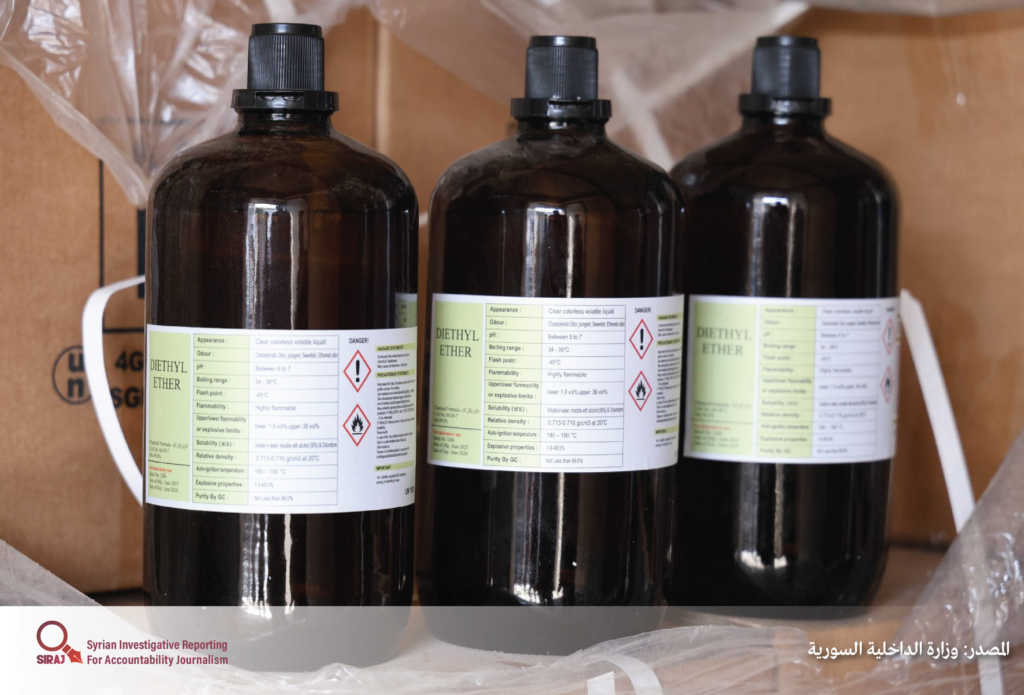
Separately, on May 6, 2026, Syria’s Ministry of Interior announced a security operation targeting a warehouse containing large quantities of precursor chemicals used in narcotics production.
According to the ministry, officers seized 160 barrels with a combined weight of approximately 15.8 metric tons, along with 320 boxes containing 1,280 bottles of liquid substances suspected of being used in drug manufacturing.
Several suspects were arrested during the operation, and authorities said investigations into narcotics trafficking networks remain ongoing.
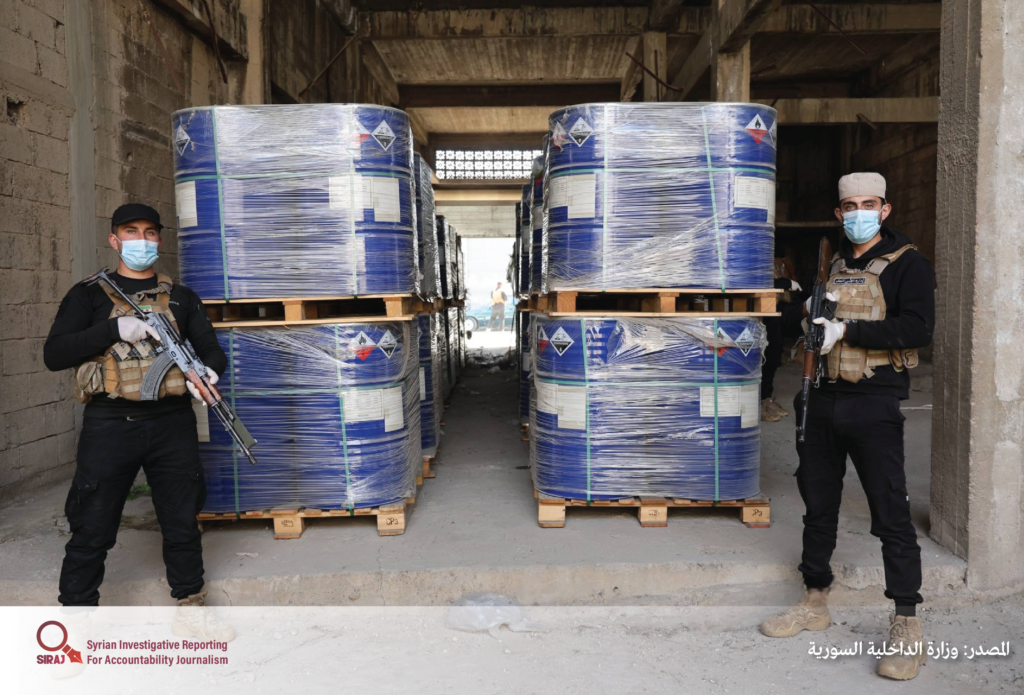
Although Syria’s Captagon production appears to have declined since the fall of the former Assad regime, the seizure underscores the continued availability of precursor chemicals. It also raises questions again about how such materials entered the country, where they were stored, and whether they were diverted through legitimate pharmaceutical supply chains or parallel distribution networks operating beyond official oversight.
- Creative direction and visual solutions: Radwan Awad.
Following the publication of the Arabic version of this investigation, Zaman al-Wasl received the following response from businessman Ghayth al-Ansari, which SIRAJ is re-publishing below.
Businessman Responds: ‘The Former Regime Extorted Me and Framed Me’
Zaman al-Wasl
Industrialist Ghayth al-Ansari, the owner of a pharmaceutical factory in Aleppo, said he had been subjected to what he described as a systematic campaign of extortion by Syria’s former security apparatus beginning in 2017. He said the campaign ultimately forced his factory to cease operations and resulted in fabricated criminal charges against both him and his employees.
According to al-Ansari, the events began after he purchased the Abdel Wahab Qanawati Pharmaceutical Factory in 2016. The facility already contained stocks of pseudoephedrine that had been legally imported under official licenses.
Al-Ansari said security apparatuses repeatedly pressured him to surrender the substance so it could be used in the manufacture of illicit drugs. He said he refused those demands, prompting authorities to repeatedly suspend the factory’s operations.
According to al-Ansari, the sequence of events included:
- In 2017, security forces raided the factory two days after unidentified men traveling in a van allegedly removed 25 kilograms of pseudoephedrine under threat.
- Factory employees were detained for five months, despite submitting documents that, according to al-Ansari, demonstrated the lawful importation and storage of the material.
- The factory ceased operations entirely in 2019 because of continuing threats and what he described as exorbitant financial demands from senior security officials.
Al-Ansari questioned the rationale behind accusations that he had sold precursor chemicals worth only about $5,000, arguing that such allegations made little economic sense given the scale of his investment in the pharmaceutical facility.
He further claimed that the illicit narcotics trade under the former regime was protected by security officials and that those who cooperated with powerful figures received official protection and armed escorts.