
Syria climbs 36 places in Reporters Without Borders’ Press Freedom Index
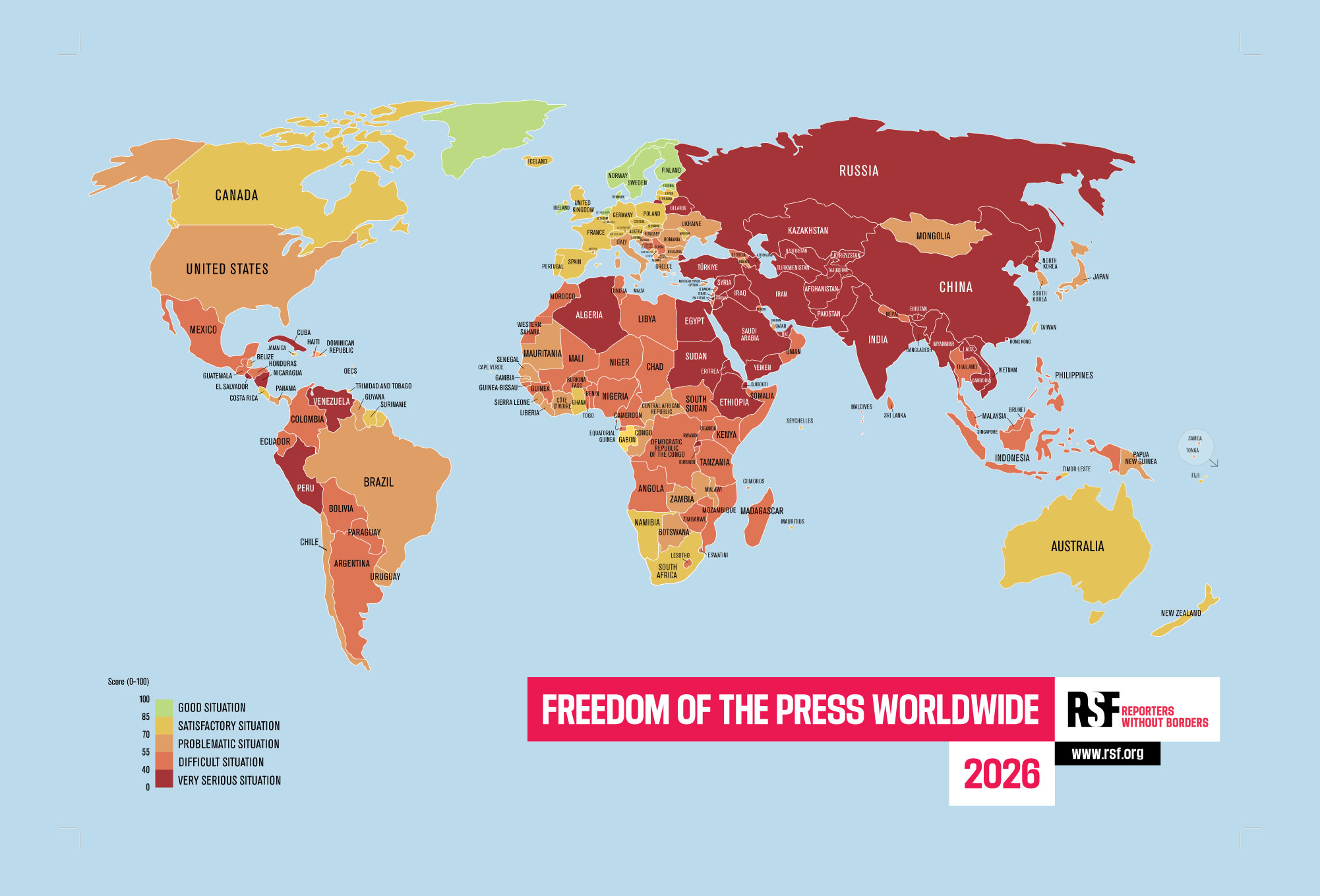
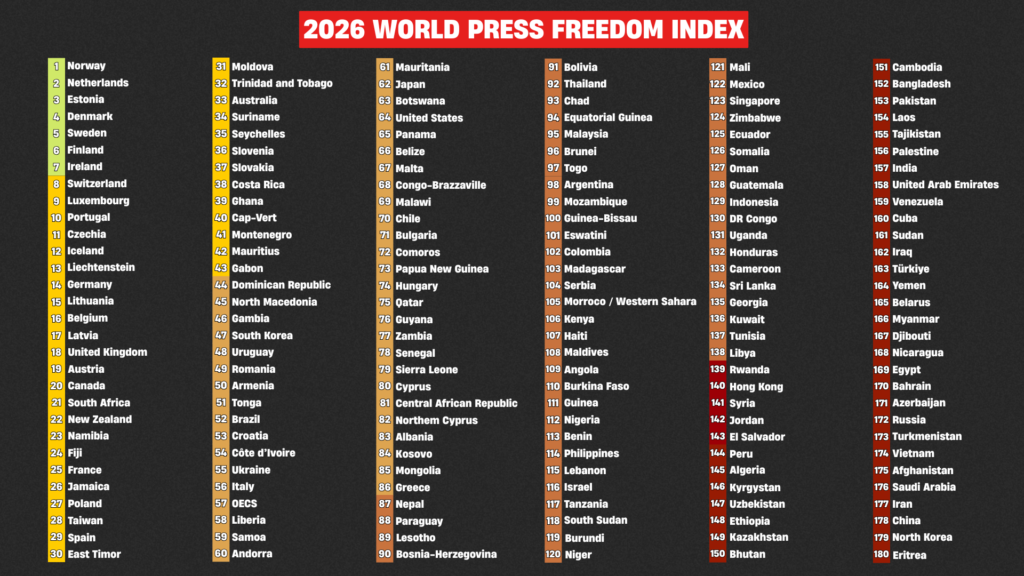
Syria climbed 36 places in the 2026 “World Press Freedom Index” published today by Reporters Without Borders (RSF), while remaining in the “very serious situation” category for journalists due to the many challenges and security risks surrounding the practice of journalism.
This comes more than a year after the fall of Bashar al-Assad’s regime and the opening of the press landscape to local and international media for the first time since the eruption of the Syrian revolution in March 2011.
According to the Paris-based non-governmental organization, post-Assad Syria saw the greatest improvement in press freedom among all countries and regions included in the 2026 index. It rose from 177th place in 2025 to 141st out of 180 countries, climbing 36 spots on the global index, after having languished at the bottom for many years as one of the world’s most repressive countries for the press.
According to RSF, Syria’s ranking surpassed that of several Arab countries, including Egypt, Jordan, Saudi Arabia, Algeria, Sudan, Yemen, and Iraq, as well as regional countries such as Turkey.
Mohammed Bassiki, executive director of the Syrian Investigative Reporting for Accountability Journalism – SIRAJ, said, “The new ranking from RSF reflects an improvement in press freedom in Syria, and it is an official recognition by the world’s leading international organization monitoring press freedom of the new reality of journalism in the country.”
He added that this improvement is in fact driven by “Syrian journalists, through their writing and their determination to push for further gains laid out and championed by the Syrian Revolution, as press freedom was one of the most important demands of the Syrian people.”
Bassiki viewed this change as an opportunity for Syrian journalists, both inside and outside the country, to join forces to support press freedom after the Assad regime’s defeat, promote accountability and transitional justice processes, and build greater trust between citizens and the media.
“For us at SIRAJ, this means more work and more investigative reporting to further expand press freedom in Syria.”
On December 8, 2024, Bashar al-Assad’s regime collapsed after he fled to Moscow, ending more than half a century of the Assad family’s brutal rule over the country.
Assad’s fall broke the state’s monopoly on information after decades of dictatorial rule, allowing independent media outlets—particularly Syrian ones—to enter the country and provide firsthand coverage of the situation, in addition to increased on-the-ground reporting by international media.
According to Jonathan Dagher, Head of the Middle East desk at RSF, “Syria’s global record and historical improvement” on the Press Freedom Index was “brought about – evidently – by the fall of the Assad regime in December 2024, and reflects an improvement in the scores of all five indicators that we rely on to measure the situation of journalists in the country: political pressures, security, legal frameworks, social frameworks, and economic frameworks.” However, this does not mean the situation in Syria is “good” for journalists today.
He noted that there are major challenges that must be addressed, such as securing justice for more than 280 journalists killed over the past decade, 183 of whom were the victims of the Assad and his allies. The new Syrian government must also provide information on the whereabouts of 45 journalists who have remained missing or disappeared since the fall of the regime.
Dagher also stressed the need for “accountability for violations committed against journalists by government forces and other armed groups in Syria, since the fall of the regime, namely in the coastal area, Sweida, and northeast Syria.” He called for “a solid legal framework that protects the right to information and ensures that journalists and media outlets can work freely, independently and safely in Syria. This applies to all journalists from diverse backgrounds.”
Dagher concluded, “Syria owes this improvement in the score to the courageous and tireless sacrifices of hundreds of independent Syrian journalists and media outlets who continued to work, from Syria and from exile, despite the extreme danger.”
Globally, this year’s “World Press Freedom Index” revealed that, for the first time since it was launched, more than half of the world’s countries have slipped into the “difficult” or “very serious” categories for the practice of journalism. In 2002, more than 20 percent of the world’s population lived in countries where press freedom was rated “good,” whereas today that figure does not exceed one percent.
Anne Boccandé, editorial director at RSF, said, “Effective measures to protect journalists are essential and must be seen as a catalyst for change, starting with putting an end to the criminalisation of journalism: the misuse of national security laws, SLAPPs, and the systematic obstruction of those who investigate, expose and name names.”
“Current protection mechanisms are not strong enough; international law is being undermined and impunity is rife. We need firm guarantees and meaningful sanctions. The ball is in the court of democracies and their citizens. It is up to them to stand in the way of those who seek to silence the press. The spread of authoritarianism isn’t inevitable.”