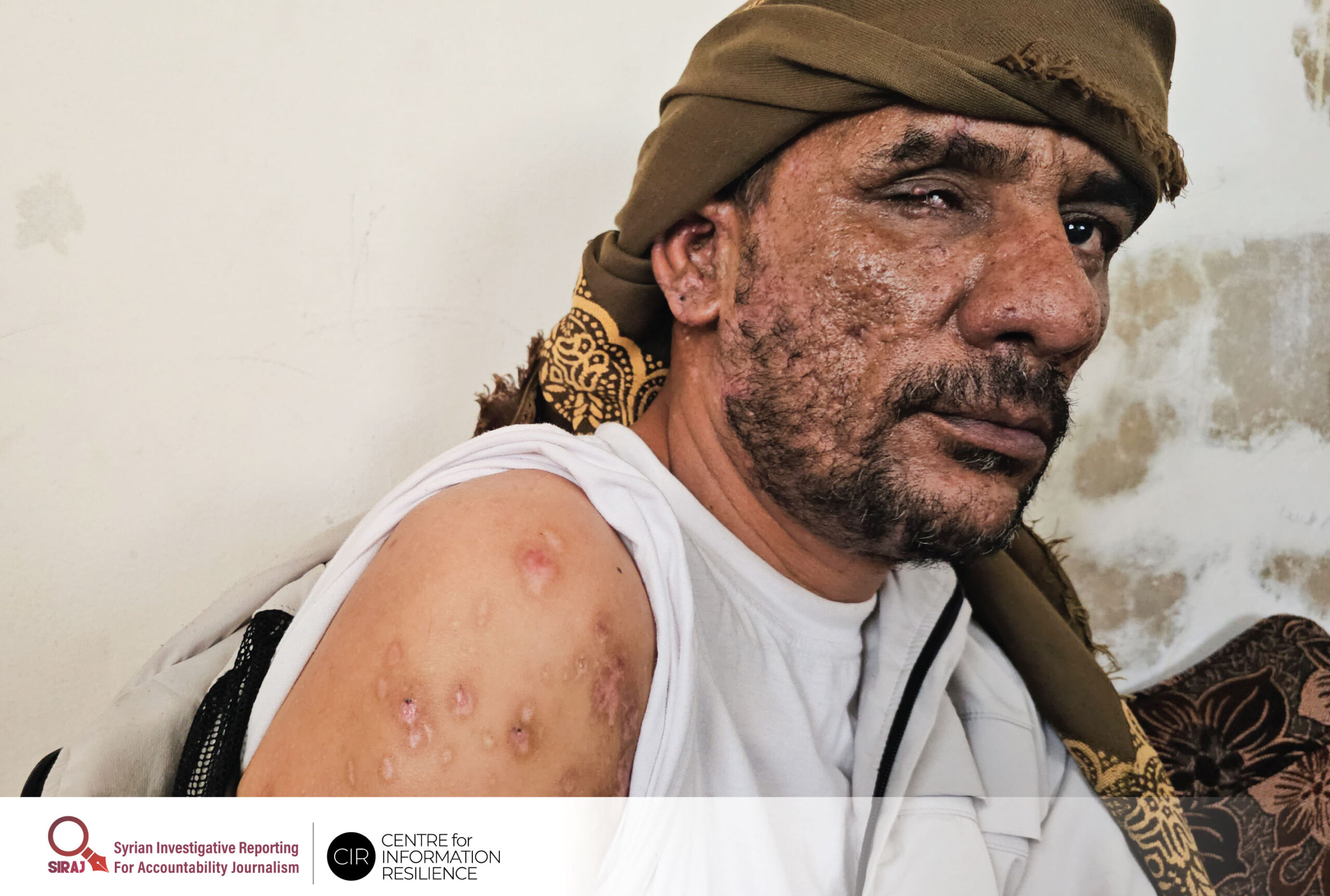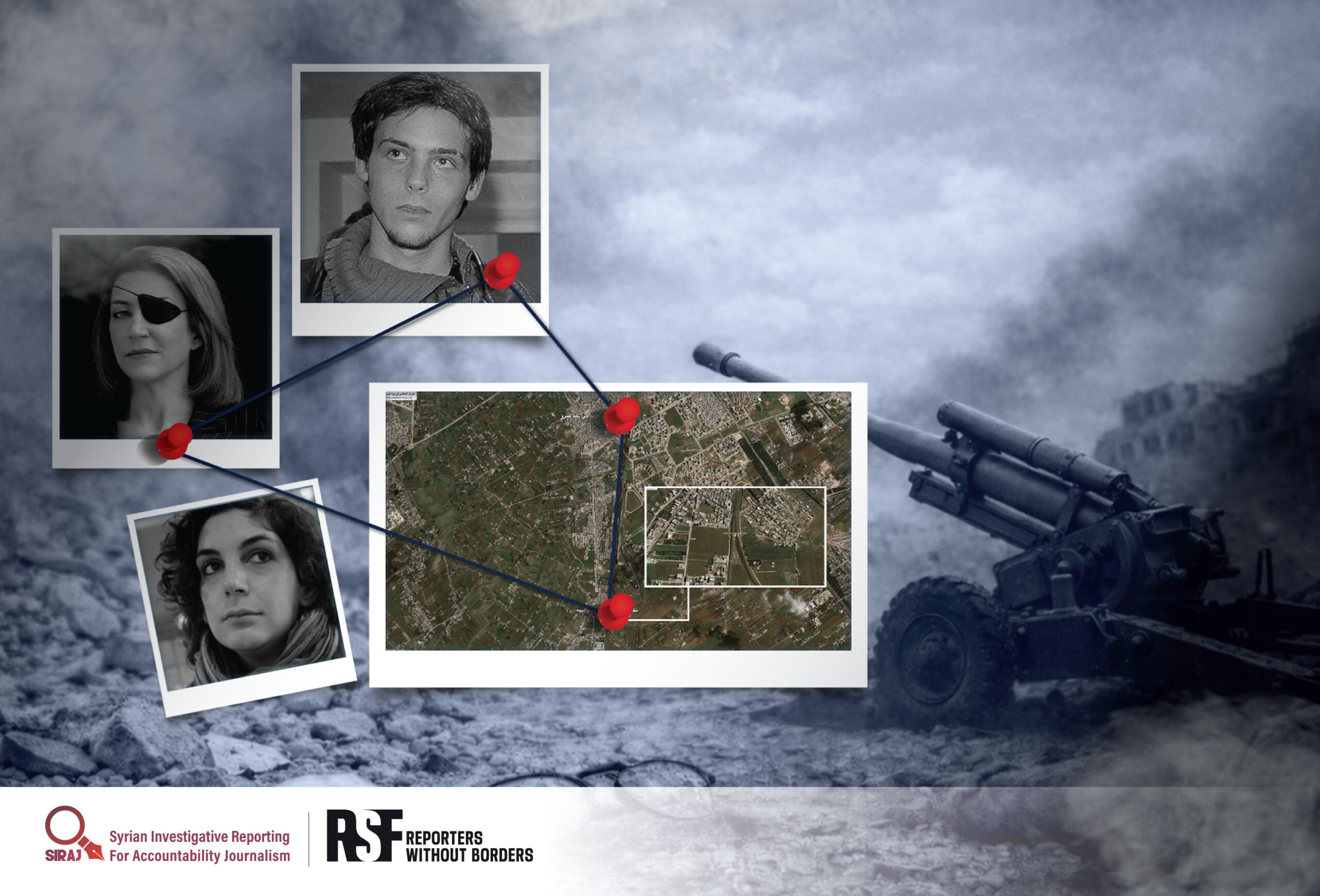


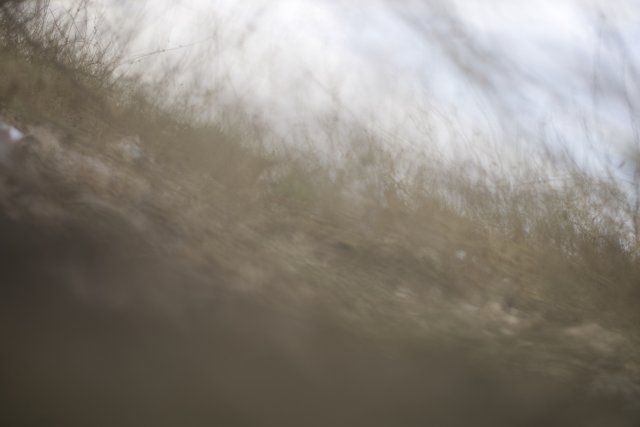
On 4 December 2024 at 9:25 a.m., Anas Al Kharboutli’s camera took its last photograph. Taken from ground, the image shows blades of grass and an overcast sky. The Syrian photojournalist was lying by the side of a road, dying, his leg torn off by a bomb dropped by a fighter jet he had photographed moments earlier. The Deutsche Presse-Agentur (DPA) journalist and winner of the 2020 Bayeux “young reporter” award in France, was covering the offensive by Hayat Tahrir al-Sham (HTS) that, four days later, would end half a century of authoritarian rule by the Assad clan. When he was targeted, Anas Al Kharboutli was one of the only Syrian journalists still actively covering the conflict since the earliest days of the Arab Spring in 2011. The veteran news professional was the last reporter killed while working under Bashar al-Assad’s regime.
According to Anas Al Kharboutli’s family, the journalist frequently complained about being under surveillance receiving threatening messages on his phone. His killing was no accident and he was no casualty. His death is the result of a deliberate attempt to target a group of journalists, as revealed in the RSF documentary “Syria: the forbidden witnesses of the Assad regime,” released in December 2025.
This strategy of spying and targeting — one of the deadliest policies implemented by any regime since the turn of the century — claimed the lives of 181 journalists in Syria between the 2011 revolution and the regime’s fall in December 2024 and relied on a near-obsessive level of surveillance of all the people trying to tell Syria’s story from within. Drawing on first-hand accounts and supporting documents, the investigation conducted by SIRAJ in partnership with RSF reveals the inner workings of this ruthless surveillance machine.
“Security without borders”
From the first months of the popular uprising against Bashar al-Assad in 2011, journalists became a preferred target of the regime, alongside opponents and demonstrators. As conduits of news on the protest movement and witnesses to the massacres committed by the authorities against their own people, journalists were an especially troublesome presence. The regime’s survival depended in part on its ability to hunt them down.
When contacted by RSF, a former member of the Department of Foreign Media Affairs at the Ministry of Information described the regime’s astonishment at being caught off guard by the spread of the uprising. The authorities then ordered that foreign journalists be systematically accompanied “to places selected in advance,” where “civilians” — who were intelligence agents in reality — would explain to them that the demonstrations were part of a “Western plot designed to support terrorism.”
The threat was deemed so serious that the Central Crisis Management Cell — a committee created at the start of the revolution to coordinate the regime’s response — was given a direct role in monitoring the media. This body, which brought together the heads of the main intelligence services, senior military officials and the Ministers of the Interior and Defence, was notably tasked with producing detailed reports on the activities of media outlets and journalists.
As this investigation shows, the entire state apparatus was involved in implementing this strategy. Having inherited a far-reaching culture of Soviet-style surveillance and influence, Syria became “security without borders,” as one source who worked at the Ministry of Information for more than 10 years ironically put it. Interviewed by SIRAJ, former Deputy Minister of Information Taleb Qadi Amin (2003–2008) confirmed that journalists who contacted the authorities to obtain a visa were in fact dealing with “a system riddled with surveillance that began at the borders.”
The system often relied on technical surveillance. Contacted by SIRAJ, a former military intelligence officer responsible for interceptions described a scene in March 2011 in which his entire team listened live, over loudspeakers, to calls made by Reuters journalist Suleiman al-Khalidi, “as if we were attending a conference.” When the reporter said to his contact, “I am at the door,” he was arrested immediately.
A blacklist of foreign journalists
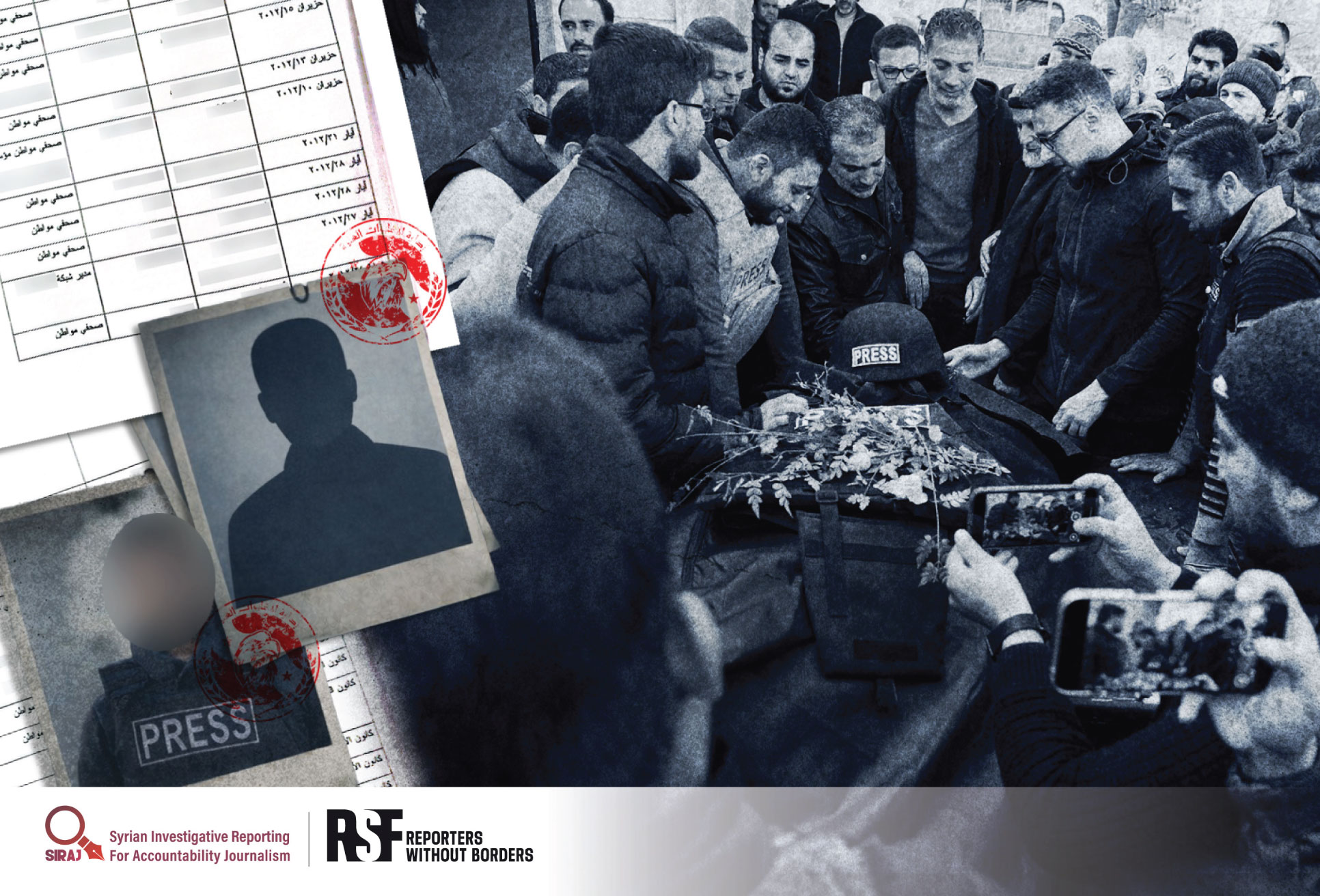
SIRAJ, which carried out a methodical search of several institutional sites used for political and security-related matters after the fall of the Bashar al-Assad regime in December 2024, found dozens of documents attesting to this constant surveillance in the archives of Syria’s Air Force Intelligence, the country’s most powerful security agency. Similar documents were also found in the General Intelligence Directorate (GID) and the archives of Branch 291, a military counter-espionage unit notably tasked with monitoring infiltration risks and collaboration with foreign actors, as well as in those of .
By pouring over these archives, SIRAJ discovered that an intelligence operation targeting its very reporters had been approved in October 2024, only weeks before the fall of the regime. Nicknamed “the Spider,” GID director Hossam Louka, a man sanctioned by the European Union, ordered “posts abroad” to obtain “the detailed identities of the agents operating this suspicious platform under the guise of journalists.”
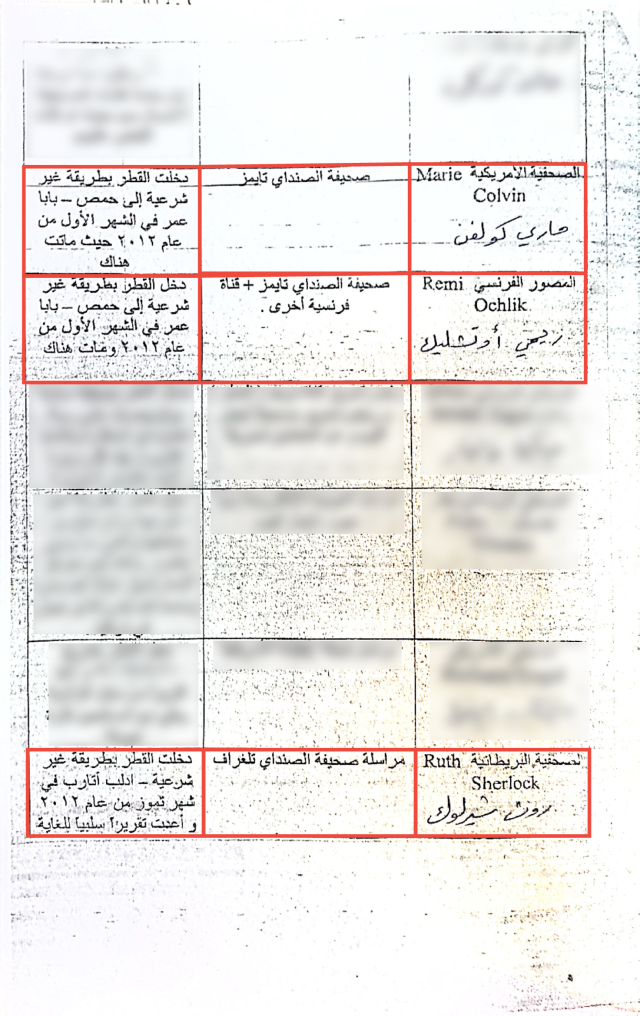
Among the recovered documents was a “blacklist” of foreign journalists. Dated 4 March 2013, it was initially drawn up by the Ministry of Information and was found in a General Intelligence Directorate note addressed to its director. The list included the names of 148 journalists who had “entered Syria illegally” over the previous two years. Ruth Sherlock, correspondent for the British newspaper The Daily Telegraph, was described as having published a “very negative” report after spending several months in Idlib, a city in north-western Syria. The list also included the names of US journalist Marie Colvin and French photographer Rémi Ochlik. Both were killed on 22 February 2012 in a planned and premeditated bombardment, according to accounts gathered by RSF and SIRAJ in a joint investigation into their murder.
Being placed on this blacklist could spell disaster for the journalists on it. The document was sent to several intelligence branches for “action,” and as the former military intelligence officer in charge of communications surveillance confirmed, the people placed on it very often ended up “either killed or arrested.”
Generally speaking, Syrian journalists who were simply doing their job were branded as terrorists by the authorities. As for correspondents appearing in Western media outlets, “they were considered potential agents,” he said. All of them were therefore legitimate military targets in the eyes of the regime.
Arnaud Froger
-
Source: Reporters Without Borders (RSF)