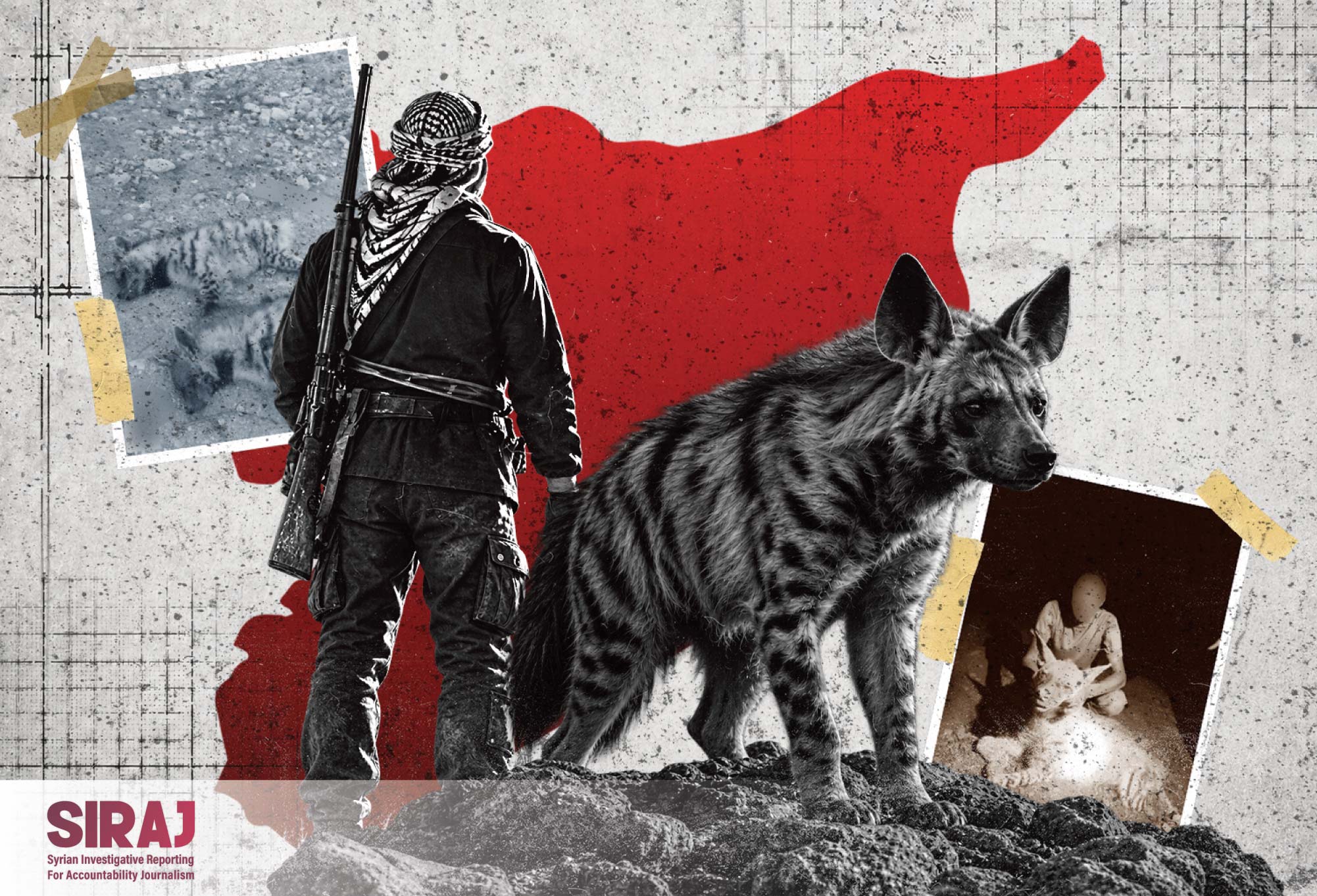


The killing of striped hyenas in Syria is no longer an isolated occurrence. It has become a recurring pattern, exposing an environmental crisis that is quietly worsening.
In late June 2026, Abu Malik al-Bukmali Malla, a hunter from the Deir ez-Zor desert, posted photographs of a striped hyena he had killed. He justified the killing by citing complaints from livestock owners who said their sheep had been repeatedly attacked. He maintained that the animal had been killed near residential homes.
The incident was only the latest in a continuing series of killings targeting this rare species. Many are documented on social media and celebrated as personal achievements or acts intended to protect local communities.
Weeks earlier, another hunter, Yusuf Malla Hamid, had documented a similar killing, further illustrating the continued targeting of striped hyenas across Syria.
But this investigation reveals a different reality behind those accounts. One of the Middle East’s rarest predatory mammals is being killed amid an almost complete absence of oversight, persistent myths and deeply rooted popular beliefs, and weak enforcement of wildlife protection laws.
Environmental experts warn that each new killing could bring the striped hyena another step closer to disappearing from the Syrian wilderness.
On August 16, 2024, Faisal Abu Dahmoush al-Akidi stood before his cellphone camera in the desert of Deir ez-Zor, holding the carcass of a striped hyena he had killed moments earlier.
Surrounded by friends, he proudly declared:
“This is what happens to anything that comes near my tent. Did you see what I did to it? This is the hyena’s fate, and the wolf will meet the same fate.”
He then threw the carcass to the ground.
The video, which circulated widely on social media, received an enthusiastic response. Many comments portrayed the killing as an act of protection against an animal widely believed to attack humans, abduct children, and threaten women and herders.
But the victim was not simply another wild animal.
The Syrian striped hyena, scientifically known as Hyaena hyaena syriaca, is considered one of the rarest predatory mammals in the Levant. The article identifies it as having been classified as endangered on the International Union for Conservation of Nature’s Red List since 2014, while environmental experts warn that its population in Syria has declined to dangerously low levels.
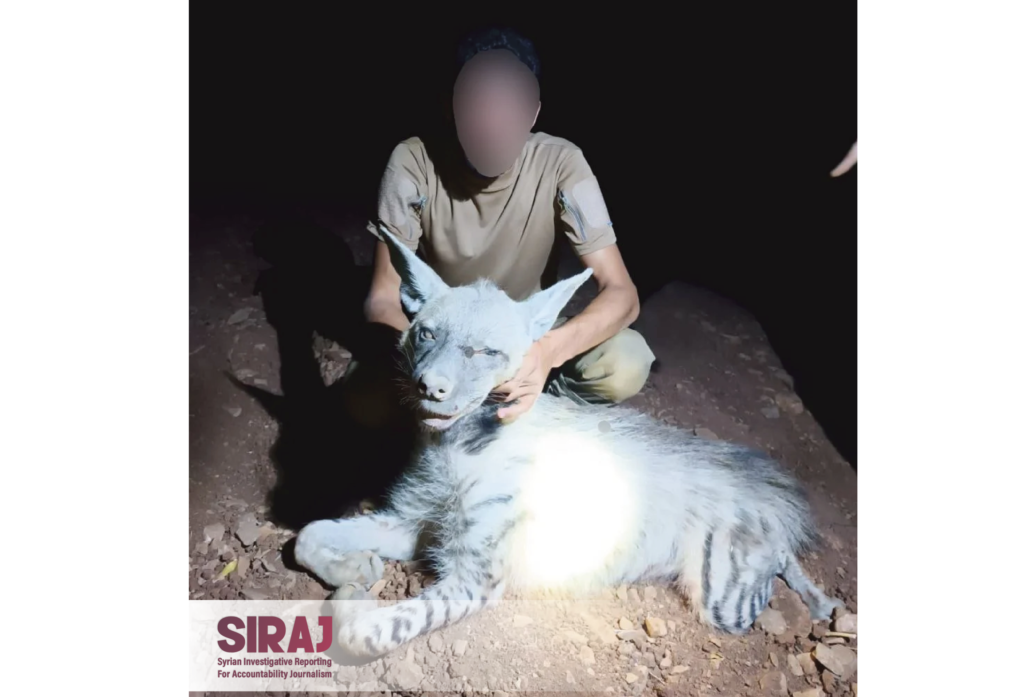
Over several months, SIRAJ’s investigative team documented 13 incidents involving the killing of striped hyenas across Syria, including in Deir ez-Zor, rural Damascus, Idlib, and northern Aleppo.
The investigation found that hunting, poisoning, and trafficking in hyena body parts are being driven by a combination of deeply rooted superstitions, practices associated with witchcraft, and weak enforcement of environmental protection laws.
It reveals how generations-old myths surrounding the striped hyena have evolved from traditional folklore into a direct threat to the species’ survival.
Environmental experts describe the hyena as one of nature’s most important cleanup crews. By consuming carcasses and bones, the animal helps prevent the spread of disease and maintain ecological balance in the wild.
Why Are Syrians Killing Hyenas?
Faisal Abu Dahmoush al-Akidi was not searching for hyenas when he ventured into the desert of eastern Syria.
His primary business is hunting and trading birds of prey, and he does not consider himself a specialized hyena hunter. But when he encounters one, he does not hesitate to kill it.
“I’ve only killed three hyenas, but I wasn’t tracking them or actively looking for them because my work involves birds of prey,” al-Akidi said. “I came across them by chance. If I had actually been searching for hyenas to kill, the number would have been much higher.”
He justified his actions as an effort to protect civilians who could not defend themselves.
Al-Akidi’s attitude is not unusual among professional and amateur hunters in different parts of Syria.
Many regard the striped hyena as a dangerous animal that should be eliminated before it attacks people or livestock. The belief remains deeply embedded in local communities despite a lack of scientific evidence supporting these widespread fears.
Ahmad al-Turki, an amateur hunter from rural Deir ez-Zor, shares that perception.
“We mainly kill hyenas in our area to prevent them from approaching women and children and frightening them,” he said.
According to al-Turki, young amateur hunters in his area have killed four hyenas so far.
Although he acknowledged that hyenas generally avoid residential areas and remain in the desert, al-Turki insisted that the animals pose an immediate threat to anyone who ventures into their territory unarmed.
“If someone is in the desert without a weapon, the hyena will definitely attack them,” he said. “It attacks people who enter the desert. If it sees someone who is unarmed and unable to defend themselves, it will kill them.”
But fear is not the only reason striped hyenas are being targeted.
There is also a financial incentive.
An illegal market exists for hyena pelts and certain body parts, creating an additional motive for hunters.
Salem, 46, who has been hunting hyenas near the Turkish border for five years, said his primary motivation is selling their fur.
He also acknowledged that the number of hyenas in the area has declined noticeably in recent years.
More significant, according to Syrian environmental expert Zaher Hashem, is the central role that myths involving magic and witchcraft play in deliberate hyena hunting—particularly in cases where the animals are targeted for reasons other than fear.
A Victim of Myth
Across wide swaths of Syria, people have long passed down similar stories about the striped hyena.
Some describe it as an animal that kidnaps children and attacks women in the wilderness. Others portray it as a grave robber or a creature tied to witchcraft and sorcery.
Over time, these stories hardened into deeply rooted beliefs, leading many people to regard killing a hyena as a legitimate act of prevention.
Bilal al-Hayek, director of biodiversity and environmental affairs at Syria’s Ministry of Local Administration and Environment, said the illegal trade in hyena body parts is one of the species’ main threats.
“The striped hyena is targeted and killed for its skin, bones and teeth,” he said, “which, according to widespread beliefs, are used in folk medicine and in magic and sorcery.”
Al-Hayek added that many popular beliefs link the striped hyena to witchcraft, luck, money and traditional healing, despite the lack of any scientific basis for those claims.
In his view, these inherited perceptions directly contribute to the continued pursuit and killing of the animal in the wild.
Environmental experts and handlers of predatory animals interviewed for this investigation said most of these stories are not supported by science or documented incidents.
For years, Hassan Shweikani has kept a number of predatory animals on a farm near Damascus, including striped hyenas that have been tamed and cared for.
He described the striped hyena as “an animal that has been socially wronged,” saying its reputation bears little resemblance to its actual nature.
“People repeat false stories about it,” he said, “such as that it eats humans, attacks them in their homes, or that its body parts are used in magic. But all of these are myths.”
According to Shweikani, the striped hyena does not naturally attack people. Instead, it tends to avoid contact with humans and flee whenever possible.
“A hyena will not attack a human at all unless it is cornered in a tight space and has no other way to defend itself,” he said.
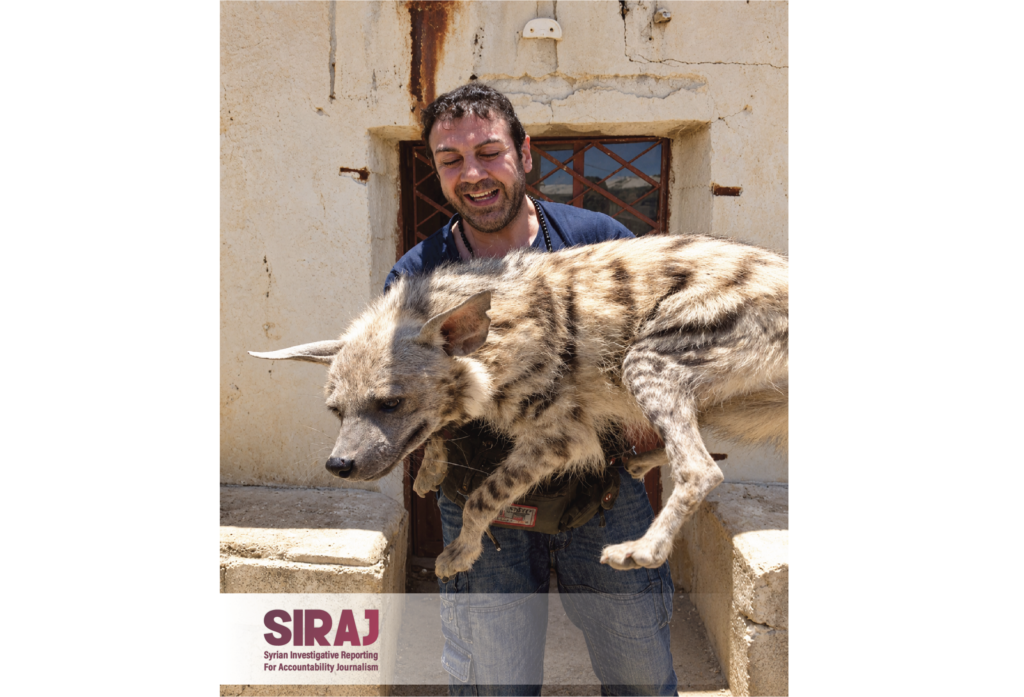
He explained that when hyenas do approach human settlements, it is not because they want to attack people but because they are searching for easy sources of food during times of scarcity, especially near garbage dumps or places where animal carcasses are left behind.
Even in those situations, he said, the animal remains far more inclined to run than to confront people.
Environmental expert Zaher Hashem agrees.
He said myths surrounding hyenas have played a central role in fueling hunting over the past several years.
Beliefs that parts of the hyena’s body can bring luck, break spells or be used in sorcery, he said, remain widespread in some areas, creating steady demand for the animal to be hunted and traded.
While many people continue to view the hyena as a threat that should be eliminated, experts say the real danger may lie not in the animal’s presence, but in its disappearance.
The continued killing of striped hyenas on a broad scale threatens not only a rare species, but also the ecological balance on which Syria’s wild landscapes depend.
A Cleanup Machine in the Wild
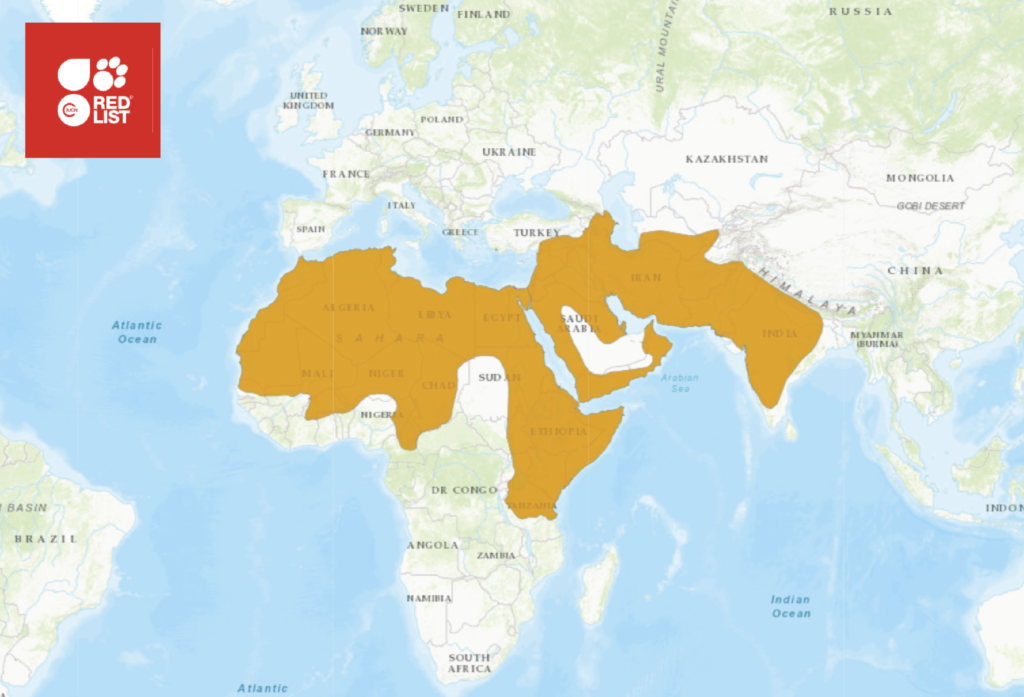
The striped hyena is known scientifically as Hyaena hyaena. A regional subspecies found in Syria, Hyaena hyaena syriaca, ranges into Lebanon, Palestine and southern Turkey.
Far from the frightening image created by folklore, experts describe the striped hyena in very different terms.
Rather than seeing it as a threat to humans, environmental specialists regard it as one of the most important components of the natural balance in wild areas.
In Syria, striped hyenas are found in desert areas, valleys and mountains. They spend most of their time far from human settlements.
Although many people believe they hear them or occasionally spot them near villages, direct encounters with humans remain relatively limited compared with many other wild animals.
Hashem said the hyena’s importance lies not only in its place within biodiversity, but also in the ecological role it plays in the food chain.
Hyenas, he explained, help maintain environmental balance by disposing of carcasses and animal remains that could otherwise become breeding grounds for disease, bacteria and parasites.
“Hyenas play a major role in cleaning the environment of carcasses and remains left behind by other predators,” Hashem said. “Their powerful jaws can crush bones. That helps prevent the spread of disease and improves ecosystems in the areas where hyenas live.”
The hyena’s ability to digest bones is rare among wild animals. It allows the species to consume remains that most other creatures cannot, making it the final stage in the ecological process of disposing of carcasses.
Shweikani, the animal keeper, said the disappearance of hyenas could have serious environmental consequences in rural and desert areas.
“Without the hyena in the desert, there would be environmental disasters,” he said. “In places where sheep, goats and cattle roam, some animals die and their carcasses are left in the wild, creating disease and environmental problems. The hyena comes and eats them, cleaning the environment.”
Then he offered a striking description:
“It is, in itself, a cleaning machine better than 10 municipalities working together — especially because it reaches non-urban areas or places where there are no sanitation services.”
Despite that vital role, hyenas are still treated in many places as pests that should be exterminated.
That keeps them in constant conflict with humans — not because of what they actually do, but because of the image built around them over decades of myth and popular belief.
When Killing Hyenas Becomes a Public Spectacle
The killing of striped hyenas is no longer confined to traditional hunting in Syria’s deserts and mountains. In recent years, it has become a recurring spectacle on social media, where hunters document their kills in photographs and videos and share them as achievements worthy of public admiration.
The video showing Faisal Abu Dahmoush al-Akidi holding the carcass of a hyena he killed in the Deir ez-Zor desert was far from an isolated case.
During this investigation, SIRAJ’s team identified dozens of videos documenting the killing of hyenas across different parts of Syria. The footage frequently shows hunters posing alongside dead animals, accompanied by captions glorifying the hunt or portraying the hyena as a dangerous predator that has been eliminated.
In many cases, the videos go beyond simply displaying a dead animal. They become elaborate spectacles, documenting the chase, the shooting, or the presentation of the carcass before the camera. The footage is then widely circulated on Facebook, TikTok, and messaging applications.
Environmental activists say this type of content has helped normalize the killing of wild animals, transforming what might once have been an individual act into behavior that receives widespread social encouragement.
As videos attract thousands of views, comments, and likes, activists warn that others may be encouraged to repeat the killings in pursuit of online fame or social acceptance.
The consequences extend beyond encouraging hunting.
These videos also reinforce negative stereotypes about striped hyenas. The animals are frequently depicted as dangerous predators or harmful creatures that must be eliminated, with little or no acknowledgment of their ecological importance or conservation status.
While social media has become a platform that offers hunters instant recognition, environmental experts warn that the longer-term consequences may be even more damaging.
The videos do more than document hunting. They help create and perpetuate a public narrative in which killing hyenas is not merely acceptable but actively celebrated by segments of society.
On the Brink of Extinction
There are currently no reliable statistics establishing how many striped hyenas remain in Syria.
But field observations collected during this investigation, along with testimony from environmental experts and hunters, paint a troubling picture of the species’ future in the country.
Dr. Abdul Hay al-Yousef, director of Animal Health and Production at Syria’s Ministry of Agriculture, told SIRAJ that global estimates suggest only 5,000 to fewer than 10,000 mature striped hyenas remain in the wild, with small, scattered, and isolated populations across large parts of the Middle East.
In Syria, however, recent population data are unavailable because of years of war and the weakness of environmental monitoring programs.
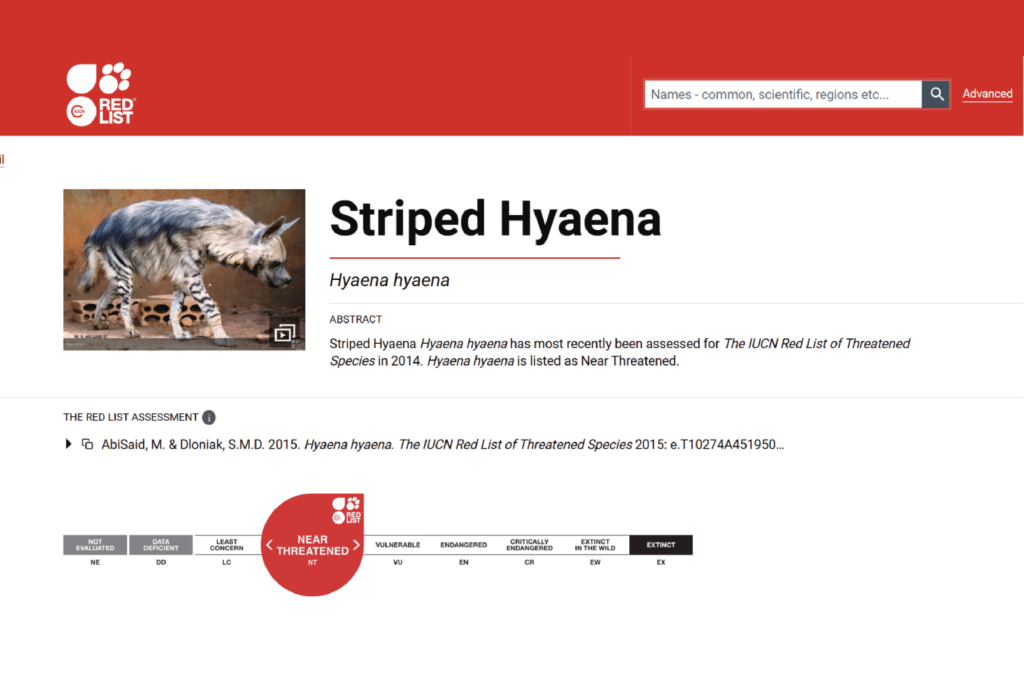
The International Union for Conservation of Nature (IUCN) classifies the striped hyena as Near Threatened on its Red List, reflecting population declines across significant parts of its natural range.
Environmental experts warn that the situation in Syria may be considerably more precarious than the species’ global classification suggests.
Syria’s Ministry of Agriculture confirms that striped hyenas can still be found in several habitats across the country, despite the continued decline in their numbers.
Bilal al-Hayek said the species remains present in most of Syria’s natural environments, particularly the Syrian desert, semi-arid regions, coastal mountains, areas surrounding Palmyra and Deir ez-Zor, and the country’s eastern and northeastern regions.
But he warned that grazing lands and rural areas pose some of the greatest threats to the animal’s survival.
“Hyenas are killed because of the mistaken belief that they attack livestock,” he said.
He added that risks increase in border regions and desert areas, where illegal hunting is widespread and enforcement remains weak, particularly along Syria’s eastern borders.
Laws That Fail to Protect Hyenas
In 2023, the Syrian government introduced Hunting Law No. 14, which regulates hunting permits and identifies animal and bird species that may or may not be hunted.
Environmental experts, however, argue that the law focuses primarily on regulating hunting activities and licensing procedures rather than providing effective protection for species threatened with extinction.
The penalties established under the law are also limited compared with the scale of environmental damage caused by illegal hunting.
Violations can carry prison sentences ranging from one to three months or fines of between 250,000 and 500,000 Syrian pounds, amounts whose actual value does not exceed a few dozen U.S. dollars.
Environmental expert Zaher Hashem said these penalties are insufficient to deter offenders, particularly when hunters stand to make money by selling hyena skins or other body parts.
The problem is compounded by the absence of effective monitoring across large stretches of Syria’s rural and desert regions.
But inadequate penalties are only part of the problem.
Limited environmental awareness among large segments of the population also contributes to the continued killing of striped hyenas.
Many are killed not for profit or commercial hunting, but because of inherited beliefs that portray the animal’s mere presence as a threat that must be eliminated, even when no actual danger exists.
As hunting, poisoning, and deliberate killing continue, driven by fear, superstition, and financial incentives, environmental experts warn that the striped hyena may be paying the price for a reputation that bears little resemblance to its actual behavior.
Hashem summarized the severity of the situation:
“Striped hyenas in Syria may already have become extinct, given the dramatic decline in their populations across areas where they once lived, including Anatolia and the Levant.”
Despite criticism from environmental experts over the lack of effective protection, Syria’s Ministry of Local Administration and Environment maintains that measures have been introduced in recent years to conserve the species.
Al-Hayek said Syria prohibited hunting striped hyenas under Hunting Law No. 14 of 2023.
He added that authorities have strengthened oversight of trade in the species and included it under protective measures associated with the Convention on International Trade in Endangered Species of Wild Fauna and Flora (CITES).
According to al-Hayek, the ministry is also working to encourage the establishment of nature reserves and monitor online advertisements involving the sale of wild animals.
It is also supporting regulated captive-breeding programs for striped hyenas at licensed facilities, with the aim of contributing to the conservation of the threatened species.
Assad’s Former Army Against the Hyenas
The killing of striped hyenas is not limited to hunters or residents of rural communities.
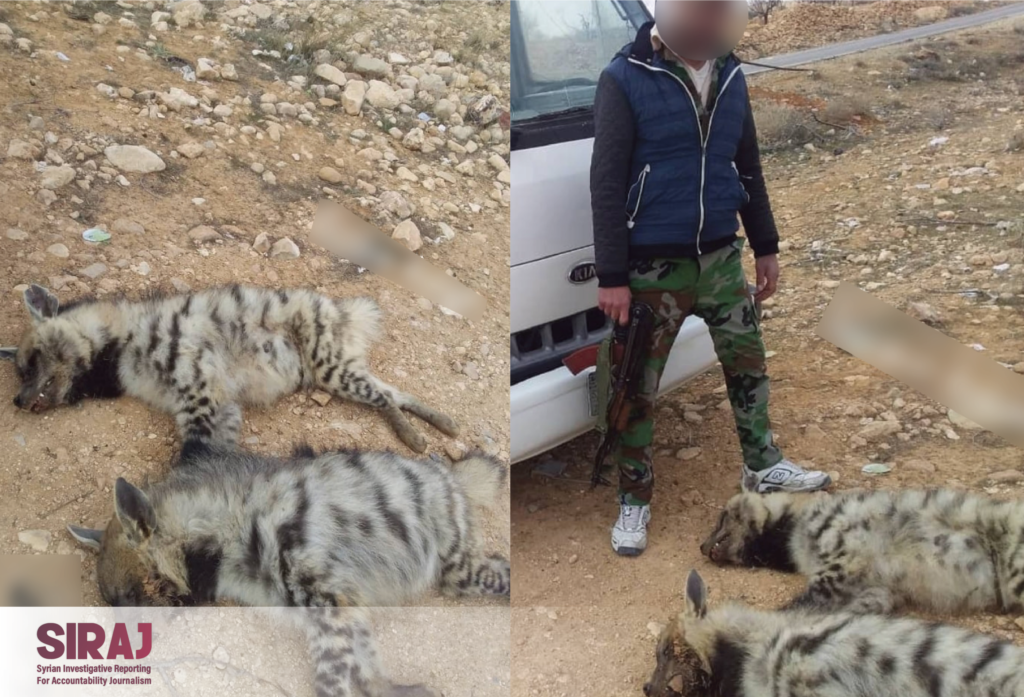
In rural Damascus, SIRAJ documented an incident involving the killing of two striped hyenas in the al-Makaser area of Deir al-Balat, near the town of Ras al-Maara in the Qalamoun Mountains, in late 2023.
Photographs and videos circulated on local social media pages showed that the animals had been shot with military rifles.
According to accounts circulated at the time, members of the Syrian army carried out the nighttime operation after the two hyenas were accused of attacking a flock of sheep in the area.
The incident, however, sparked widespread criticism among people commenting on the photographs and social media posts.
Many argued that killing wild animals was not an appropriate solution to conflicts between predators and livestock owners.
One commenter wrote:
“Gazelles have already disappeared from the Qalamoun Mountains because of excessive hunting, and the same applies to other wild animals. There are better ways to deal with hyena and wolf attacks on sheep, as conservationists do, using traps or other protective measures rather than killing or poisoning them.”
In June 2024, a group of young men appeared in a video filmed in the town of al-Shaafa, east of Deir ez-Zor, celebrating the killing of a striped hyena locally known as the “white hyena.”
The animal was presented in the photographs as a rare hunting trophy.
In reality, however, it belongs to one of the region’s most threatened wildlife species, whose numbers have continued to decline because of hunting, popular superstitions, and habitat loss.
As killings continue across Syria, specialists warn that the problem is not simply the number of hyenas that remain, but also the small and isolated nature of their populations.
Dr. Abdul Hay al-Yousef cautioned that “small and isolated populations are more vulnerable to local collapse if even a few individuals are killed.”
That vulnerability makes every new hunting incident potentially more serious than it initially appears—and another step toward the striped hyena’s disappearance from the Syrian wilderness.
- Creative Coordination and Visual Design: Radwan Awad
- Published in Arabic on DARAJ.