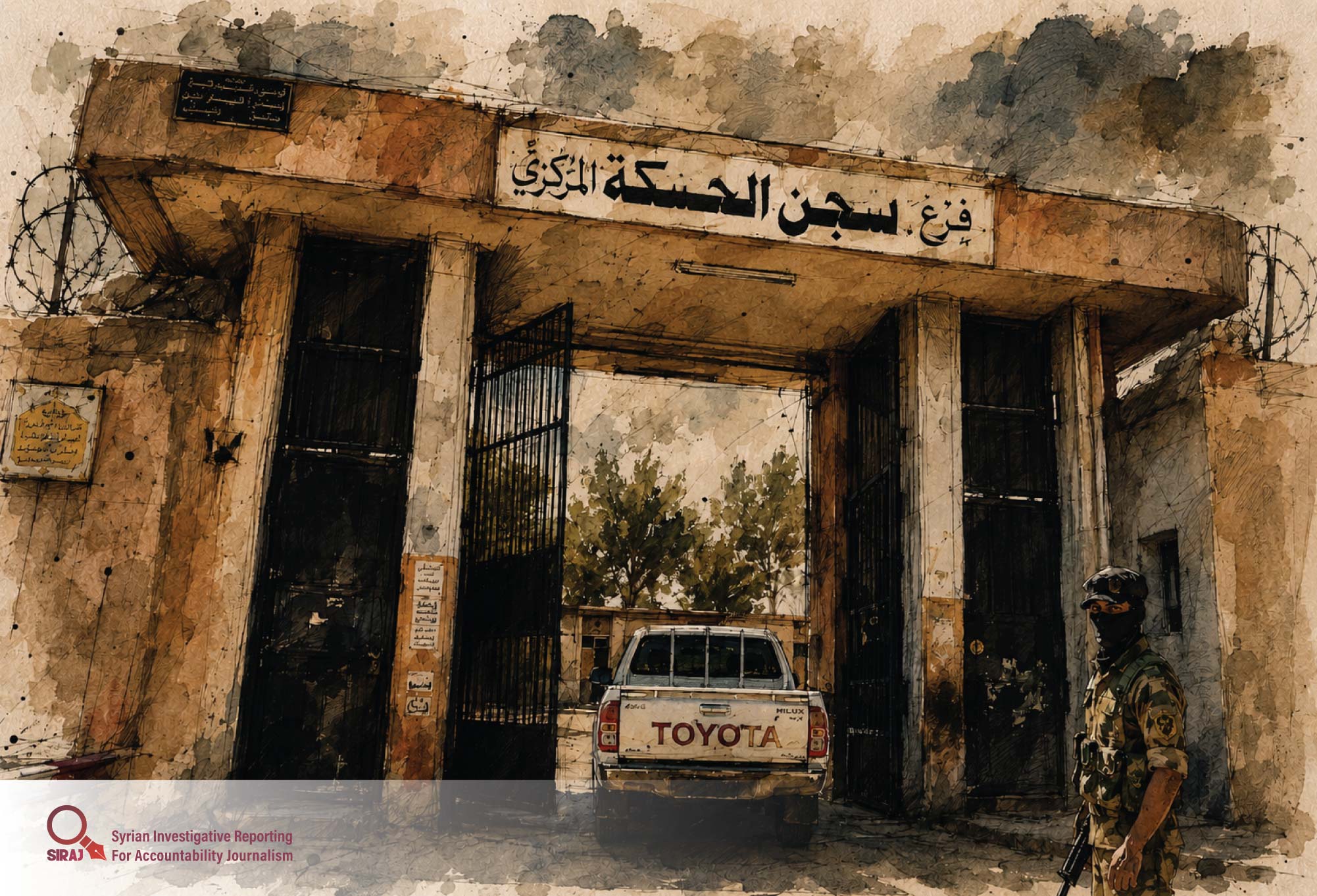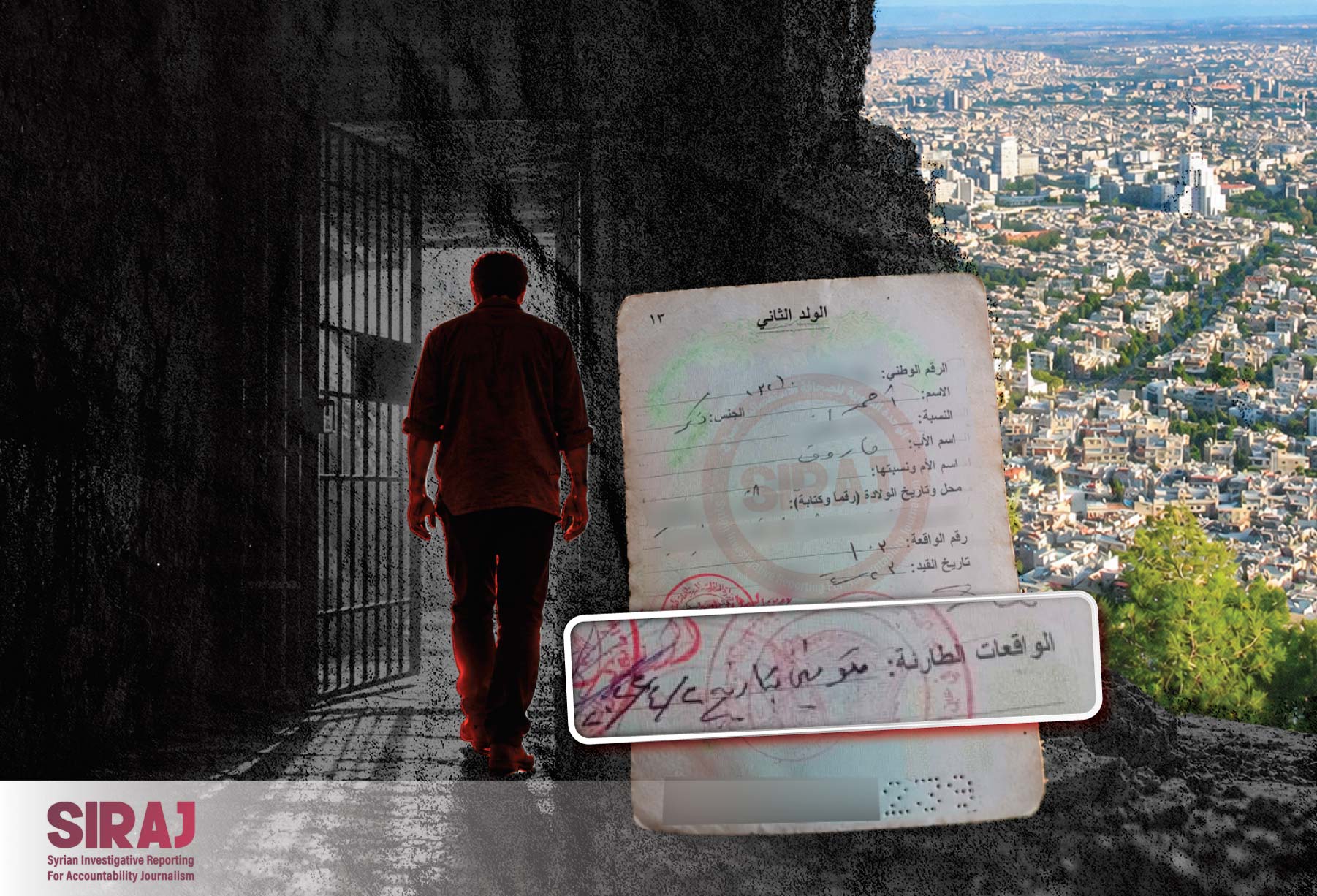


As chants from freed detainees echoed across television screens after prisoners were released from Saydnaya Prison on the night Bashar al-Assad’s government fell, December 8, 2024, former detainee Ahmad Farouk Mustafa was confronting a shock of his own—one nearly as painful as the years he had spent behind bars.
Mustafa walked out of Saydnaya Military Prison after nearly five years in detention only to discover that his family had held a funeral for him and that his wife had remarried.
There was one reason: on paper, Ahmad Mustafa was dead. Syrian authorities had registered him as deceased while he was still imprisoned in Saydnaya, entering his death into the civil registry even though he was alive.
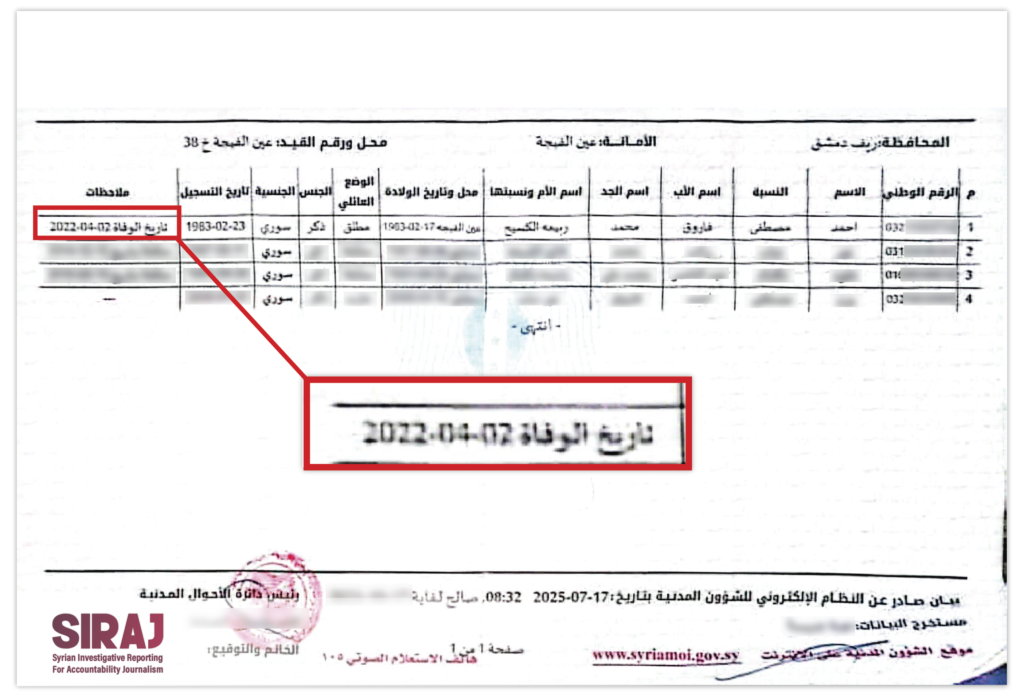
Mustafa was not the only detainee to be declared dead on paper.
The Syrian Revolution Detainees Association, an organization established after the fall of the Assad government by former Syrian detainees, documented 17 former prisoners who approached its Damascus office with the same problem. They are now navigating costly and complicated legal procedures in an effort to become, officially, alive again.
Some were formally registered as dead in Syria’s civil records. Others were listed as deceased in prison and detention-center records during the Assad era, potentially as a preliminary step toward formally registering their deaths at a later date.
For many, the shock of emerging from prison after the fall of Assad was followed by another: discovering that the state still considered them dead.
They now face a bureaucratic maze of courts and civil registry offices in an attempt to restore their legal existence.
This investigation examines the obstacles facing former detainees who were officially recorded as dead while imprisoned under Assad. Most are struggling financially and cannot afford the legal fees and court costs required to correct their records, while government and nongovernmental support remains limited.
Back From the Dead
Ahmad Mustafa, 43, is from Ain al-Fijeh in the Wadi Barada area. Before his arrest, he worked installing and repairing electrical systems.
On May 24, 2019, Mustafa was detained at the notorious al-Baraka checkpoint at the entrance to Damascus’s Tadamon neighborhood.
He was accused of “committing terrorist acts,” as well as “dealing with terrorists, bombing checkpoints and vehicles, and killing regime personnel.”
He was interrogated at the Criminal Security Branch in Bab Musalla, Damascus, before being transferred for three days to Adra Central Prison.
During his detention, Mustafa says he was subjected to “the worst forms of torture” in an effort to force him to confess to crimes he had not committed.
He refused to confess.
He was later transferred to the Military Field Court. But instead of appearing before a judge, Mustafa said he was sent directly to Saydnaya Military Prison without being told what sentence, if any, had been issued against him.
He did not see a judge until 2021.
When he finally appeared before one, Mustafa recalled, the judge simply told him, “Get out,” without explaining his sentence.
To this day, Mustafa does not know what punishment had been imposed on him. He only knows the accusations against him: dealing with terrorism, bombing security checkpoints and vehicles, and killing government personnel—charges categorized as “terrorist acts.”
While he remained in detention, his family obtained documents from the civil registry.
The records showed that Mustafa was “dead.”
His family concluded that he had died or been killed in detention. They proceeded with the formal death procedures, held a memorial service for him, and, after some time, his wife remarried.
Mustafa was released on December 8, 2024, the day the Assad government fell.
He emerged physically exhausted and suffering from tuberculosis. His return stunned his family: the man they had mourned was alive.
Because of his illness, Mustafa needed to obtain official documents. He went to the Citizen Service Center on al-Thawra Street in Damascus to request an individual civil registry extract.
An employee told him to go to the Sharia Court in Wadi Barada, which has jurisdiction over Ain al-Fijeh.
Mustafa did not understand what the problem was.
The employee simply told him: “Your case is complicated.”
When Mustafa went to the Wadi Barada Sharia Court, he was referred to a court in Damascus’s Mezzeh district.
There, the court president told him that, according to official records, he was dead—and that he would need to hire a lawyer.
Mustafa then went to the Palace of Justice in Damascus, where he obtained several documents, including a death certificate, a travel-movement record showing that he had not left the country, and a family civil registry statement.
Former detainee Ahmad Mustafa describes the difficulties he has faced since discovering that he was officially declared dead while in prison.
Mustafa eventually turned to the Syrian Revolution Detainees Association after learning about it through fellow Saydnaya survivors.
The organization opened a case file and began following up on his situation.
But Mustafa has still not been restored to legal life.
He is calling for assistance to correct his legal status, as well as access to employment and programs that could help him reintegrate into society.
“Everyone has talked about us and spoken in our name,” he said, “but there has been no real benefit for us, even though our case is an international one.”
Speaking about what it means to remain legally dead despite being alive, Mustafa added:
“The problem with the new government is that they have left us dead on paper—and in reality. This state should be taking responsibility for us.”
“I Can’t Enroll My Daughter in School”
Being officially dead affects nearly every aspect of a person’s life.
Those listed as deceased can face obstacles obtaining government documents or passports, buying and selling property, finding formal employment, accessing education and carrying out other basic civil transactions.
But the consequences do not stop with the individual.
They can also affect their families.
That is what happened to Anas Nizar al-Nahhas, a native of Hama province, when he was unable to enroll his daughter in school.
Al-Nahhas had been detained from 2013 to 2019 before eventually being released.
When he was arrested in 2013, he was transferred between several detention facilities: first the Military Security Branch in Hama, then Branch 215 and Branch 291 in Damascus.
He was later referred to the Military Field Court.
Al-Nahhas said he was accused of charges he knew nothing about, including the felony of participating in terrorist acts. During interrogation, he said, he was beaten and tortured.
After his release in 2019, al-Nahhas avoided government offices.
He rarely left his home and tried not to draw attention to himself, fearing renewed security persecution and unable to travel.
It was not until 2025, after the fall of the Assad government, that he discovered he had been declared dead.
He was trying to enroll his daughter in school when administrators asked him to provide an individual civil registry extract.
When he obtained the document, he learned that Syria’s civil registry listed him as deceased.
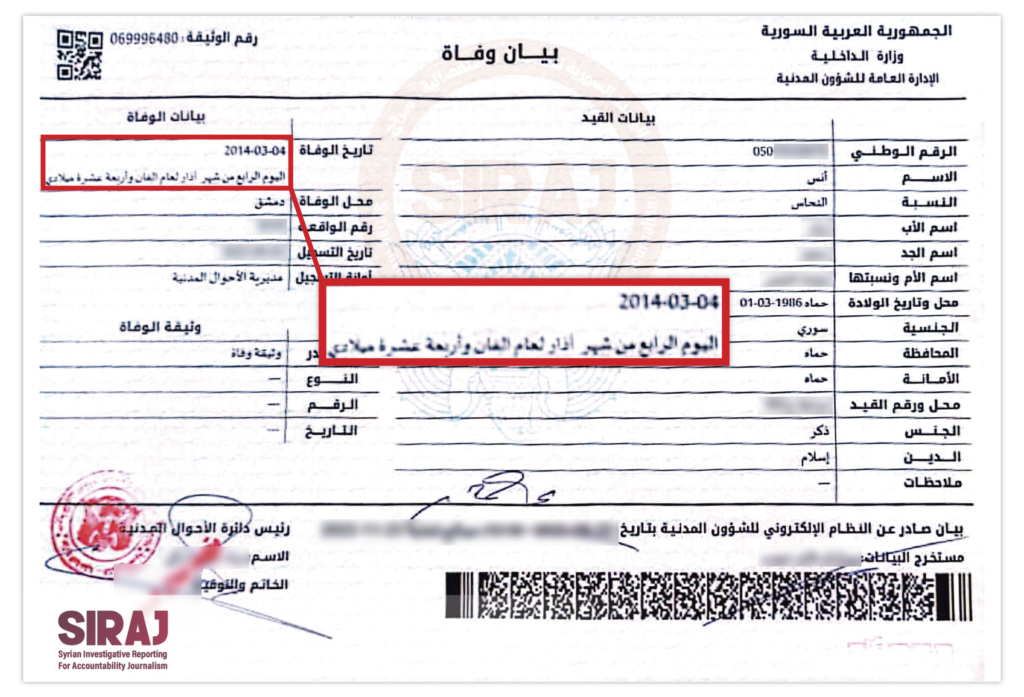
Al-Nahhas approached several lawyers, hoping they could help him navigate the process of becoming legally “alive” again.
But the prices they quoted him were far beyond what he could afford.
The lowest fee, he said, was 2 million Syrian pounds.
“Not everyone has the money to fix their legal status,” al-Nahhas said. “The lowest amount a lawyer asked for was 2 million lira, and I simply don’t have that kind of money.”
Al-Nahhas then contacted the Syrian Revolution Detainees Association.
The organization told him it would try to help resolve his case and asked him to travel to Damascus for a meeting related to the issue.
He attended the meeting.
But his case remains unresolved.
Former detainee Anas Nizar al-Nahhas describes the consequences of having been officially declared dead during his years in detention.
Easing the Pressure?
The Syrian Revolution Detainees Association, established after the fall of Assad, has documented 17 cases involving people who came to the organization after discovering they had been declared dead on paper.
Ghina al-Kurdi, director of the Missing Persons Office at the Syrian Revolution Detainees Association, believes the authorities used this practice in part to relieve themselves of pressure from families who continued searching for their sons through the Military Police and other security branches. In some cases, she said, families were told to formally register their missing relatives as dead, effectively putting an end to their inquiries.
At the same time, al-Kurdi stressed that every case is different. Some detainees had been sentenced to death, while others had never appeared before a court and did not even know what sentence, if any, had been issued against them.
Al-Kurdi urged families not to register missing relatives as deceased unless their deaths have been confirmed. In her view, each case should be described for what it is: a missing person is missing, not dead, until there is proof of death.
She recalled the case of one former detainee who appeared on the streets of Aleppo after the fall of the Assad government suffering from memory loss. Nearly a year passed before he was able to recognize his family.
Ghina al-Kurdi, director of the Missing Persons Office at the Syrian Revolution Detainees Association, explains what the organization has documented about detainees who were declared dead while still alive.
Barriers to Becoming Legally Alive Again
When it comes to restoring the legal status of people who were declared dead, al-Kurdi said the first obstacle is financial.
Correcting their status requires a lengthy court case. At the same time, she said, some government bodies that should be helping facilitate the process have been slow to respond.
These are first and foremost humanitarian cases, al-Kurdi said, and former detainees should receive the cooperation and support they need to restore their legal identities.
She noted, however, that the relatively small number of documented cases may be one reason the issue has not become a priority for government institutions, including the Bar Association, which she described as having direct responsibility alongside the Interior Ministry.
The costs involved may not appear exceptionally high in absolute terms, but they remain beyond the means of many former detainees. Many lack documents proving that they are alive, while their ability to return to work and reintegrate into everyday life often depends on obtaining official identification and civil records. Many also continue to suffer from health problems linked to the harsh conditions of detention.
Lawyer Ghazwan Qarnfal said the proper legal step is to file a lawsuit seeking to correct the civil registry record and cancel the recorded death.
The case must then be brought before a magistrate court, because civil-status records cannot be amended or corrected without a final court ruling, under Article 44 of Civil Status Law No. 13 of 2021.
Qarnfal said plaintiffs need to submit several documents as part of the case file, including a national ID card or passport, if available; a recent individual civil registry extract; a prison-release document or report, if available; the names of at least two witnesses who can support the claim; and any fingerprints or biometric evidence that can link the person to their legal identity.
He estimated that such a case could take about a year to resolve.
Qarnfal said the governing legislation is Civil Status Law No. 13 of 2021, along with Justice Ministry Circular No. 11, issued in 2026, which allows a civil-registry correction lawsuit to be filed before the civil magistrate court in the district where the person’s original record is held.
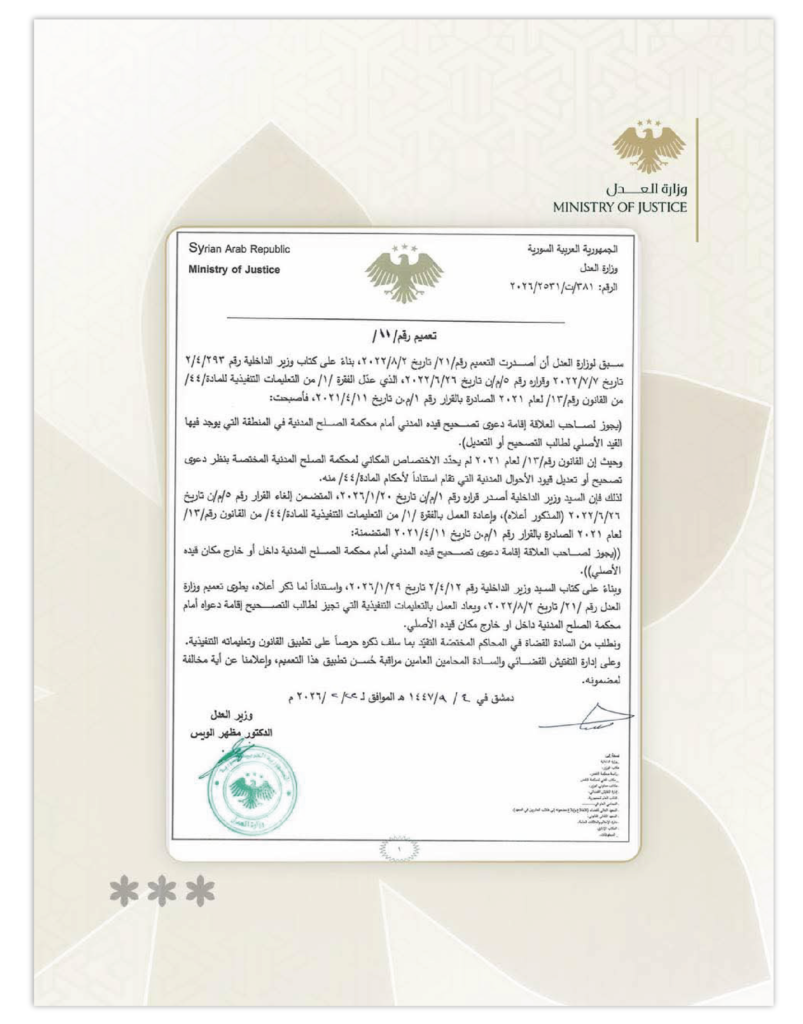
To address the cost of these cases, Qarnfal proposed that the Justice Ministry issue a circular exempting them from court fees, stamps and other charges. He also suggested that the central Bar Association instruct its branches across the country to appoint lawyers to represent plaintiffs free of charge and waive all power-of-attorney fees.
Fawaz al-Khouja, a lawyer with the Damascus Bar Association, said the legal classification of missing persons depends on what appears in the official records.
“If they are listed as dead in the records, then legally they are dead,” he said. “But if the records say they are dead while they are in fact alive, then there is a legal problem, and procedures must begin to restore them to life on paper.”
As for people whose fate remains unknown, al-Khouja said the law makes a distinction based on the circumstances of their disappearance.
“For missing persons whose fate is unknown—including people who have been missing for two, three or four years—the law provides a four-year period in wartime to allow legal and civil matters to stabilize,” he said. “After that period, a report can be prepared based on witness testimony confirming that the person was present, disappeared and has not returned.”
“If a person disappears during peacetime,” he added, “the law takes into account the normal human life span, generally between 70 and 80 years. Once that period has passed, an application can be made to have the person legally declared dead, allowing their property and rights to pass to their heirs.”
According to al-Khouja, the state does not automatically declare missing persons dead. He said the decision to seek a legal declaration of death rests with the missing person’s family. Some families pursue such a declaration, while others refuse to do so. Ultimately, he said, the matter goes before a court, which determines whether the legal grounds for declaring the person dead have been met.
“I Found Out Online That I Was Dead”
Some death declarations never made it into the civil registry. Others appeared to be moving through the system when the Assad government fell.
The Syrian Investigative Reporting for Accountability Journalism unit, SIRAJ, interviewed former detainees whose names appeared on prison death lists even though their deaths had never been formally entered into civil records.
What many fear now is that prison records could eventually be used as the basis for officially registering them as deceased.
Former detainee Mohammad Walid Kamal Fatta is among those living with that fear.
He was arrested three times under the Assad government and was released for the final time just 20 days before Assad fled the country. By chance, he later discovered online that he had been listed as dead.
Former detainee Mohammad Fatta describes his fears after discovering his name on prison death lists.
Fatta’s first arrest came at the beginning of the Syrian uprising in 2011. He remained in detention until 2021 on “terrorism” charges.
He was arrested again in 2022, this time on charges of “desertion from the army,” and remained detained until 2023.
After his second release, he returned to military service for just one week before deserting again and being arrested for a third time.
He was released for the final time 20 days before the fall of the Assad government.
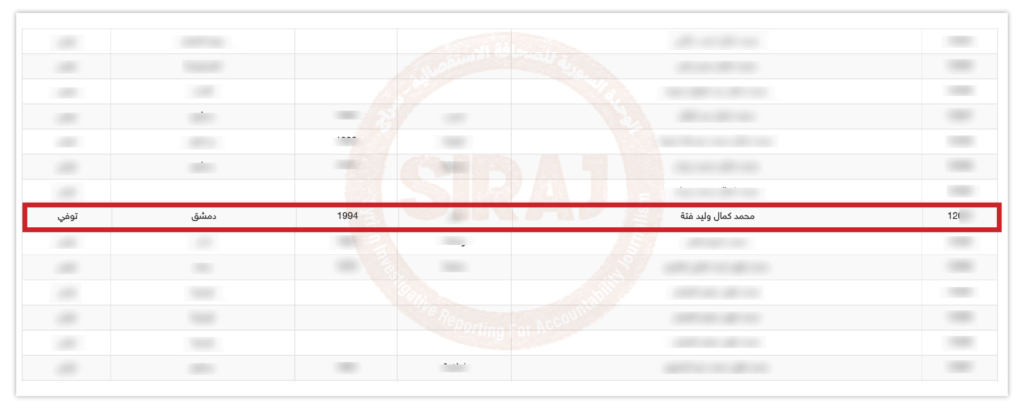
When Fatta searched the lists for the names of men who had been imprisoned with him, he found many of them listed as dead even though they were still alive.
“I’m afraid the government will rely on these lists and start issuing death certificates for us without our knowledge,” he said.
The irregularities did not stop there.
In some cases, detainees were officially declared dead on paper and then appeared in court more than a year after their recorded date of death.
In 2013, government forces arrested Mohammad Abdul Karim al-Masri in the Arsal mountain region. He remained in Saydnaya Prison until 2017, with his family receiving no information about him.
His wife, Fatima Abdul Mawla al-Masri, repeatedly visited security branches in search of her husband and was herself questioned and interrogated because of those efforts.
On February 14, 2018, the authorities entered her husband’s name among the dead in the civil registry. She obtained a family civil record at the time and learned that, officially, she was now a widow.
But after the fall of the Assad government, Fatima found documents scattered inside Saydnaya Military Prison showing that her husband had been referred to the Counterterrorism Court on September 29, 2019, and had a scheduled court hearing to appear before a judge.
In other words, official records show that he had a court proceeding more than a year and a half after the state had recorded him as dead.
Missing Solutions
Lawyer Michel Shammas told SIRAJ that cases involving detainees who were declared dead while still alive should not be treated as ordinary civil-registry errors.
“This is not about legally bringing someone back to life,” he said. “It is about removing an incorrect record of death and correcting the civil registry so that it reflects reality.”
Shammas said it is unreasonable to place the burden on former detainees to prove that they were alive during the period in which the state had recorded them as dead—particularly because they had no role in registering those deaths in the first place. The records, he said, were created by agencies of the former government.
“The person is physically present, their identity can be verified, and they are simply asking for their civil record to be corrected and the registered death removed,” he said.
Although Syrian law provides a process for correcting civil-status records—and in some cases a person may have to go to court if the administration cannot correct the record directly—Shammas said authorities should distinguish between procedures designed for ordinary circumstances and the response required for exceptional cases created by the former government’s treatment of detainees.
For that reason, he said, former detainees should not be left to navigate a lengthy bureaucratic journey through civil registry offices and courts on their own. Instead, the transitional period should include a dedicated, expedited process for handling such cases.
One option, Shammas said, would be for the Interior Ministry, which oversees civil-status affairs, to issue clear instructions to civil registry offices on how these cases should be handled.
If the necessary procedures exceed the ministry’s authority or conflict with existing civil-status law, he said, the legislative authority should adopt special legislation establishing an exceptional mechanism for correcting the records.
Shammas also said a transitional justice body could play a central role, given its responsibility for documenting abuses and verifying cases involving detention, enforced disappearance and other practices carried out by the former government. Such a body could coordinate with the Interior and Justice ministries to establish a unified mechanism for resolving these cases.
The best option, in Shammas’s view, would be a specific decision or law establishing that a former detainee who verifies their identity and appears in person before the relevant authorities can request a correction to their civil record. The state would then be responsible for determining why the person had been registered as dead and how the false death record was created—rather than requiring the victim to produce a chain of documents proving that they never died.
Correcting the civil record, Shammas added, should not result in the destruction or disappearance of evidence related to the original abuse.
If the former government registered a living person as dead, the documents and records that led to that registration should be preserved. They could constitute important evidence in investigations into the fate of detainees and help establish responsibility for such practices. The government, he said, should also investigate which authority or agency was responsible for recording the person as deceased.
The National Commission for Missing Persons did not respond to SIRAJ’s questions after we attempted to contact the commission by email.
- Additional reporting by Lina al-Masri
- Creative coordination and visual solutions: Radwan Awad