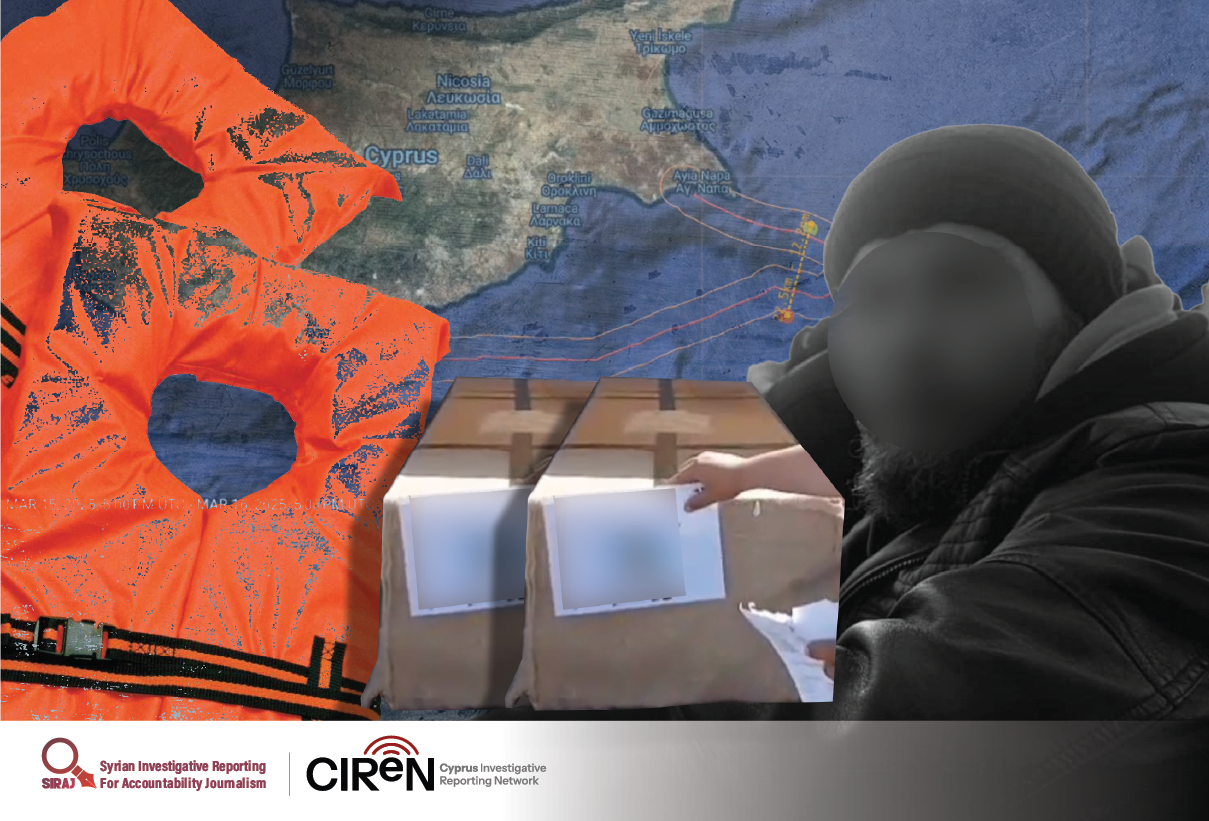


Bassam and Raad survived more than 60 hours in freezing waters off Cape Greco in March, after a migrant boat from Lebanon sank – 19 others perished. Based on survivor accounts, interviews, official statements and tracking data, CIReN analysed the rescue response, and the aftermath.
On a rainy April afternoon, Bassam sat at a Limassol cafeteria and recounted harrowing details from the three nights and three days he spent clinging to an inflatable tire in the open sea, awaiting rescue or death.
In the early hours of Friday March 14, 2025, Bassam, his brother, his cousin and a neighbor followed a smuggler across the Syrian border to Lebanon, where they boarded a small fiberglass boat with a Yamaha engine. In addition to the 21 men on board, the boat was loaded with gallons of fuel and water, and two boxes of dates. Their journey to Cyprus, some 160km westwards, could last anywhere from hours to days, depending on sea conditions and navigation skills.
The recent collapse of the Assad regime in Syria, in December 2024, had created a sudden instability for ethnic minorities like Bassam, and thousands were fleeing for fear of extremist attacks and retributions. (Most of the men on the boat were Sunni, the majority religious group in Syria.)
Eight months before the change in power, in April 2024, Cyprus authorities stopped processing asylum claims from Syrian nationals, claiming that the country’s security status needed reassessment. The island’s proximity to the Middle East had attracted the highest number of asylum applications per capita of any EU country, and the government adopted policies aimed at curtailing the influx of people. But Bassam had read on Facebook that the application process had reopened, and connected with the smuggler who published the misleading posts. He was told that the passage costs $3300, with $2000 due upfront, he told the Syrian Investigative Reporting for Accountability Journalism Association (SIRAJ).
With good weather and calm seas, the fiberglass boat the men boarded in the pre-dawn hours should have reached Cyprus while there was still daylight, but the journey took longer than expected.
The timeline is murky, but phone records obtained by reporters show that one of the perished passengers, 21-year-old Hassan, called his father from the driver’s satellite phone at 18:16. The sun had already set and, according to Bassam, they could see the lights of the Cypriot coast.
But the waves grew bigger under the March full moon, and the small boat filled with water faster than they could empty it, Bassam recalled. When a big swell overwhelmed the struggling vessel from the rear, the men quickly found themselves in the blackness of the sea.
Bassam had a small plastic water bottle tucked into the pocket of his pants, and the inflatable tire the smugglers had distributed to each passenger. The frigid water, as low as 16 degrees, was turbulent. At first he was near five men, including his brother, but soon the waves separated them.
When the sun came up the next morning Bassam said he first looked for his brother. He saw him from a distance but couldn’t reach him. He could hear the others calling out to each other, and praying.
Bassam had been saving his small bottle of water, but as he tried to help a man next to him who slipped out of his inflatable tire, a wave took it away. Later he watched another man let go of his tire to try to swim to Cyprus, only to drown.
Bassam didn’t know how to swim, so he held on, floated, and prayed to God. He said he saw many boats – commercial and fishing boats – and called out to them, but they passed him by. At one point he saw a military helicopter, but it too passed him. Eventually, his parched throat stopped making noise. When he awoke on Monday he was completely alone.
Bassam survived an estimated 64 hours before a white helicopter appeared above him and proceeded to pull him out of the sea. An hour earlier, a Cypriot coast guard vessel had spotted the only other survivor, Raad. The rest of the men from the boat had perished.
The First Survivor
Raad, 20, described events similarly to Bassam, estimating that the waves began to swell around 9pm, with the boat taking on water faster than the passengers could bail. The boat ultimately sank and everyone was left thrashing in the dark, he told reporters through a translator.
In the hours and days after the sinking, he watched people succumb to exhaustion and despair, slipping under the surface while he floated on a slowly deflating tire, without food or water. The sea was piercingly cold and by the second night he felt his mind beginning to fray. He drank seawater that scorched his throat – a burn that lingered long after his rescue — and floated with little hope of surviving.
Even on Sunday, Raad said he saw no signs of a search, though the shore was visible to him. He became aware of a rescue only when a boat appeared on Monday, March 17, and hauled him aboard. Unable to even lift a finger, he was rushed to a hospital.
As of August 2025, Raad said he had been evicted from the apartment he shared with three others when they couldn’t make rent. One of the house mates had secured other housing, and Raad had asked to stay there temporarily. The night before meeting with reporters, he slept outdoors, he said.
Raad received a single welfare payment of EUR210, he said, after which he claimed the assistance stopped. He described himself as deeply in debt, and in recent months prescribed medication for mental health.
Raad – a Sunni Muslim – was a child when his family’s home in Hama was destroyed in the Syrian civil war and they moved to Lebanon. He didn’t have a chance for education, he said, so he sold vegetables from a cart, while the local gangs exploited refugee laborers. His dream in Cyprus, he said, is to find any kind of work with humane conditions that would allow him to help his parents.
Reporters from Cyprus and Syria have pieced together the most comprehensive account of the three days and nights, based on interviews with authorities, survivors, and NGO workers – as well as officials’ public statements, and vessel and flight-tracking data.
A rescue helicopter hoists a survivor from the sea. Credit: CNA, March 18 2025. Republished with permission.
The Confounding Search
When relatives stopped hearing from the men that night, and couldn’t reach anyone on the satellite phone, they began to panic.
Watch The Med Alarm Phone, a group of volunteers assisting refugees in distress in the Mediterranean, said a relative contacted them on Saturday, March 15, and shared the satellite phone number, and a photo someone sent from their journey. The image had geolocation metadata that allowed Alarm Phone to estimate coordinates and the time the photograph was taken. (Reporters were unable to independently verify the metadata.)
Alarm Phone sent an initial email alerting authorities of a boat in distress, and the estimated coordinates at 11:11pm Cyprus time. By then, more than 24 hours had passed since the sinking.
When Alarm Phone volunteers followed up their emails with calls to the Cyprus-based Joint Rescue Coordination Center, which oversees multi-branch emergency responses, they were told that authorities were investigating.
JRCC told reporters that they launched an immediate search and rescue operation that night, but also underscored that they considered Alarm Phone’s distress alert unconfirmed.
“Many tips end up being confirmed but not all,” JRCC’s then-Deputy Commander George Economou told CIReN (he has since been appointed commander). “There were cases where they shared information that did not correspond with reality,” he added, in reference to Alarm Phone.
“For us there is a gradation of information,” JRCC’s then-Commander Andreas Charalambides told reporters. “If a piece of information that somebody is in danger is not confirmed, there is a specific process we follow and begin to investigate until danger or no danger is confirmed”.
“The process follows the same steps we follow as if we have confirmation – it’s just that no rescue occurs. So from the search and rescue part, we begin the search until we have confirmation.”
Reporters understood that the referenced process included contacting the satellite phone service provider, scanning key areas with onshore cameras and radar, and issuing a radio alert to nearby vessels.
According to Economou, the patrol boat out at sea that night – Pentadaktylos – was ordered to the location shared by AlarmPhone in their email.
Vessel tracking data obtained by OCCRP and analyzed by reporters shows that Pentadaktylos was on its usual patrol route that night, but it did not approach Alarm Phone’s coordinates, remaining at least 30km away between midnight and 8am.
Only after Pentadaktylos docked at Ayia Napa marina, around 9am on Sunday, does data show activity in the area indicated by Alarm Phone.
Authorities told CIReN that around 9am is when they independently obtained from the satellite phone company the coordinates of the last location of the boat driver’s phone, just 20 nautical miles from Alarm Phone’s coordinates, and confirmation that the last signal was sent 30 hours earlier.
Tracking data shows the Cypriot police boat Evagoras Pallikaride patrolling in an area 20-25km north of AlarmPhone’s coordinates on Sunday.“
According to officials, search and rescue helicopters were also deployed on Sunday, and air tracking data shows a surveillance plane circling the area. Officials later stated that they searched some 2750 square nautical miles.
However, when the first survivor was located by the Coast Guard on Monday afternoon, the minister of justice publicly stated that it was “completely random and coincidental,” echoing statements by the defense minister. The JRCC also stated that Monday afternoon is when they launched a search and rescue operation that led to the rescue of the second survivor and seven bodies.
According to Economou they were found within 12 nautical miles of the NGO’s coordinates and within 14 nautical miles from the satellite phone’s last known location, 37 hours after the initiation of the search.
The JRCC declined to explain the inconsistencies identified in this investigation, and referred reporters to a press release from March 19, 2025, which stated that there were discrepancies in the testimonies of the survivors rescued two days earlier, and that they may have been unrelated to the shipwreck flagged by Alarm Phone on Saturday night.
The vessel “Pentadaktylos” on patrol on March 15-16, 2025. Credit: Global Fishing Watch
Navigating the System
After the shipwreck, AlarmPhone issued a public statement, questioning whether Cypriot authorities acted in “a timely and adequate manner,” what concrete steps were taken, and whether the response to the incident will be investigated.
Political parties AKEL, VOLT and GREENS and NGO Cyprus Council for Peace also demanded an investigation into the circumstances that led to the shipwreck.
Reporters confirmed in April that a police investigation into the shipwreck is ongoing but did not recieved an update on the status by publication time. JRCC did not reply to questions about an internal investigation into its response.
The survivors, meanwhile, are in legal limbo in Cyprus.
Bassam now lives in Limassol with relatives who support him while he awaits approval of his asylum claim. Raad doesn’t have permanent housing or material support.
By mid-2025, authorities resumed processing of Syrian asylum applications, though most applicants have been rejected, the Ministry of Migration told CIReN.
“Decisions have already been issued, mostly rejecting a significant number of applications, always following an individualized assessment,” the ministry said in an email.
But the survivors told CIReN and SIRAJ that they haven’t heard anything about their cases.
Corina Drousiotou, the senior legal advisor to the UNHCR-funded asylum rights NGO
Cyprus Refugee Council, said the men were released from the hospital shortly after the rescue “without any support by the state, psychological or material,” in terms of benefits or accommodation. Drousiotou added they were initially denied access to the Social Welfare Service and the benefits asylum seekers are entitled to.
“One of the survivors belongs to a minority and has had support from the relevant community, whereas the other survivor does not have community support and is still struggling, as the benefit he receives is often delayed which leads to him being homeless,” Drousiotou confirmed to CIReN.
The Cyprus Refugee Council said they expected Asylum Services under the Ministry of Migration Policy to prioritize the cases of the two survivors due to their vulnerability, but “to date the cases are still pending.”
The Deputy Ministry of Migration and International Protection did not respond to CIReN’s request for comment on the status of the cases.
“I won’t go back,” said Bassam, who studied chemistry at a university in Syria, but is not allowed to work in Cyprus due to his status. “The situation there is terrible — nothing but killings, kidnappings, and chaos, even in our own areas.”
Burying the Dead
Relatives of the victims who were recovered the day the two survivors were rescued told reporters that they paid 3000 euros to send them back to Syria for burial.
The Cypriot funeral home that handled the logistics confirmed that they arranged transportation for six of the seven bodies recovered, and that the total included 2500 for transferring each body from the airport in Larnaca to the airport in Lebanon, and another 500 for an interpreter to translate official repatriation documents from Greek to Arabic before transferring the bodies to Syria.
The victims’ bodies arrived in their hometowns in cardboard boxes, with colored photos printed on paper and taped to the front.
An employee from the funeral home told reporters that the families waited 77 days for Cypriot authorities to issue the paperwork for repatriation, and that the transport costs were paid by the families, with no assistance from the governments.
One of the seven victims recovered on March 17 – Bassam’s 25-year-old cousin – was the only one buried in Cyprus. He said the cost of that burial – 1500 euros – was paid by a family friend. Bassam said his neighbor’s body was recovered off the coast of Lebanon, while his brother is still missing.